Help Needed: Solving y = A sin({2*10^6 ({\pi / 3 -\pi t }) + \phi })

  • Thread starter Thread starter MichaelTam
  • Start date Start date
  • Tags Tags
    Phi Waves
Join the discussion
Registration is free. Ask a follow-up in this thread, or start your own.
2 replies · 1K views
MichaelTam
Messages
93
Reaction score
6
Homework Statement
Exercise
Relevant Equations
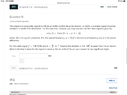
##v = f \lambda , s({x,t}) = A sin({k x - \omega t + \phi}) ##, other statements are provided in the picture.
I know so ## y = A sin({2*10^6 ({\pi / 3 -\pi t }) + \phi }) ##
There still some unknown I cannot find, can anyone give me some hint please?
 

Attachments
  • F6104606-1371-4F46-A8C2-185EE2372EAB.png
    F6104606-1371-4F46-A8C2-185EE2372EAB.png
    21.7 KB · Views: 173
Last edited:
Physics news on Phys.org
But how can I find t?## \lambda = 3 ## because ## k = 2 \pi/3 = 2 \pi/\lambda##
 
Last edited:
MichaelTam said:
But how can I find t?## \lambda = 3 ## because ## k = 2 \pi/3 = 2 \pi/\lambda##
The formula ##s(x, t) = A sin(k \cdot x - \omega \cdot t + \phi)## gives you the signal strength (##s##) at a particular position (##x##) and time (##t##). If you wanted the time at which ##s## had some particular value, you would use the formula. But that is not what the question is about.

You simply want the time for the signal to travel a distance of ##1.0 \times10^6 ## m. So you use:

##time = \frac {distance}{speed}##

You know the distance is ##1.0 \times 10^6 ## m. So the real question is can you find the speed (##v##) of the wave from the data supplied?

Edit: minor changes to improve wording.
 
Last edited:
Reply
  • Like
Likes   Reactions: Delta2