Help Solve Physics Problem: Lamp Moving at v=c/4

  • Thread starter Thread starter radimkupcak
  • Start date Start date
  • Tags Tags
    Lamp Relativity
Click For Summary
SUMMARY

The discussion centers on a physics problem involving a lamp emitting light while moving at a velocity of c/4. The key issue is determining the angle of the light cone from the perspective of a stationary observer, which is affected by the phenomenon known as "relativistic aberration." The expected answer to the angle of the emitted light is 152 degrees, derived from the principles of relativistic physics. Participants confirm that the light continues to be emitted in all directions, but the perceived angle changes due to the motion of the source.

PREREQUISITES
  • Understanding of relativistic physics concepts
  • Familiarity with the phenomenon of relativistic aberration
  • Basic knowledge of light propagation and Doppler shifts
  • Ability to visualize 2D motion and angles
NEXT STEPS
  • Research "relativistic aberration" and its mathematical formulation
  • Study the effects of Doppler shifts on light emitted from moving sources
  • Explore the implications of light propagation in different reference frames
  • Examine examples of similar physics problems involving moving light sources
USEFUL FOR

Students of physics, educators teaching relativity, and anyone interested in the effects of motion on light propagation and perception.

radimkupcak
Messages
3
Reaction score
0
Thread moved from the technical forums, so no HH Template is shown.
Hello, I need help with this problem. In 2D we have a lamp that emits light in 360 degrees around itself while stationary. Than it starts moving at velocity of c/4 what is the degree of the cone in which the light now emits to ? I hope you understand, like the angle of the field where the light falls from the perspetive of observer who is stationary. I don't know how to solve it, does anebody know ?
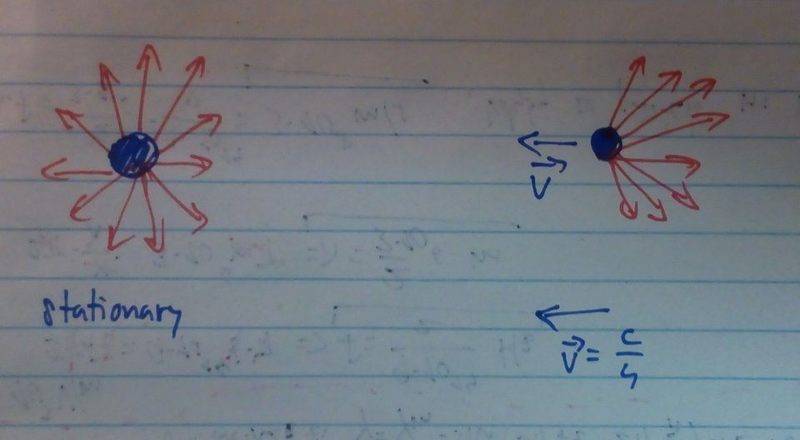
IMG_20160426_215423.jpg

Thank you Radim
 
Physics news on Phys.org
Consider a photon emitted directly to the left when the source is stationary. In what direction will it travel when the source is moving?
 
  • Like
Likes   Reactions: radimkupcak
Light is still being emitted in all directions, with Doppler shifts.
 
  • Like
Likes   Reactions: radimkupcak
Yes you are correct, I misunderstood the problem, it made no sense to me that the light would not be emitted to the left from the stationary observers perspective. They are asking for angle of beams of photons that were emitted perpendicular on the vector of velocity (but they won´t be perpendicular while it is moving) The answer is supposed to be 152 degrees, but I don't know how they got this result.
 

Attachments

  • IMG_20160426_225010.jpg
    IMG_20160426_225010.jpg
    30.5 KB · Views: 409
The phenomenon is called "aberration", and occurs in both Newtonian and relativistic physics. Google for relativistic aberration.
 
  • Like
Likes   Reactions: radimkupcak
IMG_20160427_005205.jpg

So could anyone confirm me that this approach is correct ?
 

Similar threads

  • · Replies 35 ·
2
Replies
35
Views
5K
  • · Replies 6 ·
Replies
6
Views
3K
  • · Replies 2 ·
Replies
2
Views
1K
  • · Replies 4 ·
Replies
4
Views
2K
  • · Replies 35 ·
2
Replies
35
Views
5K
  • · Replies 5 ·
Replies
5
Views
2K
Replies
12
Views
2K
  • · Replies 4 ·
Replies
4
Views
2K
  • · Replies 1 ·
Replies
1
Views
1K
  • · Replies 57 ·
2
Replies
57
Views
7K