meriadoc
- 4
- 0
I've managed to get through all of this question without trouble until part d).
The full question is given here:
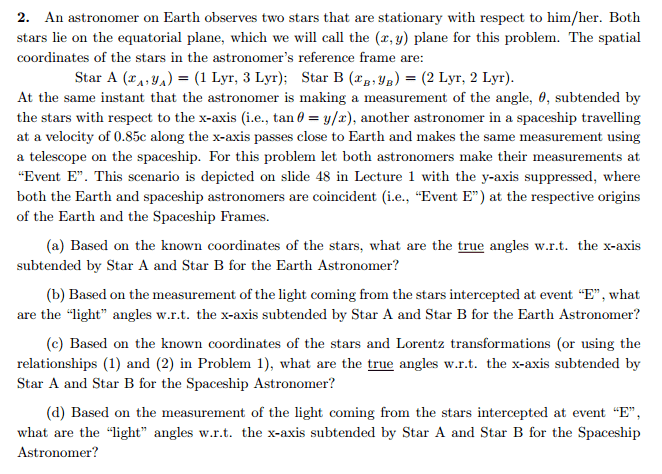
I've calculated the "true" angles of Star A and Star B as 71.57 degrees and 45 degrees respectively in Frame S, and the "light" angles should be the same, since the stars are stationary in frame S.
For part c), the "true" angles of the stars are found using Lorentz transformations to find x
[itex]x[/itex]′[itex]_A = \frac{x_A}{\gamma} = 0.527[/itex]
And similarly for B, yielding angles of 80.04 degrees and 62.21 degrees respectively.
However, I can't figure out how to calculate the angles to the stars when the light measured was emitted (part d). The answers are 23.2 degrees for Star A, and 13.4 degrees for Star B.
I should be able to do this calculation, but there's something I'm just not getting, I've been sitting on it for a while and need to move on. Any help is appreciated.
The full question is given here:
I've calculated the "true" angles of Star A and Star B as 71.57 degrees and 45 degrees respectively in Frame S, and the "light" angles should be the same, since the stars are stationary in frame S.
For part c), the "true" angles of the stars are found using Lorentz transformations to find x
[itex]x[/itex]′[itex]_A = \frac{x_A}{\gamma} = 0.527[/itex]
And similarly for B, yielding angles of 80.04 degrees and 62.21 degrees respectively.
However, I can't figure out how to calculate the angles to the stars when the light measured was emitted (part d). The answers are 23.2 degrees for Star A, and 13.4 degrees for Star B.
I should be able to do this calculation, but there's something I'm just not getting, I've been sitting on it for a while and need to move on. Any help is appreciated.