Help with basical electromagnetics

  • Thread starter Thread starter Nordcus
  • Start date Start date
  • Tags Tags
    Electromagnetics
Click For Summary
SUMMARY

This discussion focuses on the conversion of vectors from Cartesian to cylindrical coordinates and the representation of spherical coordinates in electromagnetics. The conversion of vector R to cylindrical coordinates is achieved by expressing the radial vector ##\mathbf{a}_\rho## in the z=0 plane, allowing for a straightforward representation without complex calculations. Additionally, the components of the vector ##\mathbf{a}_R## in spherical coordinates are derived using the relationships cos(alpha) for ##\mathbf{a}_z## and sin(alpha) for ##\mathbf{a}_\phi##, emphasizing the importance of understanding coordinate transformations in electromagnetics.

PREREQUISITES
  • Understanding of Cartesian and cylindrical coordinate systems
  • Familiarity with spherical coordinate systems
  • Basic knowledge of vector representation in physics
  • Proficiency in trigonometric functions and their applications
NEXT STEPS
  • Study the mathematical foundations of coordinate transformations in electromagnetics
  • Learn about vector calculus in cylindrical and spherical coordinates
  • Explore textbooks on electromagnetism, focusing on coordinate systems
  • Investigate software tools for visualizing vector fields in different coordinate systems
USEFUL FOR

Students and professionals in physics, particularly those specializing in electromagnetics, as well as educators seeking to enhance their understanding of coordinate transformations in vector analysis.

Nordcus
Messages
1
Reaction score
0
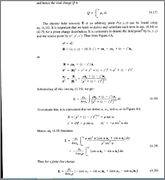
Hey guys, can someone please help me with this? In the case of the line charge (pictures 1 and 2), can someone please explain to me how he converted the vector R from cartesian coordinates to cylindrical coordinates without doing any calculation?

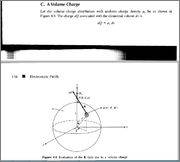
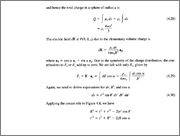
Also, on the case of the sphere (pictures 3 and 4), I didn't understand how he got the components cos(alpha) az and sin(alpha) ap of the vector ar.

Can someone please recommend me some material or book to study this subject about orthogonal basis of cylindrical and spherical coordinates?

Sorry for my bad english, and thank you very much.
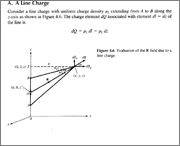
image.jpg


image.jpg


image.jpg


image.jpg
 
Engineering news on Phys.org
Nordcus said:
can someone please help me with this? In the case of the line charge (pictures 1 and 2), can someone please explain to me how he converted the vector R from cartesian coordinates to cylindrical coordinates without doing any calculation?
The radial vector ##\mathbf{a}_\rho## in the cylindrical coordinate is a unit vector that lies in the z=0 plane. Therefore, any vector which has zero ##z## component can be written as a vector of appropriate magnitude in the direction of ##\mathbf{a}_\rho##. There is also a more formal prove using the formulae for the coordinate change between Cartesian and cylindrical coordinates. It requires more work but is actually easy to show.
Nordcus said:
Also, on the case of the sphere (pictures 3 and 4), I didn't understand how he got the components cos(alpha) az and sin(alpha) ap of the vector ar.
The author wanted to write ##\mathbf{a}_R## in Cylindrical components. Since the line along ##\mathbf{a}_R## connects a general point with a point on the z axis, the ##\mathbf{a}_\phi## component must be zero leaving only ##\mathbf{a}_\rho## and ##\mathbf{a}_z## only.
 

Similar threads

  • · Replies 19 ·
Replies
19
Views
2K
Replies
2
Views
1K
  • · Replies 16 ·
Replies
16
Views
2K
  • · Replies 5 ·
Replies
5
Views
2K
  • · Replies 3 ·
Replies
3
Views
3K
  • · Replies 11 ·
Replies
11
Views
7K
  • · Replies 2 ·
Replies
2
Views
2K
Replies
10
Views
4K
  • · Replies 9 ·
Replies
9
Views
2K
  • · Replies 6 ·
Replies
6
Views
1K