Help with Damping Questions: How to Start & Learn More

  • Thread starter Thread starter Motorbiker
  • Start date Start date
  • Tags Tags
    Damping
Click For Summary

Discussion Overview

The discussion revolves around a damping problem presented in a document, focusing on how to approach the question and understand the underlying concepts of damping, natural frequency, and force balance in a mechanical system. The scope includes homework-related queries and conceptual clarifications regarding the dynamics of a mass-spring-damper system.

Discussion Character

  • Homework-related
  • Conceptual clarification
  • Technical explanation

Main Points Raised

  • One participant expresses confusion about how to start the problem and requests explanations and resources for better understanding.
  • Another participant suggests that the original poster should demonstrate their current understanding and refer to their textbook to find the natural frequency of the stationary crate.
  • A participant questions the clarity of the problem statement, noting that the term "undamped natural frequency damping ratio" appears nonsensical and may need clarification.
  • There is a suggestion to write a force balance equation on the mass M as a starting point for solving the problem.
  • Another participant emphasizes the importance of applying Newton's second law and understanding the kinematics of the system, specifically how displacement relates to the elongation of the spring and the dashpot's rate of elongation.
  • Agreement is expressed on the need to focus on kinematics as a foundational step in solving the problem.

Areas of Agreement / Disagreement

Participants generally agree on the need to clarify the problem statement and emphasize the importance of kinematics and force balance in approaching the problem. However, there is no consensus on the interpretation of the problem statement or the best starting point for the solution.

Contextual Notes

The discussion highlights potential ambiguities in the problem statement and the need for participants to clarify their understanding of the concepts involved. There are unresolved aspects regarding the specific definitions and relationships within the problem.

Motorbiker
Messages
34
Reaction score
1
Thread moved from the technical forums, so no Template is shown
Hello everyone,

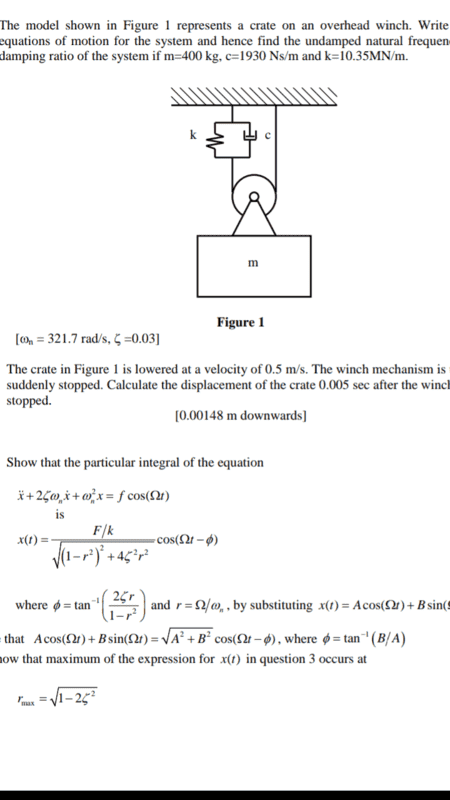
I am really stuck on the first question in the document and I don't even know where to begin.

If someone could explain what is happening and how to start the problem, I am confident I will be able to tackle it.
242092


It would also be a big help if you could direct me to some helpful resources so that I can grasp this topic fully,

Thanks a lot.
 
Last edited:
Physics news on Phys.org
You need to show us what you know so far before we can be of tutorial help. What does your textbook say about this subject? You should be able to do the first part of the problem for us and find the natural frequency of the stationary crate, no?
 
T he problem statement may be cut off, but as it appears here, it speaks of the "undamped natural frequenc(y) damping ratio." This is nonsense. Is there something else intended here?
 
  • Like
Likes   Reactions: berkeman
Let's see your force balance equation on the mass M.
 
Chester says that you need to write a force balance, but I think he means that you need to apply Newton's second law, F = m*a.

Before that, however, I suggest that you look at the kinematics of this problem. How is the displacement of the mass related to elongation of the spring and rate of elongation of the dashpot? This is the place to start, in my thinking.
 
Dr.D said:
Chester says that you need to write a force balance, but I think he means that you need to apply Newton's second law, F = m*a.

Before that, however, I suggest that you look at the kinematics of this problem. How is the displacement of the mass related to elongation of the spring and rate of elongation of the dashpot? This is the place to start, in my thinking.
Yes. I agree. The first thing to do in any "pulley problem" is to focus on the kinematics.
 

Similar threads

  • · Replies 1 ·
Replies
1
Views
3K
Replies
4
Views
2K
  • · Replies 1 ·
Replies
1
Views
2K
  • · Replies 15 ·
Replies
15
Views
12K
  • · Replies 1 ·
Replies
1
Views
2K
Replies
1
Views
1K
Replies
1
Views
2K
  • · Replies 23 ·
Replies
23
Views
4K
  • · Replies 21 ·
Replies
21
Views
2K
  • · Replies 2 ·
Replies
2
Views
1K