Help with my math in this 2nd order audio filter circuit

Click For Summary

Discussion Overview

The discussion revolves around understanding the mathematics involved in a second-order audio filter circuit, specifically how to calculate component values and impedance in the presence of reactive components like capacitors and inductors. Participants explore the implications of series and parallel configurations, the role of load in the circuit, and the use of reactance equations.

Discussion Character

  • Technical explanation
  • Conceptual clarification
  • Debate/contested
  • Mathematical reasoning

Main Points Raised

  • One participant expresses confusion about applying reactance equations for second-order circuits compared to first-order circuits, particularly regarding series and parallel configurations.
  • Another participant suggests that the effective impedance of the circuit can be approximated and provides formulas for calculating series and parallel impedance.
  • There is a discussion about the relevance of instantaneous impedance of speakers and how it affects calculations for capacitors in the circuit.
  • Concerns are raised about the potential distortion of the tweeter due to incorrect capacitor values, highlighting the importance of using the correct impedance in calculations.
  • Participants discuss the possibility of measuring speaker impedance using a multimeter and generating test tones, questioning how manufacturers typically obtain impedance data.
  • One participant introduces the concept of "Polar to Rectangular Conversion" and discusses the non-ideal behavior of speakers as resistive loads.

Areas of Agreement / Disagreement

Participants do not reach a consensus on the best approach to calculate impedance and component values in the circuit. Multiple competing views on how to handle the load and the implications of speaker impedance remain unresolved.

Contextual Notes

Participants mention various assumptions regarding the behavior of components in the circuit, such as the fluctuating impedance of speakers with frequency changes and the lack of manufacturer data on impedance plots for certain speakers.

Who May Find This Useful

This discussion may be useful for individuals interested in audio engineering, circuit design, and those seeking to understand the complexities of reactive components in filter circuits.

INTP_ty
Messages
26
Reaction score
0
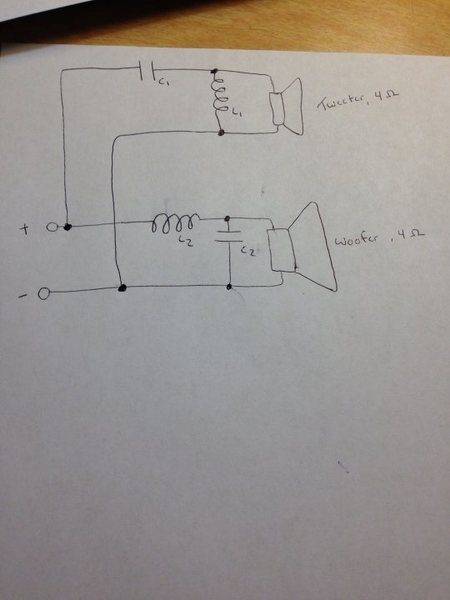
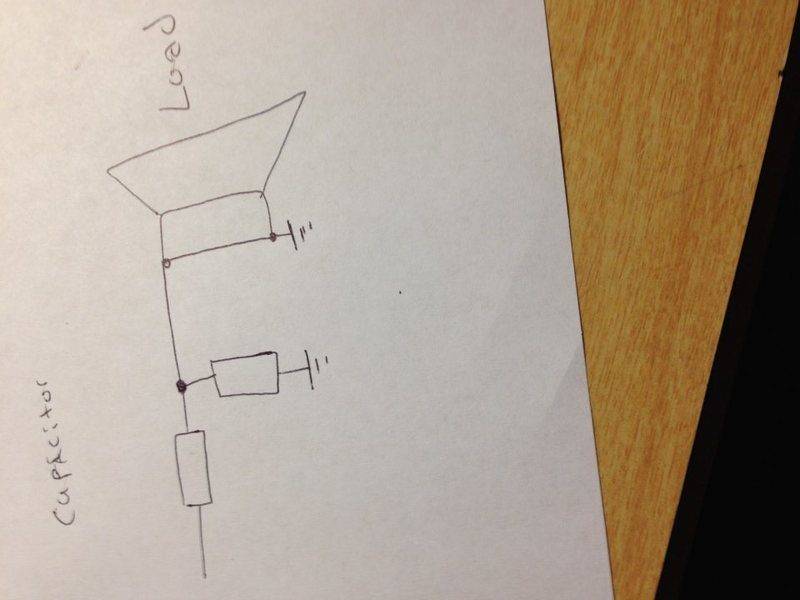
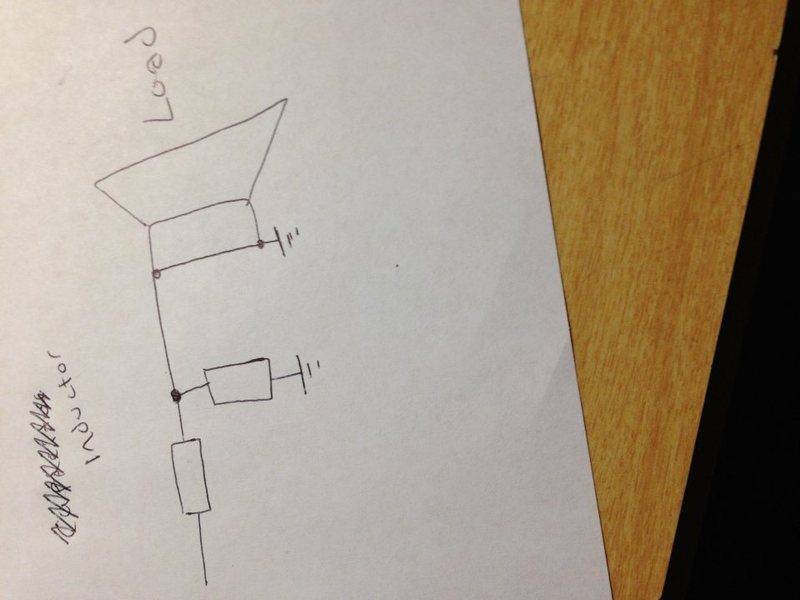
I understand how to use the reactance equations (for capacitor, xc=1/(2PiFC), & for inductor xL=2PiFL when the filter circuit is of first order to get the component values I need, but I don't understand how the math works when the circuit is of second order. The man at the electronics store told me to simply put boxes around the components, treat them as resistors, and solve. Okay, so for the capacitors I did that in figure #2 & or inductors, see figure #3.
1.jpg

1.jpg
2.jpg
3.jpg

That's what I don't get. When resistors are in series, you simply add them. When in parallel, it's 1/Rtotal=1/R1+1/R2 ...

This is a series-parallel circuit though! I watched some Youtube videos titled "series-parallel resistor circuits" & they simply... uh, let's suppose you have one resistor, R1, in series with 3 resistors, R2, R3, R4, that are in parallel. The Youtube mentor ignored the singe resistor R1 in series & focused on the ones in parallel, so R2, R3, & R4. He combined them, drew a big box around them, & called it R2. Then all that was left was R1 and "R2" which were now in series.

Simple, yeah.But, in my circuit, there is a load present. Wouldn't that matter? So is it really just R1+R2? I can't decide whether or not it's a series circuit. Yeah the two resistors are in series, but not with respect to the load (the speaker)And how does this all fit into the reactance equation? So for capacitor, you have xc=1/(2PiFC). Would I simply solve for C, then take that figure toss it in the parallel capacitor equation?
Lastly, the instantaneous impedance listed at each speaker, the tweeter 4 ohm, and woofer 4 ohm ...well I lied. Tweeter is more like 3.3 ohm around desired x over point and wooer ...well the manufacturer decided not to include it to keep people like me from getting decent results I guess? How is that going to work?

Now how in the world does that work with the reactance equation? XC is no longer 4 ohms.
 
Engineering news on Phys.org
INTP_ty said:
I understand how to use the reactance equations (for capacitor, xc=1/(2PiFC), & for inductor xL=2PiFL when the filter circuit is of first order to get the component values I need, but I don't understand how the math works when the circuit is of second order. The man at the electronics store told me to simply put boxes around the components, treat them as resistors, and solve. Okay, so for the capacitors I did that in figure #2 & or inductors, see figure #3.
That's what I don't get. When resistors are in series, you simply add them. When in parallel, it's 1/Rtotal=1/R1+1/R2 ...

This is a series-parallel circuit though! I watched some Youtube videos titled "series-parallel resistor circuits" & they simply... uh, let's suppose you have one resistor, R1, in series with 3 resistors, R2, R3, R4, that are in parallel. The Youtube mentor ignored the singe resistor R1 in series & focused on the ones in parallel, so R2, R3, & R4. He combined them, drew a big box around them, & called it R2. Then all that was left was R1 and "R2" which were now in series.

Simple, yeah.

But, in my circuit, there is a load present. Wouldn't that matter? So is it really just R1+R2? I can't decide whether or not it's a series circuit. Yeah the two resistors are in series, but not with respect to the load (the speaker)

Series/Parallel.
In your image 1, C1 is in series with your tweeter, L1 is parallel to your tweeter, C2 is Parallel to your woofer, L2 is in Series with your woofer, and your Tweeter is Parallel to your woofer. Ignoring C1, C2, L1, L2, the effective impedance would be about 2ohms, or slightly less.
Series impendence: Z = Z1 + Z2
Parallel: 1/Z = 1/Z1 + 1/Z2
Or
Z = Z1 * Z2 / Z1 + Z2

This may help on understanding that, and how to include C & L in the equation.
http://hyperphysics.phy-astr.gsu.edu/hbase/electric/imped.html#c4The biggest difference between a resistor and a Speaker, is that a resistor opposes the flow of D/C current where a speaker opposes the flow of A/C current.
A resistors resistance value will not fluctuate significantly when the frequency does, and the current passing through will also remain constant. The impedance of a speaker 'will' fluctuate as the frequency changes, and as the impedance increases the current flow will decrease proportionately. The voltage across both should remain relatively constant.

The important part here then is that the "4ohm" rating, and the "3.xohm" reading you would measure on an unconnected speaker load, is more relevant to matching the speaker to the amplifier output impedance, but is a good staring point to rough-tune your circuit. For fine tuning the values for your RLC components, checking the impedance at various frequencies would be beneficial. Most Driver manufacturers will provide data sheets that include a frequency response graph, and many post them to their website for download.

And how does this all fit into the reactance equation? So for capacitor, you have xc=1/(2PiFC). Would I simply solve for C, then take that figure toss it in the parallel capacitor equation?

Lastly, the instantaneous impedance listed at each speaker, the tweeter 4 ohm, and woofer 4 ohm ...well I lied. Tweeter is more like 3.3 ohm around desired x over point and wooer ...well the manufacturer decided not to include it to keep people like me from getting decent results I guess? How is that going to work?

Now how in the world does that work with the reactance equation? XC is no longer 4 ohms.
 
Wee-Lamm said:
Ignoring C1, C2, L1, L2, the effective impedance would be about 2ohms, or slightly less.

Let's keep things simple & go back to the first order scenario.

For Xc & XL, am I supposed to use the effective impedance or Zeq? I did not use Zeq, but instead 4 ohms (the "instantaneous" impedance of each speaker at it's intended x-over point). You mentioned later in your post that it was more relevant for matching the speaker to the amplifier's output impedance.

But, if Xc=4 ohms in Xc=1/(2PiFC), then C=10uF whereas if Xc=2 ohms in Xc=1/(2PiFC), then C=20uF.

Huge difference. That's probably why my tweeter is distorting at high-er volumes. I'm only using a 10uF capacitor when I'm supposed to be using a 20uF ...I think

*I am several octaves above the tweeter's resonant frequency.

And,

Since the manufacturer didn't list an impedance plot (it's a no name speaker), could I do it myself with a multi-meter? Say download a 3Khz test tone & feed it into my speaker. I don't understand how they can measure the impedance of a speaker without measuring whatever is driving the speaker too. I assume this is done indirectly somehow?
 
Last edited:
It is possible to measure with a multi meter and injecting a set frequency, which can be tedious checking everything from 20 - 20k Hz. TrueRTA may be worth a look, I use it to inject a tone for troubleshooting guitar amplifiers. It's free version does everything I need and more.

I am curious of what you mean by being several octaves "Above" the tweeters range? I would think we would only want to allow the higher frequencies there in a narrower band than the Midrange, and let the Midrange driver do the bulk of the work. It is likely more tolerant of "some" high frequencies than the tweeter would be of even lower midrange. I think the Tweeter would gag immensely on the low end.
 
Are you familiar with something called "Polar to Rectangular Conversion" ?

...

Speakers are almost but not quite a pure resistor.
Their DC resistance is about 80% of their nominal 8 or 4 ohm 'impedance'
that is around 6.4 or 3.2 ohms
so most of the power going into them just heats the voice coil.

The rest of the power would ideally make sound and the speaker would appear to be electrically a simple 8 or 4 ohm resistor.
That's not a bad approximation for somebody just starting out.

So you could consider your tweeter a 4 ohm resistor
and it's in parallel with inductor L1
That parallel combination is some new impedance
and note it's a different number of ohms at every different frequency
and it's in series with C1 which is likewise a function of frequency.

So you can solve, for any frequency, what fraction of applied voltage appears across your tweeter and C1.
I'd set up a spreadsheet or Basic program to iterate over the audio frequency range and plot results.

Your 1/2piFC doesn't mention phase angle
if you ignore phase angle it'll not affect your results drastically , you'll still see effect of 2nd vs 1st order crossover. Values at breakpoints will be off a little that's all.

I would make XL and XC both equal to speaker impedance at crossover frequency.
If you set up that spreadsheet or simulator program you can experiment with tweaking L and C.

There's lots of tutorials on speaker building, it's a fun hobby. I enjoy making sawdust more than doing algebra.

Have at it !
 
  • Like
Likes   Reactions: Wee-Lamm
jim hardy said:
Are you familiar with something called "Polar to Rectangular Conversion" ?

...

Speakers are almost but not quite a pure resistor.
Their DC resistance is about 80% of their nominal 8 or 4 ohm 'impedance'
that is around 6.4 or 3.2 ohms
so most of the power going into them just heats the voice coil.

The rest of the power would ideally make sound and the speaker would appear to be electrically a simple 8 or 4 ohm resistor.
That's not a bad approximation for somebody just starting out.

The only things I can comment on here is that the Audio signal will be AC, which explains why the 90 degree phase shift.
Also, it would not be unusual to see the impedance as high as 70ohms during much of the middle region of the band that is referenced by the network. This impedance is not a resistance in that it does not oppose volume but rather is an inductor that resists dramatic changes in volume. This serves to level out the frequency response which reduces the occurrence of noticeable peaks and dips.
 
I was hoping to induce INTP_ty to try his hand at simple math

i'm not sure whether he's accustomed to AC and complex arithmetic

so

if he'll calculate a table for about ten frequencies

first column frequency
second column XC
third column XL
fourth column parallel combination of tweeter ohms and XL, call it Ztweeter
fifth column is fraction of applied voltage that appears across Ztweeter, calculated by Ztweeter/( Ztweeter +XC )

he'll see the voltage across tweeter is less at low frequencies

i'd use steps of 1::2::5::10 for frequency
ie 10 hz, 20 hz, 50 hz, 100 hz, 200 hz,,,,,,,,,, 20khz

that was point of my post

if he incudes angles so much the better

same approach will work for the woofer

and i think that adresses his questions

INTP_ty said:
And how does this all fit into the reactance equation?

INTP_ty said:
Now how in the world does that work with the reactance equation? XC is no longer 4 ohms.
old jim
 
  • Like
Likes   Reactions: Wee-Lamm

Similar threads

  • · Replies 6 ·
Replies
6
Views
5K
  • · Replies 2 ·
Replies
2
Views
2K
Replies
6
Views
3K
Replies
12
Views
3K
  • · Replies 14 ·
Replies
14
Views
2K
  • · Replies 10 ·
Replies
10
Views
3K
  • · Replies 15 ·
Replies
15
Views
7K
Replies
2
Views
3K
Replies
1
Views
2K
  • · Replies 29 ·
Replies
29
Views
5K