Help with understanding this rigid-body equilibrium problem

  • Thread starter Thread starter Kolika28
  • Start date Start date
  • Tags Tags
    Equilibrium
Click For Summary
SUMMARY

This discussion focuses on strategies for solving rigid-body equilibrium problems in physics, specifically regarding the selection of objects or points for applying equations. Participants emphasize the importance of creating free body diagrams for each object involved, such as the pole and box in the first problem, and the point where three strings meet in the second problem. Key advice includes computing torques about points that simplify calculations and recognizing that forces acting at specific points do not contribute to torque. This understanding is crucial for success in exams involving complex systems.

PREREQUISITES
  • Understanding of rigid-body equilibrium principles
  • Familiarity with free body diagrams
  • Knowledge of torque calculations
  • Ability to decompose forces into x and y components
NEXT STEPS
  • Practice creating free body diagrams for various systems
  • Learn about torque computation techniques in rigid-body problems
  • Study examples of equilibrium problems involving multiple objects
  • Review strategies for analyzing forces in complex systems
USEFUL FOR

Students preparing for physics exams, particularly those focusing on rigid-body equilibrium, as well as educators seeking effective teaching strategies for complex mechanics problems.

Kolika28
Messages
146
Reaction score
28
Homework Statement
I have a hard time understanding rigid-body equilibrium problem, especially when it a system of several objects. Sorry for asking so much here, but my exam is coming up and I really want to make sure that I try to understand all the things that makes me confussed.
Relevant Equations
##\sum F_x=0##
##\sum F_y=0##
##\sum \tau=0##
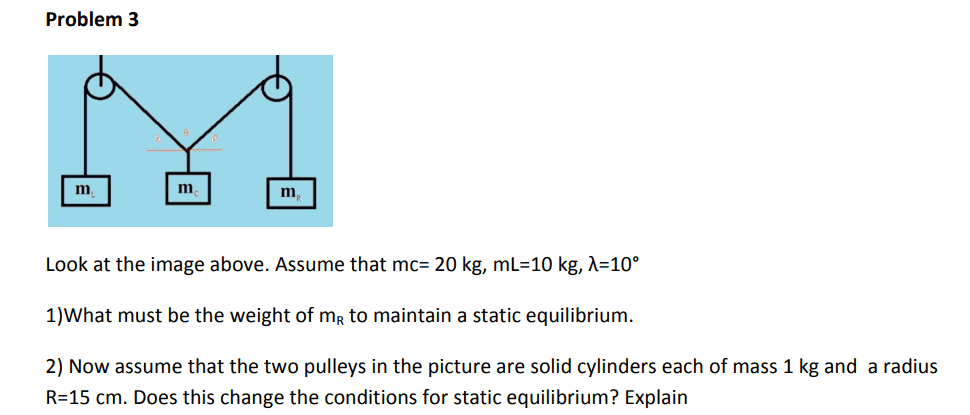
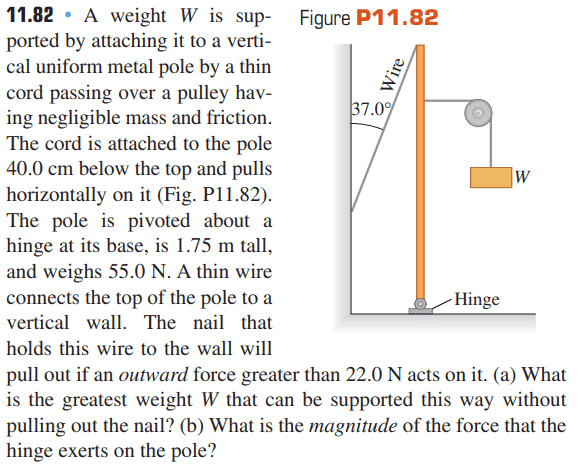
So here are two problems I have been working with lately:
1591480954147.png

1591480992588.png

I have solved both, so I don't need the help to find the answers. The thing that confusses me is which object one should choose to apply the equations above. When it comes to the first problem, we apply the equations to the pole, but why not the box? And in second problem, we apply them to the point where the three strings meet. I had to look at the solution to find out which object or point I should focus on. But I'm afraid it won't be obvious to me on the exam what object or point to pick. Does anyone have some tips?
 
Physics news on Phys.org
Kolika28 said:
which object one should choose
...
some tips?
Make free body diagrams. The ones for W, pulley or wire in the first problem and the ones for the masses and the pulleys in the second problem will be boring. The obvious key candidates will pop up pretty soon.
 
  • Like
Likes Kolika28
For torques:

You can compute torques about any point you wish. Given that freedom, you should pick the point that will lead to the easiest computations. In particular, if a force is acting at a point, and you compute torques about that same point, that force will not contribute a torque because the distance to the point is zero, so that's one torque less to worry about. Such simplifications are the first things I look for when choosing where I'm computing torques about.

For forces:

In the first problem, I would not bother writing it down for the box, because it's in a simple enough situation where you can figure out the tension in the string in your mind.

Same for box 1 and 3 in the second problem.

In an exam, you might still want to write it down just to show the person who will correct that you understood.
 
  • Like
Likes Kolika28, Lnewqban and Delta2
Kolika28 said:
Homework Statement:: I have a hard time understanding rigid-body equilibrium problem, especially when it a system of several objects. Sorry for asking so much here, but my exam is coming up and I really want to make sure that I try to understand all the things that makes me confused.
...
The thing that confusses me is which object one should choose to apply the equations above. When it comes to the first problem, we apply the equations to the pole, but why not the box? And in second problem, we apply them to the point where the three strings meet. I had to look at the solution to find out which object or point I should focus on. But I'm afraid it won't be obvious to me on the exam what object or point to pick. Does anyone have some tips?

Please, don't be sorry for asking; somebody here will always be happy to help you.
These problems require practice, time and patience.

Normally, the questions will guide you to the object which forces you need to analyze, decompose in their x and y components and later calculate.
If you apply the equations to the wrong object or point of a mechanism, you soon will understand that such choice is not taking you too far.

Nothing lost at that point, other than time, you keep going with other points and keep collecting information that will help you determine the magnitudes and directions of forces and moments.
 
  • Like
Likes Kolika28 and Delta2
Thank you so much everybody for your relplies, I really appreciate it!:smile: I will now try to solve some more problems like this with your comments in mind, and see if I understand it better now.
 
  • Like
Likes PhDeezNutz
The book claims the answer is that all the magnitudes are the same because "the gravitational force on the penguin is the same". I'm having trouble understanding this. I thought the buoyant force was equal to the weight of the fluid displaced. Weight depends on mass which depends on density. Therefore, due to the differing densities the buoyant force will be different in each case? Is this incorrect?

Similar threads

  • · Replies 3 ·
Replies
3
Views
2K
  • · Replies 10 ·
Replies
10
Views
2K
  • · Replies 14 ·
Replies
14
Views
1K
  • · Replies 11 ·
Replies
11
Views
2K
  • · Replies 12 ·
Replies
12
Views
2K
  • · Replies 7 ·
Replies
7
Views
1K
  • · Replies 1 ·
Replies
1
Views
1K
  • · Replies 1 ·
Replies
1
Views
1K
  • · Replies 5 ·
Replies
5
Views
2K
  • · Replies 6 ·
Replies
6
Views
2K