High impedance circulating current scheme(calculate stabilising resistor)

Click For Summary

Discussion Overview

The discussion revolves around calculating the stabilizing resistor for a high impedance circulating current scheme in electrical engineering, focusing on the parameters involved in the calculation and the necessary data for accurate results. It includes theoretical considerations and practical applications related to relay settings and current transformers.

Discussion Character

  • Technical explanation
  • Debate/contested
  • Homework-related

Main Points Raised

  • One participant presents a formula for calculating the maximum voltage across the relay and stabilizing resistor, along with the parameters involved, including the max short circuit rating, current transformer ratio, internal resistance, and lead burden.
  • Another participant questions the clarity of the original problem, suggesting that it resembles an incomplete homework question and emphasizes the need for a schematic diagram.
  • A participant asserts that the problem is not homework and provides additional context about the VA burden and relay setting, expressing confusion over their values.
  • There is a request for clarification on whether the relay setting and VA burden can be assumed or need to be calculated from the provided information.
  • One participant expresses confusion regarding the relevance of the current transformer ratio in the context of the relay.
  • A participant mentions having developed software for calculating stabilizing resistor values and offers to share it with interested parties.
  • Another participant notes the need for additional data from the relay manufacturer and the current transformer knee point voltage to complete the calculations.

Areas of Agreement / Disagreement

Participants express varying levels of understanding and clarity regarding the problem, with some questioning the completeness of the information provided. There is no consensus on how to proceed with the calculations or the assumptions that can be made.

Contextual Notes

Participants highlight the absence of a schematic diagram and specific values for the relay setting and VA burden, which are critical for completing the calculations. The discussion reflects uncertainty about the assumptions that can be made based on the given data.

StealthRay
Messages
51
Reaction score
0
Hi,

I am going through some texts but it was not very clear.I hope some experts here can help me on this.

The max voltage across the relay and stabilising resistor is given by;

(If/N)(Rs+Rb)

where If - max short circuit rating, A
N - current transformer, CT ratio
Rs - CT internal resistance
Rb - max lead burden

Relay impedance at setting current is given by VA burden/(I setting)2

Total relay circuit impedance = V max/I setting

Stabilising resistance = total relay circuit impedance - relay impedance at setting current.

Now if I have Isc=2000A
CT ratio=200:5
Rs=0.6 ohm
Rb=0.4 ohm

Hence max voltage calculated from the equation above = 50V.

Now here is the problem to find relay impedance at setting current,

Do I assume the relay setting and the VA burden or if these two parameters can be calculated from the above information?

Thank you.

p/s: I don't think we need to look at the circuit diagram because it just shows the protection scheme without going anywhere related to the calculation.

Edit:Posted the circuit diagram of the high impedance circulating current scheme.
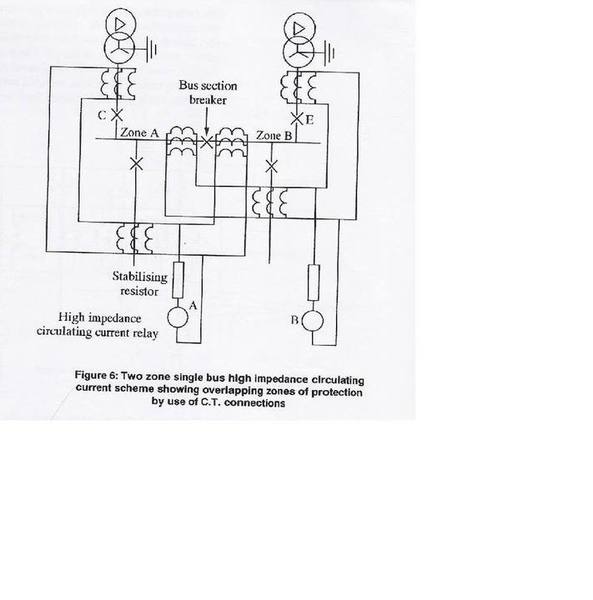
circulatingcurrentprotect.jpg
 
Last edited:
Engineering news on Phys.org
This looks very much like an incomplete version of a homework or coursework problem, presented without the schematic diagram which originally accompanied the text.

Some readers may be sufficiently familiar with this material to determine the original question, but it would be much better if you would present the question clearly in its original form.
 
Adjuster said:
This looks very much like an incomplete version of a homework or coursework problem, presented without the schematic diagram which originally accompanied the text.

Some readers may be sufficiently familiar with this material to determine the original question, but it would be much better if you would present the question clearly in its original form.

Aww,man,this is not a homework.As you can see,all the equations are there.I can even provide the step by step answers.It just that the text plainly stated the VA burden as 1 VA and relay setting as 0.1A,which I don't understand where they came from.

The final answer would be 400 ohm for the stabilising resistor.

I just need the explanation and this is not homework.

Thank you.
 
StealthRay said:
Hi,

I am going through some texts but it was not very clear.I hope some experts here can help me on this.

The max voltage across the relay and stabilising resistor is given by;

(If/N)(Rs+Rb)

where If - max short circuit rating, A
N - current transformer, CT ratio
Rs - CT internal resistance
Rb - max lead burden

Relay impedance at setting current is given by VA burden/(I setting)2

Total relay circuit impedance = V max/I setting

Stabilising resistance = total relay circuit impedance - relay impedance at setting current.

Now if I have Isc=2000A
CT ratio=200:5
Rs=0.6 ohm
Rb=0.4 ohm

Hence max voltage calculated from the equation above = 50V.

Now here is the problem to find relay impedance at setting current,

Do I assume the relay setting and the VA burden or if these two parameters can be calculated from the above information?

Thank you.

p/s: I don't think we need to look at the circuit diagram because it just shows the protection scheme without going anywhere related to the calculation.

Why are you talking about a current transformer ratio for a relay? This is confusing. Posting the diagram would help a lot.
 
berkeman said:
Why are you talking about a current transformer ratio for a relay? This is confusing. Posting the diagram would help a lot.

Ok,I have posted the circuit diagram.Thank you.
 
To Berkeman:- CT ratio needed as primary (not secondary) current given.

To All:- I have a software package developed that calculates stabilizing resistor values as well as much more, it's designed for HV Commissioning Engineers. If anyone's interested please send me a PM.
 
Last edited by a moderator:

Similar threads

  • · Replies 11 ·
Replies
11
Views
4K
  • · Replies 12 ·
Replies
12
Views
2K
  • · Replies 6 ·
Replies
6
Views
19K
  • · Replies 3 ·
Replies
3
Views
44K
  • · Replies 7 ·
Replies
7
Views
12K
Replies
2
Views
5K
Replies
4
Views
2K
  • · Replies 6 ·
Replies
6
Views
5K
  • · Replies 12 ·
Replies
12
Views
4K
  • · Replies 10 ·
Replies
10
Views
3K