cajamarcus
- 5
- 0
Hi, even though it seems so simple; I can't solve this since a few days and it's driving me crazy.
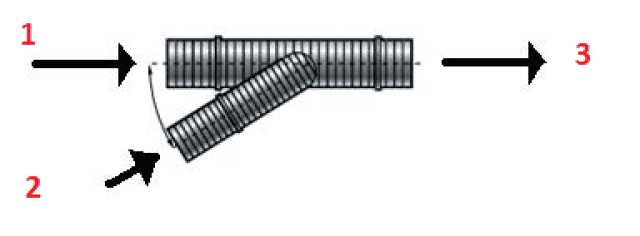
Flow gets inside the tube from point 1, it will create a vacuum, which will let a secondary flow inlet from point 2. Both flows will mix inside the tube, and get out of the junction from point 3. All the point ends are open to the ambient (so, the atmospheric pressure). The question is, what will be the static and dynamic pressures, as well as flow velocities in points 1, 2, and 3?
My basic assumption is to use Bernoulli equation and Continuity and Conservation of Mass. I am having trouble in using Bernoulli I guess.
in: Inlet
out: Outlet
P: Pressure
rho: Density
g: Gravitational acceleration
h: Height
Bernoulli Equation: P_static+P_dynamic+P_potential must be constant
Considering the fluid is water (incompressible), density will be constant.
Pin+1/2*rho*vin2+rho*g*hin=Pout+1/2*rho*vout2+rho*g*hout
considering that both the points are at the same elevation, we can ignore the potential pressure.
Pin+1/2*rho*vin2=Pout+1/2*rho*vout2
Most probably, my mistake comes at this point. Since there are 2 openings in inlet side, how should I integrate the pressures of point 1 and 2?
m: Mass flow rate
A: Crossectional area of the pipes
v: fluid velocities inside the pipes
Continuity and Conservation of Mass:
Considering the diameters of all 3 points are the same, areas are also same.
m1+m2=m3
A*rho*v1 + A*rho*v2=A*rho*v3
v1+v2=v3
My assumptions are most probably wrong. Please correct me and help to find the right equations.
Thanks!
Flow gets inside the tube from point 1, it will create a vacuum, which will let a secondary flow inlet from point 2. Both flows will mix inside the tube, and get out of the junction from point 3. All the point ends are open to the ambient (so, the atmospheric pressure). The question is, what will be the static and dynamic pressures, as well as flow velocities in points 1, 2, and 3?
My basic assumption is to use Bernoulli equation and Continuity and Conservation of Mass. I am having trouble in using Bernoulli I guess.
in: Inlet
out: Outlet
P: Pressure
rho: Density
g: Gravitational acceleration
h: Height
Bernoulli Equation: P_static+P_dynamic+P_potential must be constant
Considering the fluid is water (incompressible), density will be constant.
Pin+1/2*rho*vin2+rho*g*hin=Pout+1/2*rho*vout2+rho*g*hout
considering that both the points are at the same elevation, we can ignore the potential pressure.
Pin+1/2*rho*vin2=Pout+1/2*rho*vout2
Most probably, my mistake comes at this point. Since there are 2 openings in inlet side, how should I integrate the pressures of point 1 and 2?
m: Mass flow rate
A: Crossectional area of the pipes
v: fluid velocities inside the pipes
Continuity and Conservation of Mass:
Considering the diameters of all 3 points are the same, areas are also same.
m1+m2=m3
A*rho*v1 + A*rho*v2=A*rho*v3
v1+v2=v3
My assumptions are most probably wrong. Please correct me and help to find the right equations.
Thanks!
