How can I convert loss units, dB/mm, to mm^-1

Click For Summary

Discussion Overview

The discussion revolves around converting loss units from dB/mm to mm-1 for simulating mode loss in a waveguide. Participants explore the mathematical relationships and equations involved in this conversion, as well as the implications for calculating the absorption coefficient (α).

Discussion Character

  • Exploratory
  • Technical explanation
  • Mathematical reasoning
  • Debate/contested

Main Points Raised

  • Some participants suggest that converting dB to a linear scale involves understanding the logarithmic nature of dB and the relationship to the absorption coefficient (α).
  • One participant provides the equation T = I0 * e-x*α and expresses the need for graphs showing α vs frequency, indicating a struggle with unit conversion.
  • Questions are raised about whether the calculations are based on power or amplitude ratios, with references to different forms of the dB equation.
  • Another participant presents equations for voltage and loss, noting discrepancies in results when using different conversion factors for α.
  • Links to external resources are shared, suggesting they may contain relevant information for the conversion process.
  • A participant shares code used for transmission data analysis, indicating confusion about the correct equations and the role of refractive index in calculations.
  • Concerns are raised about the inclusion of refractive index values in the calculations and the nature of the wave being modeled (plane wave vs. exponential loss).

Areas of Agreement / Disagreement

Participants express uncertainty regarding the correct conversion methods and equations for α, with multiple competing views on how to approach the problem. The discussion remains unresolved, as no consensus is reached on the correct equations or methods to use.

Contextual Notes

Participants mention various equations and approaches without confirming their correctness, leading to potential limitations in understanding the underlying assumptions and dependencies on definitions. The discussion highlights unresolved mathematical steps and the need for clarity on the context of the waveguide simulations.
gps57
Messages
4
Reaction score
0
I am trying to simulate mode loss for a waveguide and the units I get for loss are dB/mm, but I want to convert the units to just mm^-1 so I can the absorption (α) value. I am guessing there is a specific value that I need to either multiply or divide my values with, but I'm just not sure what that value is.
 
Engineering news on Phys.org
Welcome to PF.

The dB is just one way to express a ratio as a logarithm, so addition can replace multiplication, and multiplication can replace exponentiation.

I believe you are correct, you may just need to convert the distance the signal takes to fall by 1 dB, into the distance the signal takes for to fall to 1/e.

Can you please give us the equations you are using that employ the absorption coefficient, α.
 
  • Like
Likes   Reactions: BvU
Baluncore said:
Welcome to PF.

The dB is just one way to express a ratio as a logarithm, so addition can replace multiplication, and multiplication can replace exponentiation.

I believe you are correct, you may just need to convert the distance the signal takes to fall by 1 dB, into the distance the signal takes for to fall to 1/e.

Can you please give us the equations you are using that employ the absorption coefficient,
Thank you, and thank you for your reply.

The equation I have is T = I_0 * e^{-x*α}, where T is the transmission and α the absorption coefficient. Essentially, I need graphs that show α vs frequency, but I'm just having trouble with converting the units, as I mentioned in the question.
 
Are you considering the power, or the electric or magnetic field?
What is the form of your equation given dB?
Do you use; dB =10⋅Log(power ratio); or, dB = 20⋅Log(amplitude ratio) .
 
Baluncore said:
Are you considering the power, or the electric or magnetic field?
What is the form of your equation given dB?
Do you use; dB =10⋅Log(power ratio); or, dB = 20⋅Log(amplitude ratio) .
Hi, I have these 2 equations: V=V_0*e^(-αL) and V=V_0*10^(-α_dB*L/20) where α_dB is loss in dB/mm and α is attenuation which has 1/mm units. When I solve for α, I get α = α_dB*ln(10)/20, but when I use
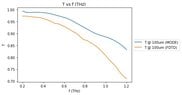
T = T_0 * e^{-L*α} to convert it to transmission, the values are not correct. The image shows a plot of what I'm trying to achieve. I want to match the MODE with the FDTD transmission. When I divide by 10 rather than 20, I get the correct values, but I can't seem to find these equations anywhere to check if they are correct. Am I using the correct equations? Where do the first 2 equations come from, it's still not clear for me?
 

Attachments

  • T vs f 100um (1).jpg
    T vs f 100um (1).jpg
    10.2 KB · Views: 155
Last edited:
TonyStewart said:

I have tried this before, here is the code
Code:
tra1filedata = genfromtxt("T vs f (1mm L=100).txt") #transmission data from FDTD
lossfiledata = genfromtxt("loss vs f xspan 200.txt") #loss data from MODE
loss_dB = lossfiledata[:,1]/1000

lambda_0 = 0.25*2.27 #wavelength
kappa = (loss_dB*lambda_0)/(20*2*np.pi*0.43) 
k0 = (2*np.pi*2.27 + kappa*1j)/lambda_0

alpha1 = 2*kappa*k0

alpha2 = 10**(loss_dB/10)

alpha = loss_dB*((math.log(10))/20) 

T = np.exp(alpha1*-1*0.1) #transmission converted from loss MODE

plt.plot(lossfiledata[:,0]*1e-12, T, label = "T @ 100um (MODE)");

plt.plot(tra1filedata[:, 0]*10e-13, tra1filedata[:, 1], label="T @ 100um (FDTD)");
For the GaAs I'm simulating, the refractive index is 3.6 and the imaginary refractive index is 0.01.
But then I'm not exactly sure how to plot it or if the code I wrote so far is correct. As you can see, I tried 3 different equations for alpha, and none of them have yielded the result I want. Would I still need to use
T = T_0 * e^{-L*α}? Because I'm essentially trying to convert the loss data from MODE to match with the transmission data from FDTD. I know the simulations are correct because the loss from both methods matches, so the error must be in the equations I'm using, I'm just not sure what it is.
 
Last edited by a moderator:
I am not good at code, but I don't see these refractive index values being used in your code. You need to include them in the calculations. Also is this a plane wave with linear loss? or is there an exponential factor? (as Baluncore suggested with E vs P)
 

Similar threads

Replies
1
Views
2K
  • · Replies 12 ·
Replies
12
Views
42K
Replies
1
Views
3K
Replies
4
Views
1K
  • · Replies 7 ·
Replies
7
Views
3K
  • · Replies 6 ·
Replies
6
Views
2K
  • · Replies 11 ·
Replies
11
Views
2K
Replies
55
Views
7K
  • · Replies 10 ·
Replies
10
Views
2K
Replies
8
Views
2K