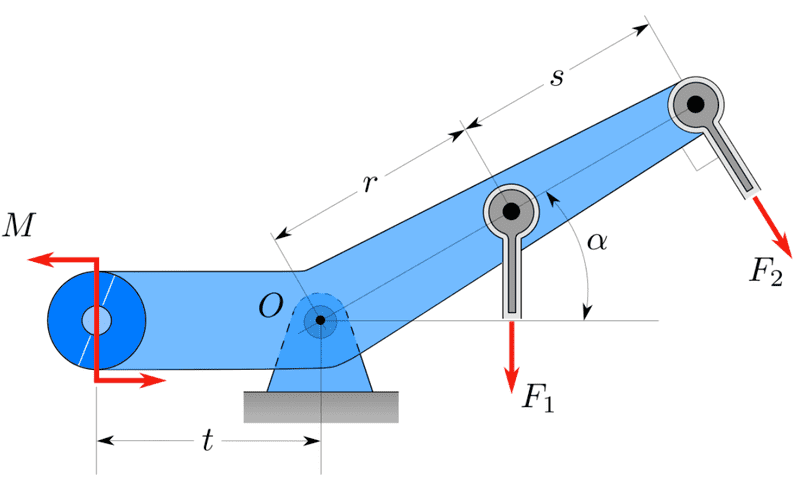
How can I draw the resultant force of the couple M, F1 and F2?

Click For Summary

Discussion Overview

The discussion revolves around expressing the resultant force R of a couple and two forces, F1 and F2, in terms of given variables (F1, F2, r, s, and α). Participants explore how to visualize and calculate this resultant force, considering the conditions for equilibrium of a rigid body.

Discussion Character

  • Homework-related
  • Mathematical reasoning
  • Debate/contested

Main Points Raised

  • One participant seeks guidance on how to draw the resultant force R and questions whether the couple creates an upward force from the origin.
  • Another participant asks for clarification on the exact statement of the problem.
  • A participant reiterates the problem statement, emphasizing the need to express the resultant force in terms of the specified variables.
  • It is noted that for a rigid body in equilibrium, the sum of forces and moments must be zero, and the moment M does not contribute an external force.
  • One participant expresses confusion about why their attempt to set the resultant force to zero was marked incorrect, suggesting that R should simply be the sum of F1 and F2.
  • Another participant explains that to sum the forces vectorially, one must resolve them into horizontal and vertical components.
  • A participant attempts to resolve F2 into components and combines them with F1, but still finds their answer to be incorrect, indicating uncertainty about the necessity of using all variables.
  • One participant challenges the correctness of the component resolution and questions whether the original poster has been taught how to determine the components of R and its magnitude.

Areas of Agreement / Disagreement

Participants express differing views on how to approach the problem, particularly regarding the resolution of forces and the role of the moment M. There is no consensus on the correct method to express the resultant force R.

Contextual Notes

Participants highlight potential misunderstandings regarding the resolution of forces into components and the application of equilibrium conditions. There are unresolved aspects regarding the use of all variables in the expression for R.
FabledIntg
Messages
43
Reaction score
0
Thread moved from the technical forums, so no Homework Template is shown
I'm supposed to express the reultant force R of M, F1 and F2 in terms of F1, F2, r, s and α. But I need to know how to draw R first. How can one do this?

Does the couple create a force uppwards from O? Can I move F_1 and F_2 also to the origin and combine the forces?

Here is the image:

qygwsn.png
 

Attachments

  • qygwsn.png
    qygwsn.png
    15.3 KB · Views: 595
Last edited:
Physics news on Phys.org
What is the exact statement of the problem?
 
Hi,

Problem: Express the resultant force in terms of F1, F2, r, t and α.
 
So you are aware that, for a rigid body to be in equilibrium, the sum of the forces and of the moments acting on the body must each be zero, right? The moment M does not contribute an external force.
 
Yes I understand that, and I've tried the answer 0, but is still says it's wrong answer.

However, if the moment doesn't contribute an external force, shouldn't the resulting force of F1 and F2 be just R = F1 + F2? I don't understand How I'm supposed to express a resulting force with all those variables. I've tried similar triangles and all sorts of trig identities.
 
FabledIntg said:
Yes I understand that, and I've tried the answer 0, but is still says it's wrong answer.

However, if the moment doesn't contribute an external force, shouldn't the resulting force of F1 and F2 be just R = F1 + F2? I don't understand How I'm supposed to express a resulting force with all those variables. I've tried similar triangles and all sorts of trig identities.
Vectorially, R = F1+ F2. But, to sum these forces, you need to resolve them into horizontal and vertical components, and then add the components. R has a component in the horizontal direction and a component in the vertical direction. If you have tried to do this, please show us what you have done.
 
Ok, but as I understand, F1 can't be divided into vertical/horixontal components since it's already pointing straigt downwards, so it has only one vertical component. For F2 I get

F2y = F2 cos(α)
F2x = F2 sin(α)

So I get R = F1 + F2y + F2x = F1 + F2 cos(α) + F2 sin(α).

Still wrong. Keep in mind that it's not nesseccary to use ALL the variables above in order to express R.
 
This is not done correctly. You seem to lack the knowledge of how to get the components of R and then to determine its magnitude. Have you been taught how to do this kind of thing in your course?
 

Similar threads

  • · Replies 3 ·
Replies
3
Views
2K
Replies
17
Views
3K
Replies
5
Views
1K
  • · Replies 2 ·
Replies
2
Views
3K
  • · Replies 1 ·
Replies
1
Views
2K
Replies
2
Views
6K
Replies
8
Views
9K
  • · Replies 6 ·
Replies
6
Views
3K
  • · Replies 5 ·
Replies
5
Views
3K
  • · Replies 2 ·
Replies
2
Views
2K