How can I solve double integrals with tricky limits and substitutions?

Click For Summary
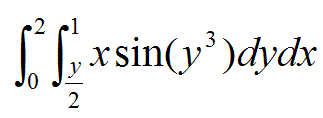
Double integrals with tricky limits can be challenging, particularly when substitutions complicate the process. A specific integral example, \[ \int_0^1\! \int_{\sqrt{y}}^1 9\sqrt{1-x^3}\,dxdy,\] was discussed, with suggestions to interchange limits to simplify the x integral. Another integral involving Sin(y^3) was noted to potentially contain a misprint, which could hinder solving it. Visualizing the problem with a graph can aid in determining new limits for integration. Understanding how to effectively change limits is crucial for solving these types of integrals.
ApeXaviour
Messages
34
Reaction score
0
I was fine with these in class, tutorials etc. It's only since I found this in a past paper that I've had a problem with them.
\[ \int_0^1\! \int_{\sqrt{y}}^1 9\sqrt{1-x^3}\,dxdy.\] <br />

Nomatter what I substitute in under the sqrt sign I just can't get out the integral for x :(
I tried changing the limits so they run from x^2 to 1 for y and 0 to 1 for x..


I'm having similar trouble with this one...
4.GIF


The Sin(y^3) here is what's getting me. Also tried changing the limits and substitution. No luck.. just ends up a big unsolvable mess for me

Thanks
Declan
 

Attachments

  • 4.GIF
    4.GIF
    2.6 KB · Views: 557
Last edited:
Physics news on Phys.org
For the first one, if you interchange the limits, y will run from 0 to x^2, which will let you do the x integral by substitution. The second integral doesn't make sense as wriiten, but the same approach as for the first one will work if you meant for the inner integral to run from x/2 to 1.
 
Hmm.. you're right. I didnt even notice that about the second one. Re-checked the past exam papers and that's exactly how it's written though. Must be a missprint.

I obviously don't have the hang of changing these limits, thanks for your help I'll try wrap my head around that now..
 
If you're having trouble finding new limits, a sketch of the graph will certainly help!
 
Question: A clock's minute hand has length 4 and its hour hand has length 3. What is the distance between the tips at the moment when it is increasing most rapidly?(Putnam Exam Question) Answer: Making assumption that both the hands moves at constant angular velocities, the answer is ## \sqrt{7} .## But don't you think this assumption is somewhat doubtful and wrong?

Similar threads

Replies
2
Views
2K
  • · Replies 1 ·
Replies
1
Views
2K
  • · Replies 27 ·
Replies
27
Views
3K
Replies
10
Views
2K
  • · Replies 3 ·
Replies
3
Views
2K
Replies
4
Views
2K
  • · Replies 10 ·
Replies
10
Views
2K
  • · Replies 17 ·
Replies
17
Views
4K
  • · Replies 9 ·
Replies
9
Views
2K
  • · Replies 2 ·
Replies
2
Views
2K