How can incorrect torque calculations lead to contradictory solutions?

  • Thread starter Thread starter smr101
  • Start date Start date
  • Tags Tags
    Shaft Torque
Click For Summary

Discussion Overview

The discussion revolves around the calculation of the angle of twist in a shaft subjected to torque, specifically addressing the discrepancies in torque calculations and their implications for the angle of twist. Participants explore the concepts of torque distribution in shaft sections, the application of formulas, and the interpretation of results in the context of a mechanical engineering problem.

Discussion Character

  • Technical explanation
  • Mathematical reasoning
  • Debate/contested

Main Points Raised

  • One participant struggles with calculating the angle of twist using the formula TL/GJ and presents an initial answer that does not match the expected result.
  • Another participant requests to see the working to identify errors in the calculations.
  • There is a realization that the shaft should be treated as parallel rather than series, which affects the calculations.
  • Some participants discuss the implications of treating shaft sections in series versus parallel, questioning which section would twist more under torque.
  • One participant mentions the need to consider both sections of the shaft simultaneously and the constraints involved.
  • There is a debate about whether the angle of twist is the same for both sections and how to incorporate the total length into the calculations.
  • Participants share their individual calculations for the angle of twist for each section, leading to confusion about the consistency of results.
  • One participant argues that the provided solution is incorrect, suggesting that the calculations for torque do not account for the requirement that both sections must twist the same angle.
  • There is a comparison made to a parallel rope analogy to illustrate the need for simultaneous consideration of both sections under load.

Areas of Agreement / Disagreement

Participants express differing views on the treatment of the shaft sections (series vs. parallel) and the implications for torque calculations. There is no consensus on the correct approach to determining the angle of twist, as multiple interpretations and calculations lead to contradictory results.

Contextual Notes

Participants highlight limitations in their understanding of the problem, including assumptions about torque distribution and the need for simultaneous equations. There are unresolved mathematical steps and dependencies on definitions that affect the clarity of the discussion.

Who May Find This Useful

This discussion may be useful for students or professionals in mechanical engineering or related fields who are grappling with concepts of torque, angle of twist, and the behavior of materials under load.

smr101
Messages
72
Reaction score
0
Thread moved from the technical engineering forums, so no Homework Help Template is shown
Hi,

Struggling with calculating the angle of twist, using TL/GJ.

The answer to (b)(i) is 946.1 Nm.

Using 0.3 m length section.

946.1 * 0.3 / 75 x 10^9 * 2.047 x 10^-7

= 0.0185 * 180/pi

= 1.06 rads

Answer is 0.273.

Question below (b)(ii):
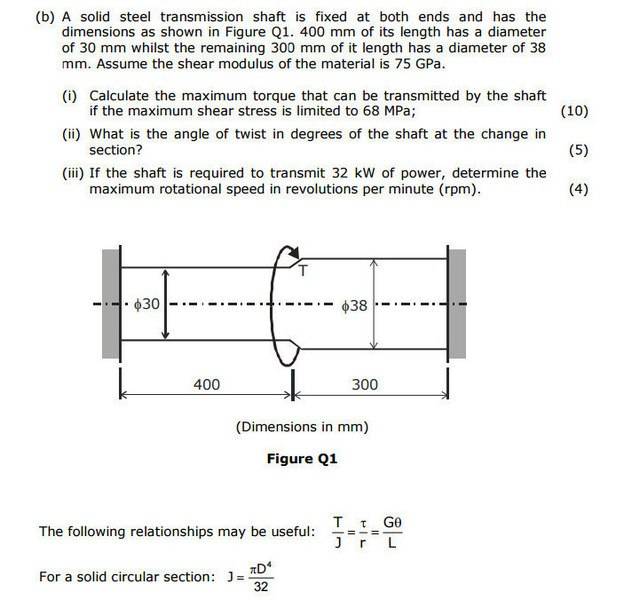
BmATM.jpg
 
Last edited:
Physics news on Phys.org
Show your working so we can see where you went wrong.
 
Just realized I was treating it as a series shaft and not parallel as it is.
 
smr101 said:
Just realized I was treating it as a series shaft and not parallel as it is.

Have edited OP, (b)(ii) now not making sense, thanks.
 
I've never heard of the terms series and parallel applied to a shaft but I would call each portion of the shaft in series with each other.

Which shaft section (long and thin or short and thick) will twist more under torque? What is the unit of angles in the equation you used? Ie was the conversion necessary?
 
billy_joule said:
I've never heard of the terms series and parallel applied to a shaft but I would call each portion of the shaft in series with each other.

Which shaft section (long and thin or short and thick) will twist more under torque? What is the unit of angles in the equation you used? Ie was the conversion necessary?

In parallel both ends are rigidly connected, in series only one is and torque is applied to the other end, so in this case it is parallel. In parallel total torque = T1 + T2 and angle of twist is equal for each section, so they will both have the same angle of twist.

Yes the conversion was necessary, the answer is converted from rads to degrees.

Still not getting the correct answer though!
 
Oh i see, I didn't notice the torque is applied in the centre.
You need to consider both sections simultaneously and with the appropriate constraints, in your attempt you found the twist if the thin section didn't exist.
Note that each section won't support the same torque load.
 
billy_joule said:
Oh i see, I didn't notice the torque is applied in the centre.
You need to consider both sections simultaneously and with the appropriate constraints, in your attempt you found the twist if the thin section didn't exist.
Note that each section won't support the same torque load.

Ok, so I should use the total length?

I am under the impression the angle of twist of one section is the same as the other, so why do they need to both be taken into account? Should one sections not be enough?
 
How did you solve the first question? The approach should be similar to that.

smr101 said:
Ok, so I should use the total length?

I am under the impression the angle of twist of one section is the same as the other, so why do they need to both be taken into account? Should one sections not be enough?
Imagine a weight hanging from two different ropes in parallel, the max weight is more than either of the two ropes can take alone. But how much more? All we know is both ropes must be stretched the same distance when one (and only one) breaks. To find the max stretch (or breaking load) you need to consider both ropes together, they share the load but not equally.
That's analogous to your shaft. You'll need to form an equation for each section of the shaft and solve them simultaneously.
 
  • #10
billy_joule said:
How did you solve the first question? The approach should be similar to that.Imagine a weight hanging from two different ropes in parallel, the max weight is more than either of the two ropes can take alone. But how much more? All we know is both ropes must be stretched the same distance when one (and only one) breaks. To find the max stretch (or breaking load) you need to consider both ropes together, they share the load but not equally.
That's analogous to your shaft. You'll need to form an equation for each section of the shaft and solve them simultaneously.

Have you done this question and got the correct solution yourself?

I've individually got the angle of twist for each using TL/JG.

The 400 mm section = 0.0242 rads using T = 360.5 Nm and 300 mm section = 0.01431 rads. Not sure where to go from here.

Worked out T and J individually for each part using the equations given in the question.
 
  • #11
smr101 said:
Have you done this question and got the correct solution yourself?
No, not yet. I'm hoping it won't need to come to that :smile:
I've individually got the angle of twist for each using TL/JG.

The 400 mm section = 0.0242 rads using T = 360.5 Nm and 300 mm section = 0.01431 rads. Not sure where to go from here.

Worked out T and J individually for each part using the equations given in the question.
That doesn't make sense. In post #6, you already correctly recognised that the angle of twist is the same for each section, and now you're saying they're different?

Lets go back to what you said in #6, we know:
θL = θR =θ (let L be the left section and R be the right)

And we know:

θL = TLLL / GJL

θR = TRLR / GJR

and so:
θ = TLLL / GJL = TRLR / GJR

If you've done Q i) correctly you know all the variables* except θ so just plug and chug.

*You may not know TR and TL individually but you do know their sum as you mentioned in #6.
 
  • #12
billy_joule said:
No, not yet. I'm hoping it won't need to come to that :smile:

That doesn't make sense. In post #6, you already correctly recognised that the angle of twist is the same for each section, and now you're saying they're different?

Lets go back to what you said in #6, we know:
θL = θR =θ (let L be the left section and R be the right)

And we know:

θL = TLLL / GJL

θR = TRLR / GJR

and so:
θ = TLLL / GJL = TRLR / GJR

If you've done Q i) correctly you know all the variables* except θ so just plug and chug.

*You may not know TR and TL individually but you do know their sum as you mentioned in #6.

So without the individual torques how do I incorporate the sum into the equation?
 
  • #13
That's why I asked this:
billy_joule said:
How did you solve the first question?
Once you've solve Q i) it should be trivial to find the torque in each section.
 
  • #14
billy_joule said:
That's why I asked this:

Once you've solve Q i) it should be trivial to find the torque in each section.

I do have the torque for each section, yes.

Still not getting the correct solution though. I'll take you through what I've done:

I have JL = 7.952 x 10^-8 and JR = 2.047 x 10^-7.

I have TR = shear stress * JR/ radius of right hand side = 732.6 Nm

I then calculated TL = (LR*JL / LL*JR) * TR
TL = 213.4 Nm

TL + TR = 946 Nm which is the correct solution for (i). So I know all number up to this point are correct as they fit with the solution for part (i).

Those are all the figures needed for the angle of twist plus the given value G = 75GPa and LL = 0.4 m and LR = 0.3 m.

Using those figures I'm not getting the correct solution.
 
  • #15
smr101 said:
I do have the torque for each section, yes.

Still not getting the correct solution though. I'll take you through what I've done:

I have JL = 7.952 x 10^-8 and JR = 2.047 x 10^-7.

I have TR = shear stress * JR/ radius of right hand side = 732.6 Nm

I then calculated TL = (LR*JL / LL*JR) * TR
TL = 213.4 Nm

TL + TR = 946 Nm which is the correct solution for (i). So I know all number up to this point are correct as they fit with the solution for part (i).
The given solution is wrong. You've found the max torque for each shaft section in isolation without considering the constraint that they must both twist the same angle. It would be a rare coincidence if both shaft sections happened to reach their max torque at the same twist angle. This is what I was trying to illustrate with my parallel rope analogy-one shaft will break before the other (except for two special cases: a certain ratio for L & r for each shaft and of course, identical shafts)

You can show the first answer is wrong by calculating the torque required to reach the twist angle in the 2nd given answer, you will find they do not match the torque value in the previous answer - the answers are contradictory.
 

Similar threads

  • · Replies 60 ·
3
Replies
60
Views
4K
Replies
13
Views
8K
  • · Replies 7 ·
Replies
7
Views
3K
  • · Replies 7 ·
Replies
7
Views
14K
  • · Replies 2 ·
Replies
2
Views
2K
  • · Replies 7 ·
Replies
7
Views
4K
  • · Replies 26 ·
Replies
26
Views
23K
  • · Replies 11 ·
Replies
11
Views
3K
  • · Replies 1 ·
Replies
1
Views
2K
  • · Replies 8 ·
Replies
8
Views
7K