How can you make a free body diagram for someone running then sliding?

Click For Summary
SUMMARY

The discussion focuses on creating a free body diagram for a bike sliding sideways after a sharp turn. Key forces identified include the normal force, friction force, and the weight acting at the center of mass. The participants emphasize the importance of calculating torque around the wheel-contact point and suggest considering a fixed point on the ground for accurate torque analysis. The conversation highlights the precarious balance of forces during sliding, drawing parallels to similar scenarios in ice skating and motorcycle riding.

PREREQUISITES
  • Understanding of free body diagrams
  • Knowledge of torque and angular momentum
  • Familiarity with forces acting on a sliding object
  • Basic principles of friction in physics
NEXT STEPS
  • Study the principles of torque in dynamic systems
  • Learn about the effects of friction on sliding objects
  • Explore free body diagram techniques for complex motion scenarios
  • Investigate angular momentum and its implications in physics
USEFUL FOR

Physics students, mechanical engineers, and anyone interested in understanding the dynamics of sliding motion and force balance in real-world scenarios.

amama
Messages
7
Reaction score
1
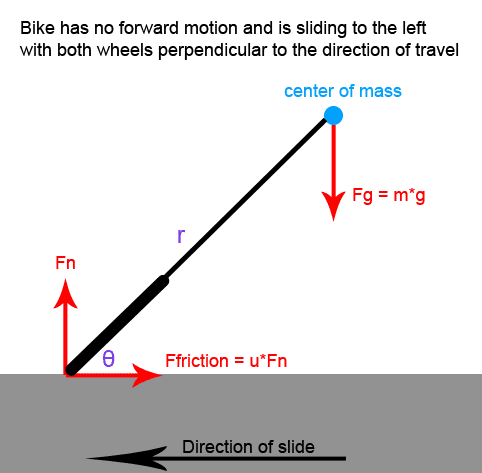
Let's say you are riding a bike very fast, and then you sharply turn into a slide (where the bike is sliding perfectly sideways).
bike sliding diagram.png


I'm trying to calculate the angle that the bike would be leaning at, but I'm having trouble creating the free body diagram.

Right now I have the normal force and friction force drawn where the wheels touch the ground. I also have the force from the weight drawn at the center of mass.

The approach I took is to calculate the torque around the wheel-contact point (pivot point) and set it equal to zero. However, right now, the only torque around the contact point is from the force of the weight, and there is nothing counteracting it, so the bike would fall. I would have guessed that the force of the friction would provide the force holding the bike up, but it doesn't provide any torque around the pivot point.

I'm guessing that I'm either missing a force or incorrectly locating the pivot point. Does anyone know where my error is?
 
Last edited:
Physics news on Phys.org
If the pivot point is the wheel, then that is accelerating. It's not a fixed point in any inertial reference frame. Instead, you could consider the torque about any fixed point on the ground.
 
  • Like
Likes   Reactions: 256bits
PeroK said:
If the pivot point is the wheel, then that is accelerating. It's not a fixed point in any inertial reference frame. Instead, you could consider the torque about any fixed point on the ground.
Thanks for the response. I might need to dig out my textbook since I don't remember all the nuances of torque. But if I set the reference point on the ground, I still don't see where the force holding the weight up would come from. Wouldn't the torque from the friction force still always be zero?

I added a diagram.
 
You may be able to keep a brief balance between the braking effect of the sliding tires and the negative acceleration of the center of mass.
The vertical distance between the contact patches of the tires and the combined center of mass of the bike-rider induces a brief CCW moment in your case.

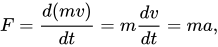
The rate of change of momentum is equivalent to a instantaneous force and subsequent moment.
If at all possible, that balance would be very brief and precarious.

{\displaystyle F={\frac {d(mv)}{dt}}=m{\frac {dv}{dt}}=ma,}


With not forward turning movement inducing a centrifugal force, the sliding bike and rider will hit the ground very quickly.

ImpishAridChick-size_restricted.gif


86409906.gif


R.gif
 
Last edited:
  • Like
Likes   Reactions: 256bits
amama said:
Thanks for the response. I might need to dig out my textbook since I don't remember all the nuances of torque. But if I set the reference point on the ground, I still don't see where the force holding the weight up would come from. Wouldn't the torque from the friction force still always be zero?

I added a diagram.
Just to give you a different perspective.
Take a broom, or yardstick, and balance it on a finger.
Now let it tip over a bit.
How much acceleration should your finger have so that the broom does not fall completely over.
 
  • Like
Likes   Reactions: PeroK and Lnewqban
Lnewqban said:
With not forward turning movement inducing a centrifugal force, the sliding bike and rider will hit the ground very quickly.

ImpishAridChick-size_restricted.gif


View attachment 293217

View attachment 293218
Another way to think of the problem would be to imagine someone doing the hockey stop on ice skates. They won't be vertical when they do it, instead they will be at an angle.


You can also do it rollerblading

 
Note that there must be sufficient friction between skates and ice to induce the negative deceleration.
The lean angle balances forces and moments during braking time in such a way that the line of direction of the resultant force passes through the center of mass of the skater and the edge of the skates.

From own experience with motorcycles I can tell you that lack of friction force puts you on the ground surprisingly quick.

Please, see:
https://en.wikipedia.org/wiki/Impulse_(physics)

http://hyperphysics.phy-astr.gsu.edu/hbase/impulse.html
nU4eQ.jpg
 
Last edited:
amama said:
Thanks for the response. I might need to dig out my textbook since I don't remember all the nuances of torque. But if I set the reference point on the ground, I still don't see where the force holding the weight up would come from. Wouldn't the torque from the friction force still always be zero?

I added a diagram.
Consider an object falling under gravity. Perhaps a rod of length ##l## falling in the horizontal position. The torque about one end of the rod would be ##mg\frac l 2##. Should the rod rotate due to that torque? But, equally, there is the same torque about the other end of the rod.

The resolution is that as the rod is accelerating, then the angular momentum about either end of the rod is increasing - a change in angular momentum does not imply rotation. In this case, the accelerating linear motion of the centre of mass represents a change in angular momentum about any point not on the vertical line through the centre of mass.

In your case, if the normal force is also ##mg##, then there is a torque and hence change in angular momentum about the point of contact. But, that change in angular momentum may represent the deceleration of the centre of mass about that point of contact - if the angle is just right.

PS although it is an unstable solution.
 
  • Like
Likes   Reactions: Lnewqban

Similar threads

  • · Replies 8 ·
Replies
8
Views
2K
  • · Replies 3 ·
Replies
3
Views
1K
  • · Replies 3 ·
Replies
3
Views
4K
  • · Replies 14 ·
Replies
14
Views
3K
  • · Replies 2 ·
Replies
2
Views
2K
  • · Replies 32 ·
2
Replies
32
Views
8K
  • · Replies 6 ·
Replies
6
Views
3K
  • · Replies 81 ·
3
Replies
81
Views
14K
  • · Replies 5 ·
Replies
5
Views
7K
  • · Replies 2 ·
Replies
2
Views
2K