Undergrad How could Euler have gone about creating his buckling formula?

Click For Summary
SUMMARY

Euler's buckling formula, which calculates the critical load on a column under longitudinal compression, is derived from principles of beam theory and involves key variables such as the modulus of elasticity, area moment of inertia, and effective length factor. The discussion emphasizes that Euler's success stemmed from a combination of innate talent and relentless dedication to hard work, as evidenced by his continued contributions to science despite becoming blind. Resources such as the Wikipedia page on Euler column buckling and mathematical derivations available on arXiv provide further insights into the formula's derivation and assumptions.

PREREQUISITES
  • Understanding of Euler's critical load in structural engineering
  • Familiarity with modulus of elasticity in materials science
  • Knowledge of area moment of inertia in mechanics
  • Basic principles of beam theory
NEXT STEPS
  • Research the derivation of Euler's buckling formula on Wikipedia
  • Study the assumptions involved in Euler's column buckling analysis
  • Explore the application of Euler columns in mechanical design
  • Read the mathematical derivation of Euler's solutions on arXiv
USEFUL FOR

Engineers, mathematicians, and students in structural and mechanical engineering who are interested in the historical context and mathematical foundations of buckling theory.

musicgold
Messages
303
Reaction score
19
TL;DR
How do some scientist go about finding seemingly simple and elegant formulas to describe complicated situations?
Admittedly Euler was a genius and I am a noob, but I sometimes feel that there must have been a method or process that he followed to go about such problems and came up with these elegant solutions. It couldn't have been just a sudden flash of genius. For example, I wonder how he could have come up with the pi factor or why a square and not a cube for the denominator. If I were to grapple with a `100 times simpler problem, how could I go about creating a formula?
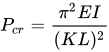
{\displaystyle P_{cr}={\frac {\pi ^{2}EI}{(KL)^{2}}}}

where
{\displaystyle P_{cr}}
, Euler's critical load (longitudinal compression load on column),
E
, modulus of elasticity of column material,
I
, minimum area moment of inertia of the cross section of the column,
L
, unsupported length of column,
K
, column effective length factor
 
Last edited:
  • Like
Likes Delta2
Physics news on Phys.org
I don't know this specific formula, i assume its something from beam theory which i am not good at. But anyway I believe the method or process that Euler followed was simply his commitment and dedication to hard work. Einstein said that genius is 99% hard work and only 1% talent. Certainly Euler had that 1% talent factor but his hard work is indisputable. Even when Euler got totally blind from both eyes, he didn't stop working for science, discovering new things. So i just think that was his secret process/method, serious and hard work.
 
  • Like
Likes Lnewqban
There is a mathematical derivation for that formula. Search Euler column buckling. The Wikipedia link has a derivation that looks like something I saw in a strength of materials class a long time ago, then promptly forgot. Note also the assumptions that go into it.

BTW, I once used an Euler column as an overload spring in a machine. We needed a light weight pushrod that would buckle with a force of about 8 lbs. The Euler column formula really does work. The pushrod was designed for 8 lbs, and it buckled at 8 lbs.
 
  • Like
Likes vanhees71, etotheipi and Paul Colby
In sci-fi when an author is talking about space travellers or describing the movement of galaxies they will say something like “movement in space only means anything in relation to another object”. Examples of this would be, a space ship moving away from earth at 100 km/s, or 2 galaxies moving towards each other at one light year per century. I think it would make it easier to describe movement in space if we had three axis that we all agree on and we used 0 km/s relative to the speed of...

Similar threads

Replies
1
Views
3K
  • · Replies 9 ·
Replies
9
Views
1K
  • · Replies 2 ·
Replies
2
Views
2K
Replies
8
Views
49K
  • · Replies 5 ·
Replies
5
Views
2K
Replies
8
Views
14K
  • · Replies 1 ·
Replies
1
Views
2K
Replies
13
Views
5K
  • · Replies 11 ·
Replies
11
Views
2K
Replies
3
Views
2K