Ziga Casar
- 4
- 0
Hello guys,
I have a problem and I don't know how to solve it properly ...
So I have this situation:
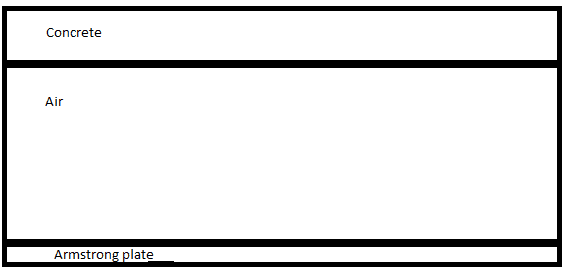
And I must calculate the heat transfer (Q) through it ...
I know that the Indoor Temperature is 21C and the outdoor Temperature is 0C, I also know the following data for all layers:
Concrete: d (thickes) = 0.4m, k (Thermal conductivity) = 1.10 W/mK
Air: d = 2.25m, k = 0.0244 W/mK
Armstrong plate: d = 0.015m, k = 0.06 W/mK
And the surface is S = 731.9 m^2
I know I should calculate through this expression: Q = U S (T1-T2) and 1/U = SUM(d/k) = SUM(1/alpha)
the sum of d/k is no problem but for sum of 1/alpha, I do not know hot to calculate the alphas (Convection coefficient), because there is one alpha from air to Armstrong and one alpha from concrete to air (Or are there 2 alphas for each because the temperature under Armstrong plate is higher that the temperature above the Armstrong plate ...?)
So here is the problem, because there is a natural motion of air and a big horizontal plate I do not know hot to calculate the alphas... Can somebody please help me?
I have a problem and I don't know how to solve it properly ...
So I have this situation:
And I must calculate the heat transfer (Q) through it ...
I know that the Indoor Temperature is 21C and the outdoor Temperature is 0C, I also know the following data for all layers:
Concrete: d (thickes) = 0.4m, k (Thermal conductivity) = 1.10 W/mK
Air: d = 2.25m, k = 0.0244 W/mK
Armstrong plate: d = 0.015m, k = 0.06 W/mK
And the surface is S = 731.9 m^2
I know I should calculate through this expression: Q = U S (T1-T2) and 1/U = SUM(d/k) = SUM(1/alpha)
the sum of d/k is no problem but for sum of 1/alpha, I do not know hot to calculate the alphas (Convection coefficient), because there is one alpha from air to Armstrong and one alpha from concrete to air (Or are there 2 alphas for each because the temperature under Armstrong plate is higher that the temperature above the Armstrong plate ...?)
So here is the problem, because there is a natural motion of air and a big horizontal plate I do not know hot to calculate the alphas... Can somebody please help me?