How do I calculate the tension on top of a pole?

  • Thread starter Thread starter telephonedude
  • Start date Start date
  • Tags Tags
    Pole Tension
Click For Summary
SUMMARY

The discussion centers on calculating the tension exerted on a 1-meter steel pole with a 10-centimeter diameter when a 5-kilogram cement block is placed on top. It is established that if the block is perfectly balanced, there is no tension, only compression, as the pole experiences compressive forces equal to the weight of the block. The problem is categorized as a “column stability” issue, highlighting that the slenderness ratio of the pole (70 diameters) affects its stability and potential swaying behavior.

PREREQUISITES
  • Understanding of basic physics principles, specifically forces and tension
  • Knowledge of column stability and buckling concepts
  • Familiarity with material properties of steel and cement
  • Basic calculations involving weight and compression
NEXT STEPS
  • Research the principles of column stability and buckling in structural engineering
  • Learn about the material properties of steel and how they relate to load-bearing capacity
  • Explore the effects of slenderness ratios on structural stability
  • Investigate methods for calculating compressive forces in structural elements
USEFUL FOR

Structural engineers, physics students, and anyone involved in designing or analyzing load-bearing structures will benefit from this discussion.

telephonedude
Messages
1
Reaction score
0
TL;DR
How do I calculate the tension of a cement block on top of a steel pole. Please bear with me, I am not that proficient with math but I am eager to learn.
Let's say I have a 1 meter steel pole with a diameter of 10 centimeters standing upright, and I have a cement block of 30 cm length and 10 cm width and an assumed weight of 5 kilograms.

If I place the cement block on top of the steel pole, assuming that neither the pole or the cement block tips how much tension would it be exerting onto the steel pole? And how much tension can the steel pole take until it starts to bend or break?
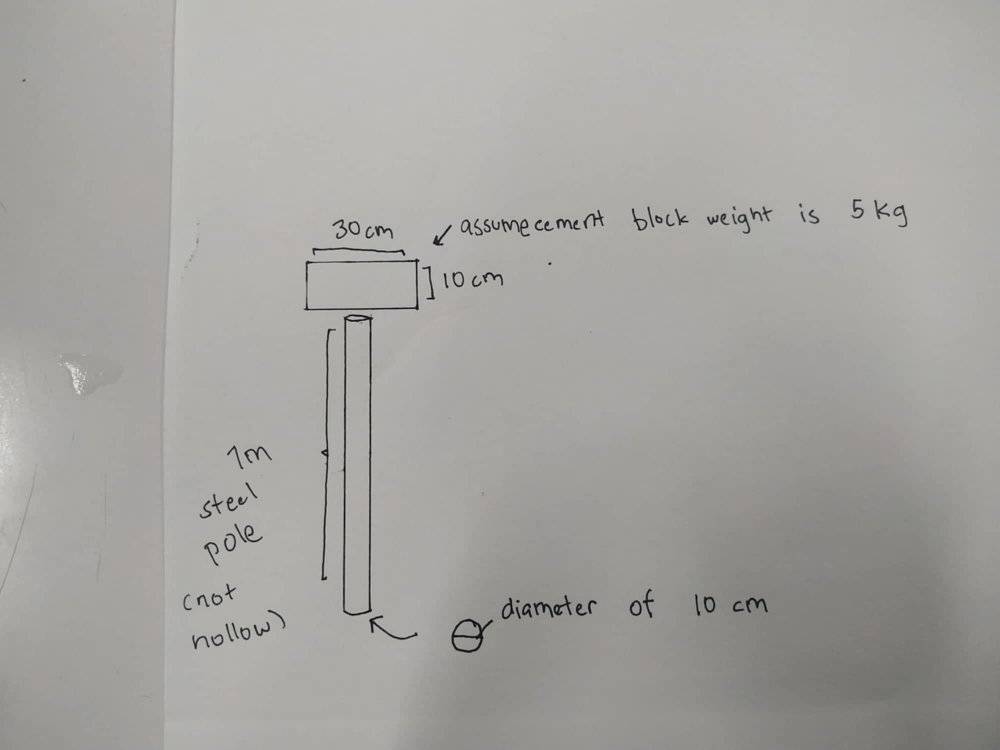
73342356_419435188747710_345217170466144256_n.jpg
 
Engineering news on Phys.org
Zero. If the block is perfectly balanced, there is no tension in this situation, only compression.
 
Last edited:
Welcome to PF.
This question is best classed as a “column stability” problem.
Here the column height is 70 diameters, so it is a slender column.
There will be a small tension on one side of the column and much greater compression on the other.
It may sway like an inverted pendulum.
https://en.wikipedia.org/wiki/Buckling#Columns
 
Compressión will be equal to weight of cement block, doesn't it? It will be 5kg
 
JackMit said:
Compressión will be equal to weight of cement block, doesn't it? It will be 5kg
The compression at the bottom of the pole will include the weight of the solid pole.
 

Similar threads

  • · Replies 1 ·
Replies
1
Views
1K
  • · Replies 56 ·
2
Replies
56
Views
9K
  • · Replies 27 ·
Replies
27
Views
6K
Replies
2
Views
2K
  • · Replies 15 ·
Replies
15
Views
4K
  • · Replies 7 ·
Replies
7
Views
3K
Replies
3
Views
2K
  • · Replies 4 ·
Replies
4
Views
2K
  • · Replies 22 ·
Replies
22
Views
6K
  • · Replies 3 ·
Replies
3
Views
6K