How do I find the frequency, speed and direction of a wave

Join the discussion
Registration is free. Start your own thread to ask a follow-up.
4 replies · 1K views
therealist
Messages
1
Reaction score
1
Homework Statement
How do I find frequency, speed and direction of a wave
Relevant Equations
Not sure what to write here
Hey I am trying to learn how waves move in time and I am not sure how to solve the following question. Can someone please guide me through it.
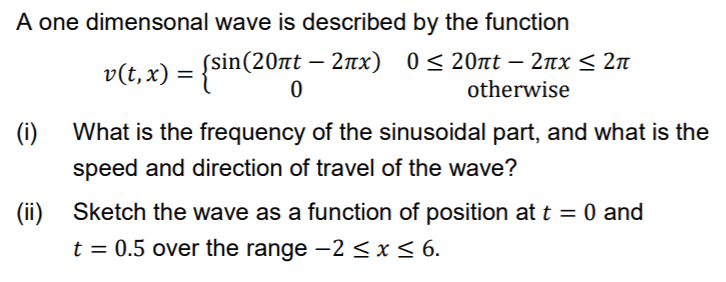
1589550063960.png
 
  • Like
Likes   Reactions: Delta2
Physics news on Phys.org
Hello real one, :welcome: !

Short answer: No. PF guidelines forbid us to assist. First you have to make an effort to solve and post it. Shows us what you know already and helps us to help you do the exercise.

Surely you can do first part of ii) for ##t=0## !
 
  • Like
Likes   Reactions: Delta2
therealist said:
Homework Statement:: How do I find frequency, speed and direction of a wave
Relevant Equations:: Not sure what to write here

Hey I am trying to learn how waves move in time and I am not sure how to solve the following question. Can someone please guide me through it. View attachment 262812

In your text or lecture notes, there SHOULD be wave equation in a GENERIC form that connects x(t) to v(t,x). So do "reverse engineering" and get x(t) from v(t,x), assuming that you are either given the form outright, or you have to do some sort of integration.

Otherwise, as BvU has stated, you are asking us to do the work for you, and this is forbidden on PF. This forum is not Chegg.

Zz.
 
I ll try to help to give you a jump start, though as @BvU said you should have post your attempt before you receive any help cause that's a basic rule here in physics forums.

It should be in your book or notes that the general equation for a harmonic one dimensional wave propagating over the x-axis is
$$v(x,t)=v_0\sin(2\pi ft-\frac{2\pi}{\lambda}x)$$
where ##f## is the frequency of the wave, ##\lambda## is the wavelength of wave and ##c=\lambda f## is the speed of the wave. (and ##v_0## is the amplitude of the wave.)

So by comparing the general equation and the equation you are given what can you deduce for the values of ##f##,##\lambda## and ##c##?
 
Last edited:
  • Like
Likes   Reactions: etotheipi
To see why the equation has the form @Delta2 mentioned, you might consider what effect incrementing the time by the time period ##T## or incrementing the ##x## coordinate by the wavelength ##\lambda## has on the phase. For instance, can you figure out what ##\omega T## equals if ##v(x, t) = v(x, t+T)##?
 
Last edited by a moderator: