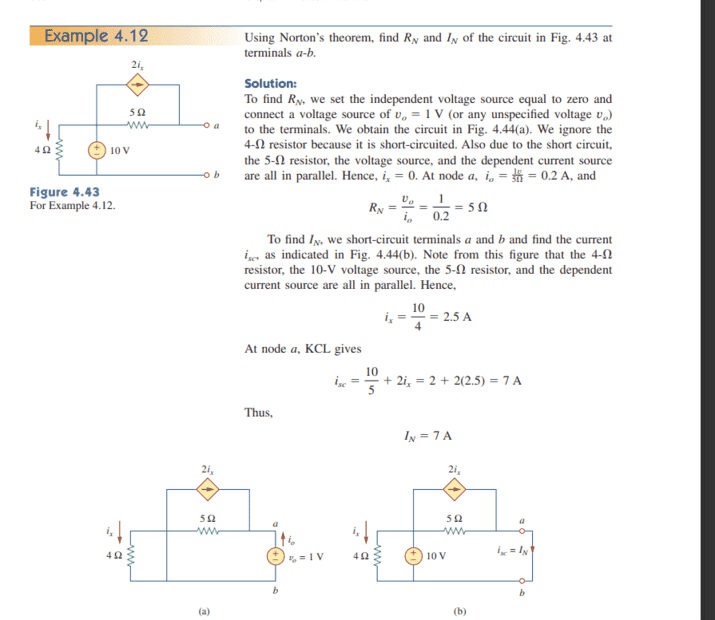
How do I know that ##i_x = 0## ?

  • Context: Engineering 
  • Thread starter Thread starter link223
  • Start date Start date
Click For Summary
SUMMARY

The discussion clarifies that when a resistor, such as a 4-ohm resistor, is short-circuited, it does not change its resistance value; rather, it results in zero current flowing through it. The voltage across the 4-ohm resistor remains zero due to the presence of the short circuit, confirming that the resistor remains intact while the current is effectively bypassed. Participants emphasized the distinction between the physical state of the resistor and the electrical behavior in the circuit.

PREREQUISITES
  • Understanding of basic electrical circuit concepts
  • Knowledge of Ohm's Law
  • Familiarity with series and parallel circuit configurations
  • Concept of short circuits in electrical engineering
NEXT STEPS
  • Study the implications of short circuits in electrical circuits
  • Learn about the behavior of resistors in parallel configurations
  • Explore circuit analysis techniques using Kirchhoff's laws
  • Investigate the effects of different resistor values in short-circuited scenarios
USEFUL FOR

Electrical engineering students, circuit designers, and anyone interested in understanding the behavior of resistors in electrical circuits.

link223
Messages
70
Reaction score
12
Homework Statement
How do I know that ##i_x = 0 ~ ?## Is it because of the fact that resistor, source and dependent current source are in parallel? If that is not the reason, what is?

Thanks in advance.
Relevant Equations
Norton's theorem
I was first thinking that i_x is zero because the 4 ohms resistor can be ignored because it is parallel with a short circuit, but I assumed that only the resistance is zero whilst i_x flows through and that is what'd make the voltage across 4-ohms resistor to be zero.
1650710254845.png
 
Physics news on Phys.org
In figure 4.44(a), the voltage across the 4-ohm resistor is zero. Therefore, there is no current flowing through the 4-ohm resistor. The resistance of that 4-ohm resistor has not changed. It is simply short-circuited.
 
  • Love
Likes   Reactions: link223
Ahaaa got it, thank you!
Just to make sure, So when I have a short circuit parallel to a resistor, the resistor will basically always stay intact, whilst the current will be zero on the other hand.

I was kind of confused, because we say the 4-ohms resistor is short-circuited from which I derive that it acts as a short circuit i.e. current can freely run through that branch(/resistor) which is basically not the case at all.
 

Similar threads

Replies
15
Views
2K
  • · Replies 3 ·
Replies
3
Views
2K
Replies
3
Views
2K
  • · Replies 9 ·
Replies
9
Views
2K
  • · Replies 3 ·
Replies
3
Views
2K
  • · Replies 13 ·
Replies
13
Views
2K
  • · Replies 3 ·
Replies
3
Views
8K
  • · Replies 7 ·
Replies
7
Views
3K
  • · Replies 10 ·
Replies
10
Views
4K
  • · Replies 15 ·
Replies
15
Views
2K