SUMMARY
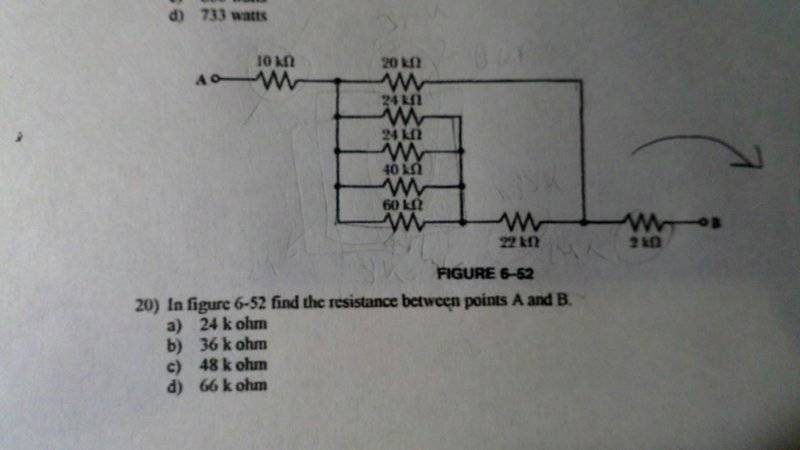
The discussion focuses on solving a combination circuit involving resistors of various values, specifically 10kΩ, 20kΩ, 22kΩ, 24kΩ, 2kΩ, 40kΩ, and 60kΩ. Participants detail their methods for calculating total resistance by first combining resistors in parallel and then adding series resistances. The correct approach involves calculating the parallel resistances to obtain a single value before adding series resistances, ultimately leading to the correct total resistance. Miscalculations and misunderstandings about the order of operations are highlighted, emphasizing the importance of systematic problem-solving in circuit analysis.
PREREQUISITES
- Understanding of Ohm's Law
- Knowledge of series and parallel resistor combinations
- Familiarity with resistor values and their symbols
- Basic circuit analysis skills
NEXT STEPS
- Study the principles of series and parallel circuits in detail
- Learn how to calculate total resistance in complex circuits
- Explore circuit simulation tools like LTspice for practical applications
- Review common mistakes in circuit calculations and how to avoid them
USEFUL FOR
Electronics students, hobbyists working with circuits, and anyone involved in circuit design or analysis will benefit from this discussion.