How Do You Apply the Washer Method Correctly?

  • Context: MHB 
  • Thread starter Thread starter stripedcat
  • Start date Start date
  • Tags Tags
    Method Shell
Click For Summary
SUMMARY

The discussion focuses on the application of the Washer Method for calculating the volume of solids of revolution, specifically when rotating around the x-axis and y-axis. The correct outer and inner radius functions are established as R(y) = 5 + y and r(y) = 2 for the x-axis, and R(y) = 5 - y for the y-axis. The volume is calculated using the integral V = π∫(5 - x)² - 4 dx, leading to a final volume of 27π. The conversation highlights the importance of correctly identifying the axis of rotation and the corresponding integral setup.

PREREQUISITES
  • Understanding of the Washer Method for volume calculation
  • Familiarity with integral calculus, specifically volume integrals
  • Knowledge of functions and their graphical representations
  • Ability to differentiate between the x-axis and y-axis rotations in solids of revolution
NEXT STEPS
  • Study the Shell Method for volume calculation in solids of revolution
  • Practice setting up integrals for different axes of rotation
  • Review the concept of cross-sections in volume calculations
  • Explore common errors in volume calculations and how to avoid them
USEFUL FOR

Students and educators in calculus, particularly those focusing on volume calculations of solids of revolution, as well as anyone seeking to clarify the Washer and Shell Methods.

stripedcat
Messages
44
Reaction score
0
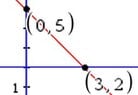
Just doing the Washer Method for now, once that's sorted out I'm going to see if I can do the Shell Method. I just want to be sure I'm doing this right here.

View attachment 2649

That's x=0, y=2, y=5-x

This is around the X-Axis.

R(y) = 5+y, r(y)=2

Assuming that part is at least correct. The integral goes from 2 to 5.

[math]\pi \int (5+y)^2 - (2)^2[/math]
[math]y^2+10y+21[/math]
[math]y^3/3+5y^2+21y[/math]

Then insert 5 and, solve, then the 2, solve, and subtract the 2 result from the 5 result, then the that result times pi?
 

Attachments

  • graph.jpg
    graph.jpg
    4.5 KB · Views: 122
Physics news on Phys.org
If you are rotating that region about the $x$-axis, your integral should be along the $x$-axis (using "$dx$").

The outer radius is going to be:

$R(x) = 5 - x$

and the inner radius is going to be:

$r(x) = 2$.

So each washer will have "volume":

$\pi((R(x))^2 - (r(x))^2)\ dx$

From your diagram, it appears we are integrating from $x = 0$ to $x = 3$, so the volume of the solid of revolution is:

$\displaystyle V = \pi\int_0^3 (5 - x)^2 - 4\ dx$

The integral you are trying to work out is revolution about the $y$-axis, so there is some confusion here, but even if it were about the $y$-axis, the integral you have listed is not correct.
 
One thing that may help is that you draw the cross-section "rectangle" that you are trying to integrate across. If you want to use washer/disk, the rectangle should be perpendicular to the axis of rotation. If you want to use shell method, it should be parallel.

If you evalulate the integral posted by Deveno, you get $27 \pi$.

You can check that if you use the shell method, you get:

\[
2\pi \int_a^b y h(y) dy = 2\pi \int_2^5 y (5-y) dy = 27 \pi
\]

The results are both equal.
 
Deveno said:
If you are rotating that region about the $x$-axis, your integral should be along the $x$-axis (using "$dx$").

The outer radius is going to be:

$R(x) = 5 - x$

and the inner radius is going to be:

$r(x) = 2$.

So each washer will have "volume":

$\pi((R(x))^2 - (r(x))^2)\ dx$

From your diagram, it appears we are integrating from $x = 0$ to $x = 3$, so the volume of the solid of revolution is:

$\displaystyle V = \pi\int_0^3 (5 - x)^2 - 4\ dx$

The integral you are trying to work out is revolution about the $y$-axis, so there is some confusion here, but even if it were about the $y$-axis, the integral you have listed is not correct.

It actually wants both, I just typo'd the X axis because it was the first one and I was sure on how to do that one.

It's valid for the Y axis then?
 
If we are rotating about the $y$-axis, we really ought to call it the "disk" method, because we don't have a "hole" in the middle.

In that case, we have: $R(y) = 5 - y$ and our volume element is:

$\pi(R(y))^2 dy = \pi(5 - y)^2\ dy$, so that we have:

$\displaystyle V = \pi\int_2^5 (5 - y)^2\ dy$

which again, is not the integral you originally posted.
 
Hrm, well crap, my notes are wrong then. I somehow got the impression that rather than just solving y= 5 - x that you just reversed it, which would make it + instead of -. I'll have to re-watch the lecture.

EDIT: Oh fantastic, the lectures are wrong... Again.

Thank you for the help though. I'll be back once I email the instructor...

Again.

EDIT2:

How in the heck did I get the x-axis rotation right then? I was using faulty information and got lucky? My answer totally agrees with that above 27pi, which is the result of a x^3/3-5x^2+21x with a 3 plugged in for the x value.

And the lecture on arc length seems to have the same error as the shell method video... gah!
 
Last edited:

Similar threads

  • · Replies 1 ·
Replies
1
Views
2K
  • · Replies 2 ·
Replies
2
Views
1K
  • · Replies 3 ·
Replies
3
Views
3K
  • · Replies 1 ·
Replies
1
Views
2K
  • · Replies 1 ·
Replies
1
Views
3K
  • · Replies 4 ·
Replies
4
Views
4K
  • · Replies 2 ·
Replies
2
Views
3K
  • · Replies 1 ·
Replies
1
Views
3K
  • · Replies 5 ·
Replies
5
Views
3K
  • · Replies 1 ·
Replies
1
Views
2K