How Do You Calculate Elastic Modulus from Stress and Strain Data?

  • Thread starter Thread starter Matthew Heywood
  • Start date Start date
  • Tags Tags
    Mechanics
Click For Summary
SUMMARY

The discussion focuses on calculating the elastic modulus (E) from stress and strain data, specifically using the bending stress formula σ = My/I. The user has derived the bending stress as σ = 3PL/2bd², where P is the load, L is the length, b is the width, and d is the depth of the beam. The user seeks clarification on how to relate this to the elastic modulus, given that E = σ/ε and ε = y/R, where y is the distance from the neutral axis and R is the radius of curvature.

PREREQUISITES
  • Understanding of bending moment and shear force diagrams
  • Familiarity with the concepts of stress and strain in materials
  • Knowledge of the second moment of area (I) for cross-sections
  • Basic principles of material mechanics, particularly elastic behavior
NEXT STEPS
  • Research the calculation of the second moment of area (I) for various cross-sectional shapes
  • Study the relationship between bending stress and elastic modulus in material mechanics
  • Explore the derivation of the elastic modulus from experimental stress-strain data
  • Learn about the implications of material yielding on stress calculations
USEFUL FOR

Mechanical engineers, materials scientists, and students studying structural analysis or material mechanics will benefit from this discussion, particularly those interested in calculating elastic properties from experimental data.

Matthew Heywood
Messages
25
Reaction score
0
Hello

I've attached the question as a JPEG, and I need some help with part b. I've completed part A and got the results:

at x=0: Q= 0 & P/2, M = 0
at x=L/2: Q = P/2 & -P/2, M = PL/4
at x=L: Q = -P/2 & 0, M = 0
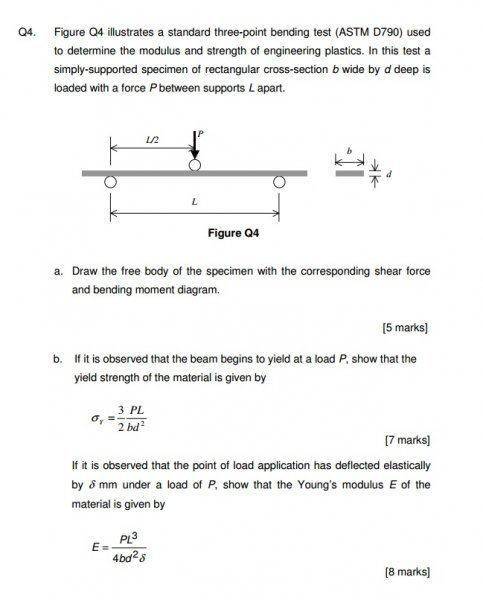
Q4.jpg

Any help will be appreciated. Thanks!

Edit: Had to edit so my results from A were more readable. Sorry.
 
Physics news on Phys.org
Your diagram is correct from what I remember it should look like.

For the second part, the bending moment diagram you drew would give you the maximum bending moment. How would you find the second moment of area I for the cross-section and how do the bending moment and the second moment of area relate to the bending stress?

If the material begins to yield, then your bending stress is equal to what strength?
 
Thank you for the reply.

So σ = My/I: M = PL/4, I = bd3/12 and y = d/2
∴ σ = (PL/4)(d/2) / bd3/12 = 12(PL/4)d / 2bd3 = 3PL/2bd2

Thanks!

How would I then proceed to calculate E in that form? E = σ/ε and ε = y/R ?
 

Similar threads

Replies
3
Views
3K
  • · Replies 6 ·
Replies
6
Views
2K
  • · Replies 53 ·
2
Replies
53
Views
10K
  • · Replies 3 ·
Replies
3
Views
2K
  • · Replies 5 ·
Replies
5
Views
2K
  • · Replies 3 ·
Replies
3
Views
5K
  • · Replies 5 ·
Replies
5
Views
10K
Replies
4
Views
3K
Replies
4
Views
4K
  • · Replies 14 ·
Replies
14
Views
2K