How Do You Calculate Elastic Modulus and Strengths from a Stress-Strain Curve?

Click For Summary

Discussion Overview

The discussion revolves around calculating various mechanical properties from a stress-strain curve, specifically focusing on elastic modulus (Young’s modulus), yield strength, tensile strength, and elongation (both uniform and total). Participants are seeking clarification on how to derive these values from the curve and the definitions of the terms involved.

Discussion Character

  • Technical explanation
  • Conceptual clarification
  • Homework-related

Main Points Raised

  • One participant attempts to calculate Young’s modulus but expresses uncertainty about the correct value.
  • Another participant challenges the calculation of Young’s modulus and asks for definitions of the terms to ensure understanding.
  • A participant clarifies their understanding of yield and tensile strength but struggles with how to obtain original and final lengths for calculating elongation from the curve.
  • There is a mention of the elastic modulus being measured from the initial linear portion of the stress-strain curve, specifically from 0 to 0.02 strain, but confusion arises regarding its application to different materials.
  • Discussion includes a reference to the definition of 'engineering strain' and a suggestion to review external resources for clarification.
  • A participant notes that the 2% rule for estimating Young's modulus applies specifically to materials like aluminum, which do not exhibit a linear stress-strain relationship like steel does.

Areas of Agreement / Disagreement

Participants generally agree on the definitions of yield strength and tensile strength, but there is uncertainty and disagreement regarding the calculation of Young’s modulus and the application of the 2% rule to different materials. The discussion remains unresolved regarding the correct approach to finding lengths for elongation calculations.

Contextual Notes

Participants express limitations in their understanding of the definitions and calculations involved, particularly regarding the application of the 2% rule and the nature of the stress-strain curve for different materials. There is also a lack of consensus on how to derive certain values from the curve.

Name:riley
Messages
2
Reaction score
0
Hello I'm having trouble wrapping my head around finding things from stress strain curvesI need to find:
Elastic modulus (Young’s modulus)
•Yield strength
•Tensile strength
•Uniform and total elongation (ductility)
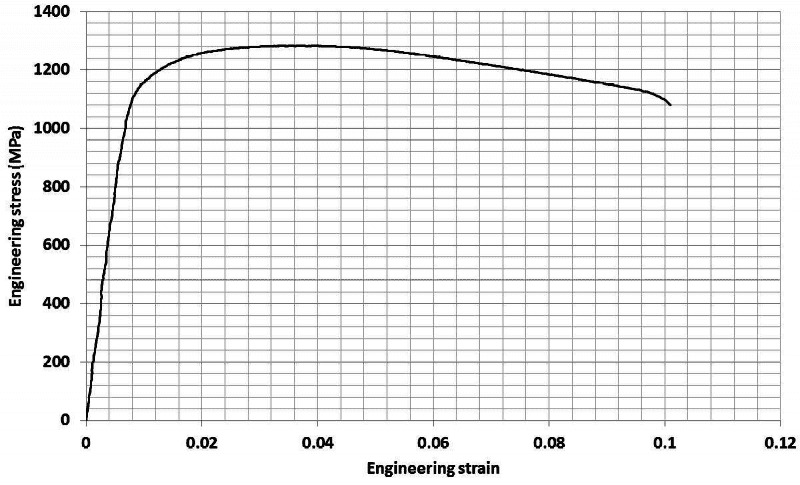
upload_2014-10-14_20-26-54.png


elastic modulus I think is 1240/0.02 = 62000

but I'm unsure of how to find the others.

Thank you to anyone who helps out.
 
Physics news on Phys.org
No, that is not the Youngs modulus.

Can you define any of the terms in your own words? i.e. do you know what you are looking for?
 
Thank you for your response

I am OK with yield and tensile strength it turns out.

I know what the elongation is and understand the formula Lf - Lo/Lo I just don't understand where to get the lengths from in the curve, I believe the strain is the elongation of the material but don't know where to get the original an final lengths from. Either from uniform at the 0.2% point or the total elongation.

The elastic modulus is the measure of the elasticity of the material, I know that is measured form 0 to 0.02 ( the 2% rule) of the strain as this is the beginning of the plastic region. As E= stress/strain I thought but it seems that's not the case.

I hope these explanations are satisfactory, I understand why you asked for them I guess I should have showed more of an effort to find the answers.
 
Last edited:
Name:riley said:
Thank you for your response

I am OK with yield and tensile strength it turns out.

I know what the elongation is and understand the formula Lf - Lo/Lo I just don't understand where to get the lengths from in the curve, I believe the strain is the elongation of the material but don't know where to get the original an final lengths from. Either from uniform at the 0.2% point or the total elongation.

You need to review the definition of 'engineering strain':

http://www.engineeringtoolbox.com/stress-strain-d_950.html

Scroll down until your reach the section titled 'Strain'.

The elastic modulus is the measure of the elasticity of the material, I know that is measured form 0 to 0.02 ( the 2% rule) of the strain as this is the beginning of the plastic region. As E= stress/strain I thought but it seems that's not the case.

This rule only applies to materials for which there is no region where Hooke's law applies, i.e., the stress is not a linear function of the strain anywhere on the stress-strain curve. Steel, for example, has a well-defined region where the stress-strain curve is linear; aluminum does not, and therefore the 2% rule is used to estimate Young's modulus for aluminum and aluminum alloys.
 

Similar threads

  • · Replies 5 ·
Replies
5
Views
10K
Replies
7
Views
8K
  • · Replies 3 ·
Replies
3
Views
5K
Replies
6
Views
88K
  • · Replies 53 ·
2
Replies
53
Views
10K
Replies
1
Views
2K
Replies
2
Views
2K
  • · Replies 5 ·
Replies
5
Views
2K
  • · Replies 19 ·
Replies
19
Views
4K
  • · Replies 2 ·
Replies
2
Views
6K