How Do You Calculate the Length of a Swinging Rod in a Physical Pendulum?

Click For Summary
SUMMARY

The length of a swinging rod acting as a physical pendulum can be calculated using the formula T = 2π * sqrt(I / mgh), where T is the period (1.74 s), g is the acceleration due to gravity (9.80 m/s²), and h is the distance from the pivot point to the center of mass. The moment of inertia (I) for a rod suspended from its end is I = (1/3)mL². Correctly substituting h as (2/3)L leads to the accurate calculation of the rod's length, which is approximately 4.51 m. Misunderstanding the relationship between h and L resulted in incorrect initial calculations.

PREREQUISITES
  • Understanding of physical pendulum dynamics
  • Familiarity with moment of inertia calculations
  • Basic algebra skills for rearranging equations
  • Knowledge of gravitational acceleration (g = 9.80 m/s²)
NEXT STEPS
  • Study the derivation of the physical pendulum formula
  • Learn about moment of inertia for various shapes
  • Explore the concept of center of mass in rigid bodies
  • Practice solving pendulum problems with different configurations
USEFUL FOR

Physics students, educators, and anyone interested in understanding the mechanics of pendulums and rigid body dynamics.

mikefitz
Messages
155
Reaction score
0
A rod suspended on its end and acting as a physical pendulum swings with a period of 1.74 s. What is its length? (g = 9.80 m/s2)

Ok so in order to solve this I need to use the physical pendulum formula:

T = 2Pi * sqrt (I / mgh) ==> I am looking for 'h'

To get 'h' I need to first calculate 'I' which requires mass for a rod.
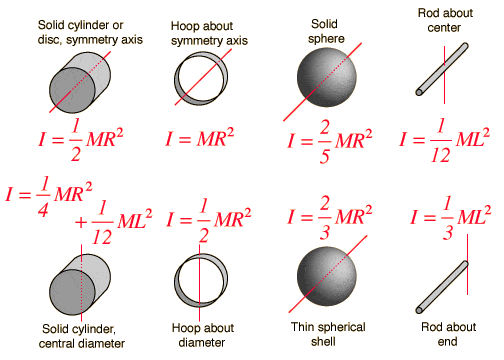
mic.gif


So, taking it from here I'm not sure where to begin. I've tried rearranging the formulas I've been given with no luck - any ideas?
 
Physics news on Phys.org
h is the distance from the pivot point to the center of mass of the rod. You can express that in terms of the length of the rod and you can express I in terms of the length of the rod.
 
Ok let me try this:
1.74=2Pi * sqrt ((1/12*mL^2) / (m*9.81*2L)
=> .27=sqrt((1/12L / 19.62))
1/12L = 1.504
L=~18m ??

This is wrong. I canceled out m and L in my early steps, did this throw my calculations off?
 
The stick is suspended from its end, not its middle.
 
1.74=2Pi * sqrt((1/3L^2) / (m(9.81)(2L)

*question: I haven't had algebra for a while, but you can just cancel the m's and cancel the L's, leaving only one 'L' in the numerator, correct?

If that assumption is correct I get L=4.51m - my book disagrees with this answer though; any idea why?
 
Looks like you are setting h = 2L, which isn't right. As OlderDan explained, h is the distance from the pivot point to the center of mass of the rod.
 

Similar threads

  • · Replies 9 ·
Replies
9
Views
2K
Replies
3
Views
2K
  • · Replies 14 ·
Replies
14
Views
2K
  • · Replies 27 ·
Replies
27
Views
2K
Replies
14
Views
2K
  • · Replies 3 ·
Replies
3
Views
4K
Replies
2
Views
2K
  • · Replies 6 ·
Replies
6
Views
4K
  • · Replies 19 ·
Replies
19
Views
3K
  • · Replies 4 ·
Replies
4
Views
2K