How Do You Calculate the Length of a Swinging Rod in a Physical Pendulum?

Click For Summary

Homework Help Overview

The discussion revolves around calculating the length of a rod acting as a physical pendulum, given its period and the acceleration due to gravity. Participants are exploring the relationships between the period, moment of inertia, and the geometry of the pendulum.

Discussion Character

  • Mixed

Approaches and Questions Raised

  • Participants are attempting to apply the physical pendulum formula and rearranging it to solve for the length of the rod. There are discussions about the definitions of variables such as 'h' and 'I', and how they relate to the length of the rod.

Discussion Status

Some participants have provided calculations and expressed uncertainty about their algebraic manipulations. There is a recognition of the need to correctly identify the distance from the pivot to the center of mass, and some guidance has been offered regarding the setup of the problem.

Contextual Notes

Participants are working under the constraints of using the physical pendulum formula and are questioning their assumptions about the geometry of the rod and the cancellation of variables in their calculations.

mikefitz
Messages
155
Reaction score
0
A rod suspended on its end and acting as a physical pendulum swings with a period of 1.74 s. What is its length? (g = 9.80 m/s2)

Ok so in order to solve this I need to use the physical pendulum formula:

T = 2Pi * sqrt (I / mgh) ==> I am looking for 'h'

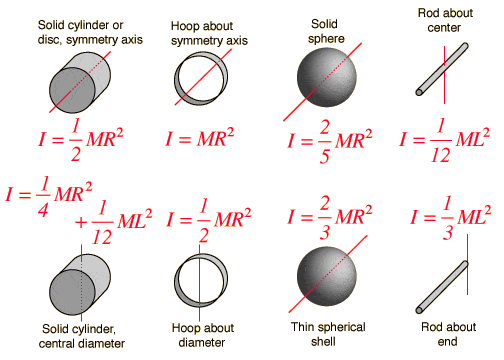
To get 'h' I need to first calculate 'I' which requires mass for a rod.
mic.gif


So, taking it from here I'm not sure where to begin. I've tried rearranging the formulas I've been given with no luck - any ideas?
 
Physics news on Phys.org
h is the distance from the pivot point to the center of mass of the rod. You can express that in terms of the length of the rod and you can express I in terms of the length of the rod.
 
Ok let me try this:
1.74=2Pi * sqrt ((1/12*mL^2) / (m*9.81*2L)
=> .27=sqrt((1/12L / 19.62))
1/12L = 1.504
L=~18m ??

This is wrong. I canceled out m and L in my early steps, did this throw my calculations off?
 
The stick is suspended from its end, not its middle.
 
1.74=2Pi * sqrt((1/3L^2) / (m(9.81)(2L)

*question: I haven't had algebra for a while, but you can just cancel the m's and cancel the L's, leaving only one 'L' in the numerator, correct?

If that assumption is correct I get L=4.51m - my book disagrees with this answer though; any idea why?
 
Looks like you are setting h = 2L, which isn't right. As OlderDan explained, h is the distance from the pivot point to the center of mass of the rod.
 

Similar threads

  • · Replies 9 ·
Replies
9
Views
3K
Replies
3
Views
2K
  • · Replies 14 ·
Replies
14
Views
2K
  • · Replies 27 ·
Replies
27
Views
2K
Replies
14
Views
3K
  • · Replies 3 ·
Replies
3
Views
4K
Replies
2
Views
2K
  • · Replies 6 ·
Replies
6
Views
4K
  • · Replies 19 ·
Replies
19
Views
3K
  • · Replies 4 ·
Replies
4
Views
2K