MHB How do you calculate the moments of inertia for a cone?

Click For Summary
Calculating the moments of inertia for a cone involves integrating over its volume using cylindrical coordinates. The cone's intersection with a plane at constant z forms a circle, which can be integrated by varying x and y within the bounds defined by the cone's geometry. The integral for the moment of inertia combines the density function with the squared distance from the axis of rotation. Guidance is provided on setting up the triple integral for the cone's volume, emphasizing the need to understand the limits of integration. Understanding these concepts is crucial for successfully calculating the moments of inertia.
Kaspelek
Messages
26
Reaction score
0
Hi Guys,

It has been a while since my last post but it's great to be back.

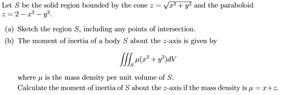
I am having some trouble with part b) of this question. Don't fully understand the concept and what I'm meant to do.

Any guidance or assistance would be greatly appreciated.

Thanks in advance you legends!
 

Attachments

  • q2.PNG
    q2.PNG
    11.3 KB · Views: 103
Physics news on Phys.org
Re: Regions and moments of intertia

Kaspelek said:
Hi Guys,

It has been a while since my last post but it's great to be back.

I am having some trouble with part b) of this question. Don't fully understand the concept and what I'm meant to do.

Any guidance or assistance would be greatly appreciated.

Thanks in advance you legends!

Welcome back Kaspelek! :)

Which intersection points did you find in (a)?Let's start with the cone up to some limit $z_0$.
The cone intersect with any plane with constant $z$ as a circle with radius $z$.
Such a circle can be integrated by running $x$ from $-z$ to $+z$, and by running y from $-\sqrt{z^2-x^2}$ to $+\sqrt{z^2-x^2}$.

\begin{aligned}
\iiint_{\text{Cone}} \mu (x^2+y^2)dV
&= \iiint_{\text{Cone}} (x+z) (x^2+y^2)dV \\
&= \int_0^{z_0}\int_{-z}^{+z}\int_{-\sqrt{z^2-x^2}}^{+\sqrt{z^2-x^2}} (x+z) (x^2+y^2) dydxdz
\end{aligned}
Do you know how to calculate that?
 
There are probably loads of proofs of this online, but I do not want to cheat. Here is my attempt: Convexity says that $$f(\lambda a + (1-\lambda)b) \leq \lambda f(a) + (1-\lambda) f(b)$$ $$f(b + \lambda(a-b)) \leq f(b) + \lambda (f(a) - f(b))$$ We know from the intermediate value theorem that there exists a ##c \in (b,a)## such that $$\frac{f(a) - f(b)}{a-b} = f'(c).$$ Hence $$f(b + \lambda(a-b)) \leq f(b) + \lambda (a - b) f'(c))$$ $$\frac{f(b + \lambda(a-b)) - f(b)}{\lambda(a-b)}...

Similar threads

  • · Replies 5 ·
Replies
5
Views
4K
  • · Replies 11 ·
Replies
11
Views
2K
  • · Replies 40 ·
2
Replies
40
Views
5K
  • · Replies 6 ·
Replies
6
Views
4K
  • · Replies 19 ·
Replies
19
Views
2K
  • · Replies 1 ·
Replies
1
Views
1K
  • · Replies 10 ·
Replies
10
Views
2K
Replies
4
Views
3K
  • · Replies 4 ·
Replies
4
Views
2K
  • · Replies 10 ·
Replies
10
Views
7K