How do you calculate the series resistance for this Triac control circuit?

Click For Summary

Discussion Overview

The discussion revolves around calculating the series resistance for a Triac control circuit, specifically focusing on the gate trigger current and the implications of using high voltage AC mains. Participants explore the design considerations for safely triggering a BT139 triac using an MOC3052 optoisolator, including calculations related to resistor values and power dissipation.

Discussion Character

  • Technical explanation
  • Debate/contested
  • Mathematical reasoning

Main Points Raised

  • One participant calculates the required resistance value for the circuit, suggesting a value of approximately 388.75 kΩ based on a peak current of 0.8 mA and a peak voltage of 311 V.
  • Another participant argues that 0.8 mA may not be sufficient for reliable operation, proposing a higher gate trigger current of around 35 mA instead.
  • Concerns are raised about the power dissipation of 35 mA being too high for the optoisolator, questioning how to trigger the triac without exceeding component ratings.
  • Discussion includes the interpretation of datasheet specifications, with one participant seeking clarification on terms like VD and T2+ G+.
  • Participants suggest various methods for triggering the triac, including the use of zero-crossing optical triac drivers and considerations for different load types (inductive vs. resistive).
  • One participant mentions the importance of calculating power dissipation in the gate resistor and suggests using fusible resistors for safety in case of failure.

Areas of Agreement / Disagreement

There is no consensus on the appropriate gate trigger current, with differing opinions on the sufficiency of 0.8 mA versus the suggested 35 mA. The discussion remains unresolved regarding the optimal resistor value and the implications of power dissipation in the circuit.

Contextual Notes

Participants express uncertainty about the minimum gate trigger current required for reliable triac operation and the implications of using high voltage in the circuit design. There are also unresolved questions about the specific characteristics and definitions provided in the datasheet.

Who May Find This Useful

Electronics enthusiasts, engineers working with AC control circuits, and those interested in triac applications may find this discussion relevant.

Wrichik Basu
Science Advisor
Insights Author
Gold Member
Messages
2,180
Reaction score
2,691
Disclaimer: Some of you might easily recognize that the components and circuit I am talking about are related to one of my projects, on which I had posted some months ago. Actually, the circuit is the same as the one in my project, but the one I am posting in this thread actually uses high voltage AC mains, so I am never going to implement it. This is just to satisfy my curiosity.

The schematic is given below:
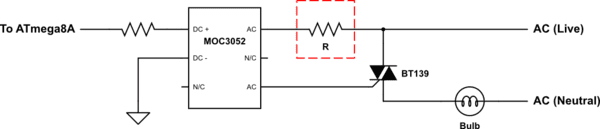
1622055522294.png

As you can see, I am controlling the BT139 triac using the MOC3052 optoisolator. Both of them can handle high voltages. The circuit above is similar to the sample circuit shown in the datasheet of the opto. My question is, how do I calculate the value of R (boxed in red) in high voltages?

Say, I want to connect this Triac to my mains, which are at 220 V RMS, or 311 V peak. As per the datasheet, the opto can handle a maximum of 300 mW power dissipation at its detector. For safety, let's take a value of 250 mW. So, the peak current through the gate of the triac would be ##250~\text{mW} / 311~\text{V} = 0.8 \text{mA}##, and the value of ##R## would turn out to be ##311~\text{V} / 0.8 \text{mA} = 388.75~\mathrm{k\Omega}##. Using standard resistors, I can get ##330~\mathrm{k\Omega} + 47~\mathrm{k\Omega} + 10~\mathrm{k\Omega} + 1~\mathrm{k\Omega}##. Does this look sane?

Also, I had another question: what is the minimum gate trigger current (IG) required to switch on the triac? In the triac datasheet, the maximum IG is given as 2A, but nothing has been said about the minimum IG. If my above calculation is mathematically correct, will 0.8 mA be enough to turn on the triac?
 
Engineering news on Phys.org
This is all about the "gate trigger current" part of the datasheet, which is pretty well characterized. Note that when they specify the maximum value, they mean the value that is guaranteed to work, not a value that can't be exceeded. This is because it appears in the "characteristics" section, not the "limiting values" section (that value is "peak gate current". 0.8mA may very well be enough sometimes for some devices, but it's not enough for a good reliable design. You'll want something more like 35mA.
 
DaveE said:
This is all about the "gate trigger current" part of the datasheet, which is pretty well characterized.
I had seen that portion, but couldn't really make out what they are trying to say. IT is probably the current through the triac, and Tj is the junction temperature. What does VD and T2+ G+ mean here? How can I translate the values to higher currents, like, say, 6A?
DaveE said:
You'll want something more like 35mA.
Hmm, that's where the problem lies. 35mA means 311 V * 35 mA ≈ 11 W, far higher than what the opto can handle. In fact, I haven't even seen this high power resistors. Then how do people use this Triac in high voltage circuits? Is there some other way to trigger the triac?
 
Wrichik Basu said:
IT is probably the current through the triac, and Tj is the junction temperature.
Yes

Wrichik Basu said:
What does VD and T2+ G+ mean here?
Vd is the voltage across the device from MT1 to MT2. T2+ G+ refers to the polarity of the trigger current w.r.t. the anode/cathode. It's described in the links below. Since you are triggering from the device voltage (thanks for posting a schematic, BTW) you are operating in the ++ or -- region for resistive loads.
Wrichik Basu said:
How can I translate the values to higher currents, like, say, 6A?
I don't think you need to worry about that for triggering. The triac will turn on with low current anyway since it starts from 0, and once it is triggered it is on and will stay on regardless of how you drive the gate. It will only turn off when the current polarity switches (assuming you've removed the gate drive by then.

The conditions listed (like Vd=12V) are only there to tell you how they tested them for characterization and screening. It is up to you to figure out, based on general knowledge of the device type, how it might be different in your application.
Wrichik Basu said:
35mA means 311 V * 35 mA ≈ 11 W, far higher than what the opto can handle.
Assuming the triac triggers reliably, the voltage across the driver is removed when the triac turns on. So the stress on the driver is removed. High voltage and high current shouldn't happen at the same time for the driver, it is a pulsed load. OTOH, if the triac doesn't trigger, then you may have a problem. I often see big gate resistors in thyristor circuits because of this. Although cheap consumer designs may just let the resistor or IC fry if the device isn't triggering, as long as it fails safely. You can also put a capacitor in parallel with the gate resistor to give the triac a current surge that then goes away, this is a common feature in higher power circuits to get the device on ASAP.

Triacs are difficult devices to understand compared to transistors and ICs. Some reading and copying application circuits may be needed. They haven't really changed in about 70 years, so the best descriptions tend to be older. It's a bit of a lost art, even though for AC switching they are still universally used. I think some of the best descriptions are from RCA, and Motorola (On Semi) but that may be more than you want to read. You can search for "triac triggering", "thyristor handbook", or similar to get more info.

Wrichik Basu said:
Is there some other way to trigger the triac?
There are lots of solutions, but I like the IC you have chosen. Unless you find some limitation I would procced as you are.
 
  • Informative
Likes   Reactions: Wrichik Basu
Maybe you can consider using a zero-crossing optical triac driver to reduce the initial inrush current during startup of an incandescent bulb or capacitive load. But please note that this may not be suitable for inductive loads.

Historically, it has been recommended to use optical triac drivers without zero-crossing detection to drive inductive loads.

https://www.mouser.com/datasheet/2/149/MOC3041M-195885.pdf
 
Last edited:
  • Like
Likes   Reactions: DaveE
Thanks, @DaveE, for the really long explanation. I will go through the design guidelines you have linked. But one question: how do I choose a value of the resistor? In the datasheet of the opto, they have given a similar circuit, and said that R = VpAC / ITSM:

1622102369466.png

ITSM = 1A as per the datasheet, and VpAC is probably the peak AC voltage, so 311 V in my case. So, do I just put a resistance around 311 Ω without caring about the power dissipation? Will this be valid if I have to continuously switch the triac on and off based on zero crossing detection (to get a dimming effect)?
 
Wrichik Basu said:
Thanks, @DaveE, for the really long explanation. I will go through the design guidelines you have linked. But one question: how do I choose a value of the resistor? In the datasheet of the opto, they have given a similar circuit, and said that R = VpAC / ITSM:

View attachment 283615
ITSM = 1A as per the datasheet, and VpAC is probably the peak AC voltage, so 311 V in my case. So, do I just put a resistance around 311 Ω without caring about the power dissipation? Will this be valid if I have to continuously switch the triac on and off based on zero crossing detection (to get a dimming effect)?
Yes, I would follow that advice. Because the triacs will (should) turn on there won't be much power dissipation. If the big triac fails open the gate resistor will have huge power applied and will also fail. So use a small one that won't cause much damage when it burns up. There are special "fusible resistors" that are designed to fail safely like this, but I think most people would just use a normal small resistor (1206, or 1/4W for example) and test it. The big triac is likely to fail shorted anyway, which will just turn on the load and remove the stress from the gate circuit. The failure mode of gate current but no anode current isn't the most likely.

As far as normal operation, you can calculate a worst case power dissipation in the gate resistor Like so:
Trigger current < 35mA
Turn on time < 5usec
Gate voltage <311V
Max frequency <60Hz

This gives a power dissipation of 3.3mW
 
  • Informative
  • Like
Likes   Reactions: Wrichik Basu and alan123hk
DaveE said:
As far as normal operation, you can calculate a worst case power dissipation in the gate resistor Like so:
Trigger current < 35mA
Turn on time < 5usec
Gate voltage <311V
Max frequency <60Hz

This gives a power dissipation of 3.3mW
This is a reasonable and professional calculation.
 
  • Like
Likes   Reactions: Wrichik Basu
Thanks once again, @DaveE.
DaveE said:
Turn on time < 5usec
In my case, this will be 10ms.
 
  • #10
Wrichik Basu said:
Thanks once again, @DaveE.

In my case, this will be 10ms.
No, this is the time it takes the triac to switch on. During this time the triac current is increasing and the triac voltage is dropping. It's listed on the data sheet at 5usec typical. Once the triac voltage switches to a volt or so the gate drive current is essentially removed, so there's no power dissipation in the resistor when the big triac is on or when the small triac is off.
 
  • Like
Likes   Reactions: Wrichik Basu
  • #11
DaveE said:
No, this is the time it takes the triac to switch on. During this time the triac current is increasing and the triac voltage is dropping. It's listed on the data sheet at 5usec typical. Once the triac voltage switches to a volt or so the gate drive current is essentially removed, so there's no power dissipation in the resistor when the big triac is on or when the small triac is off.
Oh, yes, sorry. In my ATmega code I am actually turning on the opto for 10μs. I forgot that and wrote 10ms instead.
 

Similar threads

Replies
4
Views
7K
Replies
8
Views
3K
  • · Replies 5 ·
Replies
5
Views
1K
  • · Replies 34 ·
2
Replies
34
Views
6K
Replies
3
Views
1K
  • · Replies 2 ·
Replies
2
Views
1K
  • · Replies 3 ·
Replies
3
Views
2K
Replies
0
Views
2K
Replies
7
Views
3K
  • · Replies 8 ·
Replies
8
Views
2K