How Do You Connect Multiple Diffusion Pumps for UHV Systems?

Click For Summary
SUMMARY

Connecting multiple diffusion pumps for ultra high vacuum (UHV) systems is best achieved by using parallel configurations rather than series. Each diffusion pump should have a short, wide, and straight connection to the vacuum chamber to maximize efficiency. A large-aperture gate valve is recommended to prevent throttling and backstreaming of oil. For optimal performance, consider using turbomolecular pumps combined with oil-free roughing pumps, as they are more efficient and reduce contamination risks.

PREREQUISITES
  • Understanding of diffusion pump operation and limitations
  • Knowledge of vacuum system components, including gate valves and mechanical pumps
  • Familiarity with turbomolecular pump technology
  • Basic principles of vacuum pressure measurement (e.g., torr)
NEXT STEPS
  • Research the design and operation of turbomolecular pumps
  • Learn about the use of ion pumps in UHV applications
  • Study the effects of foreline pressure on diffusion pump performance
  • Investigate vacuum system design principles for minimizing contamination
USEFUL FOR

Engineers, researchers, and technicians involved in vacuum technology, particularly those designing or maintaining UHV systems.
SupaVillain
Messages
47
Reaction score
2
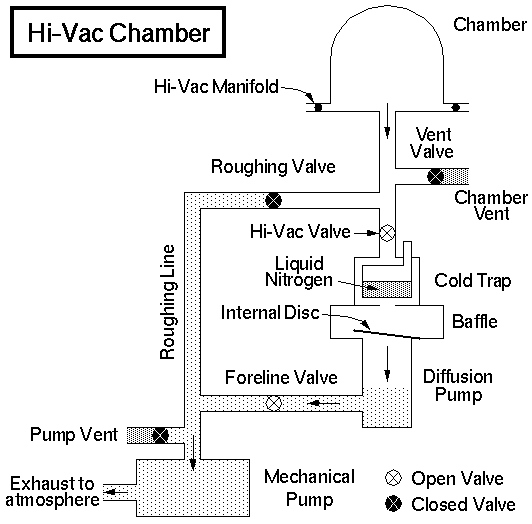
If using diffusion pumps (2 or 3 in series) to achieve ultra high vacuum, how do you hook them up together, for example adding them onto a system like in the provided picture? Would you use T-connectors to put them all on the same input and output valves or would you have valves for each pump?
vacuum_system_diffusion_pump.gif
 
Physics news on Phys.org
SupaVillain said:
If using diffusion pumps (2 or 3 in series) to achieve ultra high vacuum, how do you hook them up together, for example adding them onto a system like in the provided picture? Would you use T-connectors to put them all on the same input and output valves or would you have valves for each pump?

I have never seen Diffusion pumps used in series. Generally, the input end of a Diff. pump is at high vacuum, while the foreline pressure is only low vacuum. The foreline is typically pumped by a mechanical pump, as shown in your diagram.

For UHV work, you might see Diff pumps being used to get to high vacuum, followed by other kinds of pumps to get to even higher vacuum (ion pumps, etc.)

Generally, folks will use a large-aperture gate valve over a diffusion pump (to keep from throttling the pump). If you are concerned about backstreaming of oil into the vacuum system, you can add some kind of a cold trap between the pump and the gate valve.

O'Hanlon's, "A Users Guide to Vacuum Technology" is a good book to look for.
 
Well after doing some research I mean even wikipedia says diffusion pumps can get to UHV and that picture shows a system that can supposedly get to 10-7 torr. They have been engineered in series or parallel because vacuum can work in accumulation. I guess I am just going to to have to do research on the vacuum strength of the valves and lines themselves.
 
Your diagram looks OK to me. You should make sure that the connection from the chamber to the diffusion pump is as short, straight, and large diameter as possible to maximize pumping efficiency. One way to do this is to use a large gate valve for the High-vac valve.

If you want to use several diffusion pumps, then you should connect them in parallel, not in series. For each you should try for a short, wide, straight connection to the vessel to be pumped. This is not always possible.

Finally, diffusion pumps are not the most convenient technology to use. If you are thinking about building a system from scratch, you should consider using a turbomolecular (turbo) pump and an oil-free roughing pump instead. These are robust, efficient and easy to use, furthermore they minimize the risk of contaminating your chamber if hydrocarbonds and turning it into a deep-fryer. (Consider what happens in case of a power failure. Will the vacuum suck the oil out of the diffusion pump and into the chamber?)
 
SupaVillain said:
Well after doing some research I mean even wikipedia says diffusion pumps can get to UHV and that picture shows a system that can supposedly get to 10-7 torr.

10e-7 is not really UHV, You should be able to reach that with a good turbopump/roughing pump combination provided you can bake out your system. If you want a better vacuum you should consider adding an ion pump.

Diffusion pumps are not nearly as popular as they used to be for reasons already mentioned above, they have (mostly) been replaced by modern turbo pumps.
 

Similar threads

  • · Replies 5 ·
Replies
5
Views
3K
  • · Replies 1 ·
Replies
1
Views
3K
Replies
3
Views
2K
  • · Replies 4 ·
Replies
4
Views
3K
Replies
8
Views
2K
  • · Replies 43 ·
2
Replies
43
Views
13K
  • · Replies 2 ·
Replies
2
Views
3K
  • · Replies 2 ·
Replies
2
Views
3K
  • · Replies 10 ·
Replies
10
Views
4K
  • · Replies 1 ·
Replies
1
Views
4K