How Do You Connect Multiple Diffusion Pumps for UHV Systems?

Click For Summary

Discussion Overview

The discussion centers around the configuration and use of multiple diffusion pumps in ultra high vacuum (UHV) systems, exploring how to connect them effectively and the implications of such configurations. Participants examine the theoretical and practical aspects of using diffusion pumps, including their placement in series or parallel, and the overall design of vacuum systems.

Discussion Character

  • Exploratory
  • Technical explanation
  • Debate/contested

Main Points Raised

  • Some participants question the feasibility of using diffusion pumps in series, suggesting that they are typically used in conjunction with mechanical pumps to achieve high vacuum before transitioning to UHV.
  • Others propose that diffusion pumps can indeed be engineered to work in series or parallel configurations, noting that vacuum can accumulate effectively.
  • A participant emphasizes the importance of minimizing the length and diameter of connections to enhance pumping efficiency, recommending the use of large gate valves.
  • Concerns are raised about the potential for oil backstreaming from diffusion pumps into the vacuum system, suggesting the use of cold traps as a preventive measure.
  • Some participants advocate for considering turbomolecular pumps as a more modern and efficient alternative to diffusion pumps, citing their robustness and reduced contamination risk.
  • There is a discussion about the definition of UHV, with one participant arguing that achieving 10-7 torr does not qualify as UHV and suggesting that ion pumps may be necessary for better vacuum levels.

Areas of Agreement / Disagreement

Participants express differing views on the use of diffusion pumps in series versus parallel, and there is no consensus on the best configuration or the definition of UHV. The discussion remains unresolved regarding the optimal approach to connecting multiple diffusion pumps.

Contextual Notes

Participants mention various assumptions about the vacuum strength of valves and lines, as well as the operational challenges associated with diffusion pumps, without reaching definitive conclusions.

SupaVillain
Messages
47
Reaction score
2
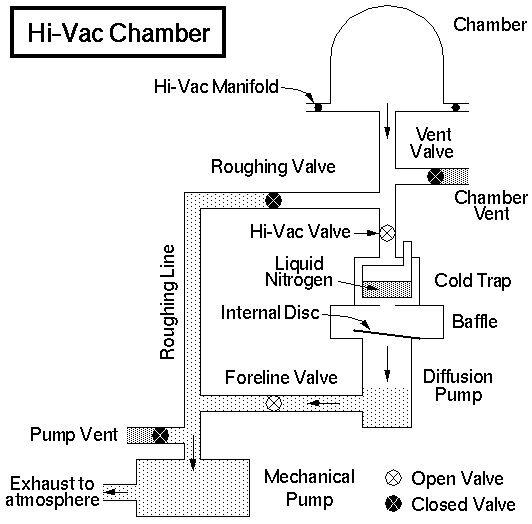
If using diffusion pumps (2 or 3 in series) to achieve ultra high vacuum, how do you hook them up together, for example adding them onto a system like in the provided picture? Would you use T-connectors to put them all on the same input and output valves or would you have valves for each pump?
vacuum_system_diffusion_pump.gif
 
Physics news on Phys.org
SupaVillain said:
If using diffusion pumps (2 or 3 in series) to achieve ultra high vacuum, how do you hook them up together, for example adding them onto a system like in the provided picture? Would you use T-connectors to put them all on the same input and output valves or would you have valves for each pump?

I have never seen Diffusion pumps used in series. Generally, the input end of a Diff. pump is at high vacuum, while the foreline pressure is only low vacuum. The foreline is typically pumped by a mechanical pump, as shown in your diagram.

For UHV work, you might see Diff pumps being used to get to high vacuum, followed by other kinds of pumps to get to even higher vacuum (ion pumps, etc.)

Generally, folks will use a large-aperture gate valve over a diffusion pump (to keep from throttling the pump). If you are concerned about backstreaming of oil into the vacuum system, you can add some kind of a cold trap between the pump and the gate valve.

O'Hanlon's, "A Users Guide to Vacuum Technology" is a good book to look for.
 
Well after doing some research I mean even wikipedia says diffusion pumps can get to UHV and that picture shows a system that can supposedly get to 10-7 torr. They have been engineered in series or parallel because vacuum can work in accumulation. I guess I am just going to to have to do research on the vacuum strength of the valves and lines themselves.
 
Your diagram looks OK to me. You should make sure that the connection from the chamber to the diffusion pump is as short, straight, and large diameter as possible to maximize pumping efficiency. One way to do this is to use a large gate valve for the High-vac valve.

If you want to use several diffusion pumps, then you should connect them in parallel, not in series. For each you should try for a short, wide, straight connection to the vessel to be pumped. This is not always possible.

Finally, diffusion pumps are not the most convenient technology to use. If you are thinking about building a system from scratch, you should consider using a turbomolecular (turbo) pump and an oil-free roughing pump instead. These are robust, efficient and easy to use, furthermore they minimize the risk of contaminating your chamber if hydrocarbonds and turning it into a deep-fryer. (Consider what happens in case of a power failure. Will the vacuum suck the oil out of the diffusion pump and into the chamber?)
 
SupaVillain said:
Well after doing some research I mean even wikipedia says diffusion pumps can get to UHV and that picture shows a system that can supposedly get to 10-7 torr.

10e-7 is not really UHV, You should be able to reach that with a good turbopump/roughing pump combination provided you can bake out your system. If you want a better vacuum you should consider adding an ion pump.

Diffusion pumps are not nearly as popular as they used to be for reasons already mentioned above, they have (mostly) been replaced by modern turbo pumps.
 

Similar threads

  • · Replies 5 ·
Replies
5
Views
4K
  • · Replies 1 ·
Replies
1
Views
3K
Replies
3
Views
2K
  • · Replies 4 ·
Replies
4
Views
3K
Replies
8
Views
2K
  • · Replies 43 ·
2
Replies
43
Views
14K
  • · Replies 2 ·
Replies
2
Views
3K
  • · Replies 2 ·
Replies
2
Views
3K
  • · Replies 10 ·
Replies
10
Views
4K
  • · Replies 1 ·
Replies
1
Views
5K