How Do You Determine Horizontal Shifts in Sinusoidal Functions?

Click For Summary
SUMMARY

The discussion focuses on determining horizontal shifts in sinusoidal functions, specifically how to identify phase shifts in graphs. Participants clarify that a horizontal shift to the right can be quantified by observing the midline of the graph and comparing it to the standard sine function, which has no shifts. For example, a shift of 15 units or 80 units to the right indicates that the midline of the graph is displaced from the origin by these respective amounts. Understanding these shifts is crucial for accurately interpreting sinusoidal graphs.

PREREQUISITES
  • Understanding of sinusoidal functions and their properties
  • Familiarity with graphing techniques for trigonometric functions
  • Knowledge of phase shifts and their impact on function graphs
  • Basic skills in interpreting mathematical notation related to functions
NEXT STEPS
  • Study the characteristics of the standard sine function and its graph
  • Learn how to identify and calculate phase shifts in various trigonometric functions
  • Explore graphical transformations and their effects on function behavior
  • Practice graphing sinusoidal functions with different horizontal shifts
USEFUL FOR

Students studying trigonometry, educators teaching sinusoidal functions, and anyone looking to enhance their understanding of graph transformations in mathematics.

DoomBringer2
Messages
4
Reaction score
0
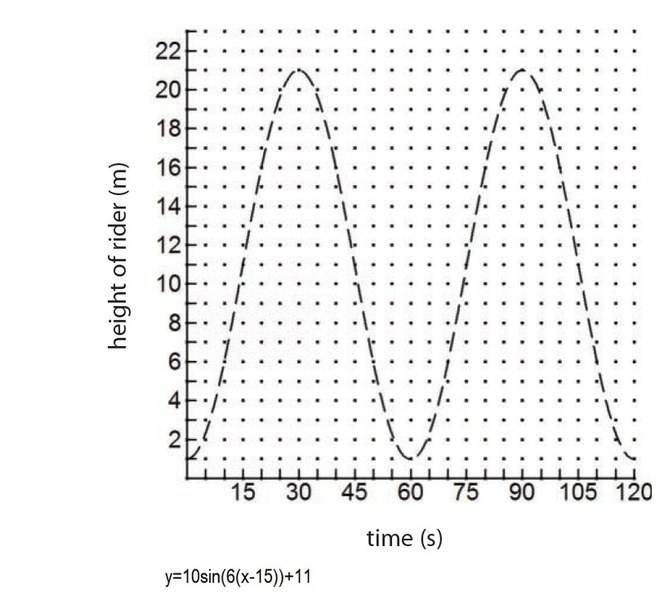
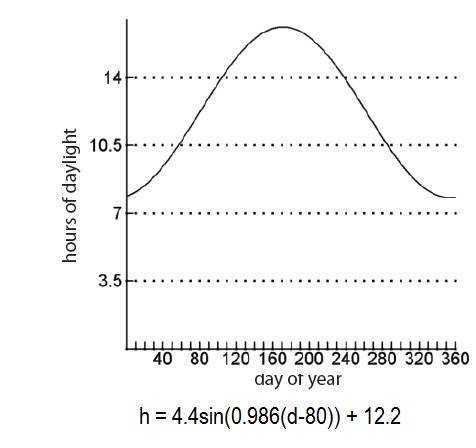
1. Hello everyone, I am having some trouble determining precise phase shifting by observing the graphs.
dRt4B.jpg


book says this graph has horizontally shifted to the right by 15 units. How was this determined? I can't figure it out!

second this graph:
hLXCQ.jpg

Says the graph was shifted 80 units to the right but again how is this determined? Please help thnx
 
Physics news on Phys.org
Welcome to PF!

Hail DoomBringer2! Welcome to PF! :smile:
DoomBringer2 said:
book says this graph has horizontally shifted to the right by 15 units. How was this determined? I can't figure it out!

Says the graph was shifted 80 units to the right but again how is this determined?

Concentrate on the middle of the graph …

at zero phase shift, it should have that middle value at time 0. :wink:
 
Hint: What does the normal sin function look like without any left or right shifts?
 
thanks a lot guys and gals, I am about to submit my work. hopefully I got it right lol
 

Similar threads

  • · Replies 3 ·
Replies
3
Views
2K
  • · Replies 6 ·
Replies
6
Views
3K
  • · Replies 2 ·
Replies
2
Views
2K
  • · Replies 2 ·
Replies
2
Views
2K
Replies
2
Views
3K
  • · Replies 6 ·
Replies
6
Views
2K
  • · Replies 14 ·
Replies
14
Views
3K
Replies
3
Views
1K
  • · Replies 8 ·
Replies
8
Views
2K
  • · Replies 3 ·
Replies
3
Views
2K