How Do You Simplify Complex Derivatives in Calculus?

  • Thread starter Thread starter tahayassen
  • Start date Start date
  • Tags Tags
    Calculus Multiple
Click For Summary

Homework Help Overview

The discussion revolves around simplifying complex derivatives in calculus, specifically focusing on the differentiation of a function involving a quotient and a square root. Participants are exploring the transition between different forms of the derivative and the application of various calculus techniques.

Discussion Character

  • Exploratory, Mathematical reasoning, Assumption checking

Approaches and Questions Raised

  • Participants are attempting to simplify derivatives and are questioning the methods used, such as the product rule versus the quotient rule. There are inquiries about the appropriate techniques or theorems needed to address specific problems. Some participants express confusion about manipulating expressions with negative exponents.

Discussion Status

The discussion includes multiple attempts to clarify the steps involved in simplifying derivatives, with some participants providing partial solutions or insights. There is an ongoing exploration of different interpretations and methods, particularly regarding the use of L'Hôpital's rule and the handling of negative exponents.

Contextual Notes

Participants mention constraints such as impending exam pressures and the need for clarity in their understanding of calculus concepts. There are also references to specific mathematical expressions and the challenges associated with them, indicating a focus on detailed problem-solving without reaching definitive conclusions.

tahayassen
Messages
269
Reaction score
1
1) [tex]f(x)=\frac { { x }^{ 2 } }{ \sqrt { x+1 } } \\ f'(x)=\frac { 2x\sqrt { x+1 } -\frac { \sqrt { x+1 } }{ 2 } }{ x+1 } \\ f'(x)=\frac { x(3x+4) }{ 2{ (x+1) }^{ \frac { 3 }{ 2 } } }[/tex]

Can somebody show how you can get from the second step to the third step? I tried factoring x+1 from the numerator but it just made it even messier.

2)
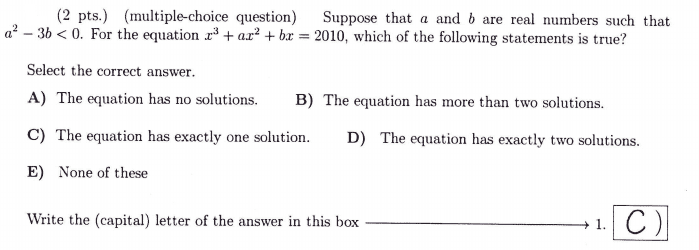
2usc0ok.png


Can somebody tell me what method/technique or what theorem I need to use in order to do this question?

3)
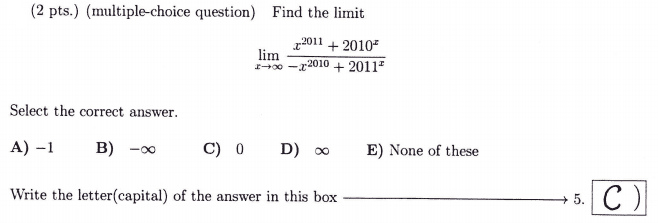
35lt849.png


Can somebody tell me what method/technique or what theorem I need to use in order to do this question?
 
Last edited:
Physics news on Phys.org
tahayassen said:
1) [tex]f(x)=\frac { { x }^{ 2 } }{ \sqrt { x+1 } } \\ f'(x)=\frac { 2x\sqrt { x+1 } -\frac { \sqrt { x+1 } }{ 2 } }{ x+1 } \\ f'(x)=\frac { 3(3x+4) }{ 2{ (x+1) }^{ \frac { 3 }{ 2 } } }[/tex]

Can somebody show how you can get from the second step to the third step? I tried factoring x+1 from the numerator but it just made it even messier.

2)

2usc0ok.png


Can somebody tell me what method/technique or what theorem I need to use in order to do this question?

3)

35lt849.png


Can somebody tell me what method/technique or what theorem I need to use in order to do this question?

Show your work: what have you tried so far?
 
tahayassen said:
1) [tex]f(x)=\frac { { x }^{ 2 } }{ \sqrt { x+1 } } \\ f'(x)=\frac { 2x\sqrt { x+1 } -\frac { \sqrt { x+1 } }{ 2 } }{ x+1 } \\ f'(x)=\frac { 3(3x+4) }{ 2{ (x+1) }^{ \frac { 3 }{ 2 } } }[/tex]

Can somebody show how you can get from the second step to the third step? I tried factoring x+1 from the numerator but it just made it even messier.
How does the denominator in the third step compare to the denominator in the second step?
 
One more question:

4)

[tex]{ (\frac { 1 }{ 3 } x+\frac { 1 }{ 3 } { x }^{ -1 }+{ x }^{ -2 }) }^{ -1 }\\ =\frac { 1 }{ 3 } { x }^{ -1 }+\frac { 1 }{ 3 } { x }+{ x }^{ 2 }[/tex]

That's correct, right? But if it were -2 instead of -1, you wouldn't be able to distribute the exponent right? You'd still be able to distribute the negative though, correct?

I'll upload my work in a sec
 
Last edited:
I solved question 1. The key was to use the product rule - not the quotient rule for derivatives and then use common denominators to add the fractions.

For question 2, I tried to use the discriminant for cubic functions to make some sort of resemblance to the inequality, but no luck. See: http://en.wikipedia.org/wiki/Discriminant#Formula_2

Here is my attempt for question 3:

[tex]\underset { x\rightarrow \infty }{ lim } \frac { { x }^{ 2011 }+{ 2010 }^{ x } }{ -{ x }^{ 2010 }+{ 2011 }^{ x } } \\ =\underset { x\rightarrow \infty }{ lim } \frac { { { x }^{ 2010 }(x }+{ 2010 }^{ x }{ x }^{ -2010 }) }{ { x }^{ 2010 }(-1+{ 2011 }^{ x }{ x }^{ -2010 }) } \\ =\underset { x\rightarrow \infty }{ lim } \frac { { x }+{ 2010 }^{ x }{ x }^{ -2010 } }{ -1+{ 2011 }^{ x }{ x }^{ -2010 } }[/tex]

Just to add, I have a calculus exam in 4 hours and 15 minutes from the time of this post, so sorry about not showing my work the first time.
 
tahayassen said:
One more question:

4)

[tex]{ (\frac { 1 }{ 3 } x+\frac { 1 }{ 3 } { x }^{ -1 }+{ x }^{ -2 }) }^{ -1 }\\ =\frac { 1 }{ 3 } { x }^{ -1 }+\frac { 1 }{ 3 } { x }+{ x }^{ 2 }[/tex]

That's correct, right?
No, it's not. You can't distribute exponents over a sum or difference, and that seems to be what you did.
tahayassen said:
But if it were -2 instead of -1, you wouldn't be able to distribute the exponent right? You'd still be able to distribute the negative though, correct?

I'll upload my work in a sec
 
tahayassen said:
I solved question 1. The key was to use the product rule - not the quotient rule for derivatives and then use common denominators to add the fractions.

For question 2, I tried to use the discriminant for cubic functions to make some sort of resemblance to the inequality, but no luck. See: http://en.wikipedia.org/wiki/Discriminant#Formula_2

Here is my attempt for question 3:

[tex]\underset { x\rightarrow \infty }{ lim } \frac { { x }^{ 2011 }+{ 2010 }^{ x } }{ -{ x }^{ 2010 }+{ 2011 }^{ x } } \\ =\underset { x\rightarrow \infty }{ lim } \frac { { { x }^{ 2010 }(x }+{ 2010 }^{ x }{ x }^{ -2010 }) }{ { x }^{ 2010 }(-1+{ 2011 }^{ x }{ x }^{ -2010 }) } \\ =\underset { x\rightarrow \infty }{ lim } \frac { { x }+{ 2010 }^{ x }{ x }^{ -2010 } }{ -1+{ 2011 }^{ x }{ x }^{ -2010 } }[/tex]
I don't think this will be any help. The dominant term is the 2011x in the denominator, which leads me to believe that the limit of the overall expression is 0. I would be inclined to use L'Hopital's rule to confirm that guess.
tahayassen said:
Just to add, I have a calculus exam in 4 hours and 15 minutes from the time of this post, so sorry about not showing my work the first time.
 
I'm currently on my tablet, so I won't be able to post latex.

Mark44 said:
I don't think this will be any help. The dominant term is the 2011x in the denominator, which leads me to believe that the limit of the overall expression is 0. I would be inclined to use L'Hopital's rule to confirm that guess.

Doh. I'm not sure how that slipped from my mind. I'll try it in a second. I think this is the right way.

Thanks for answering question 4. So if instead of a negative exponent for the brackets, the contents of the brackets was just in the denominator of a fraction, then you still wouldn't be able to move each term to the numerator by changing the signs of the exponents right?

Anyone know how to solve question 2?
 
tahayassen said:
I solved question 1. The key was to use the product rule - not the quotient rule for derivatives and then use common denominators to add the fractions.
You can easily get the desired answer after correcting your 'second line':

[itex]\displaystyle f'(x)=\frac{2\sqrt { x+1 }}{2\sqrt { x+1 }}\left(\frac { 2x\sqrt { x+1 } -\frac {x^2 }{ 2\sqrt { x+1} } }{ x+1 }\right)[/itex]
[itex]\displaystyle <br /> =\frac{4x(x+1)-x^2}{2(x+1)^{\frac{3}{2}}}[/itex]

[itex]\displaystyle <br /> =\frac{x(3x+4)}{2(x+1)^{\frac{3}{2}}}[/itex]​
 
  • #10
The solution to #2 was to take the derivative of the equation. Then calculate the discriminant for the the derivative.

The solution to #3 was to apply L'Hôpital's rule 2011 times (or when you noticed the pattern and skipped right to the end).
 

Similar threads

  • · Replies 105 ·
4
Replies
105
Views
11K
  • · Replies 5 ·
Replies
5
Views
2K
Replies
4
Views
3K
  • · Replies 10 ·
Replies
10
Views
3K
  • · Replies 5 ·
Replies
5
Views
3K
  • · Replies 21 ·
Replies
21
Views
2K
  • · Replies 10 ·
Replies
10
Views
2K
  • · Replies 4 ·
Replies
4
Views
2K
  • · Replies 1 ·
Replies
1
Views
2K
  • · Replies 12 ·
Replies
12
Views
2K