How Do You Solve Equilibrium Problems Using Moments?

Click For Summary

Homework Help Overview

The discussion revolves around solving equilibrium problems using moments, specifically focusing on the application of forces and the balance of moments in a static system.

Discussion Character

  • Exploratory, Conceptual clarification, Mathematical reasoning

Approaches and Questions Raised

  • Participants explore the relationship between support forces and distances, questioning the proportionality of ratios involved. There are discussions about the need for multiple equations to solve for unknown forces and the significance of choosing reference points for moments.

Discussion Status

Participants have shared insights and clarifications regarding the setup of the problem, including the importance of the sum of moments being zero in equilibrium situations. Some guidance has been provided on how to approach the problem, particularly regarding the use of reference points to simplify calculations.

Contextual Notes

There is an emphasis on the necessity of two equations to solve for the two unknown support forces, and participants are reflecting on their understanding of the concepts involved in static equilibrium.

TheePhysicsStudent
Messages
21
Reaction score
17
Homework Statement
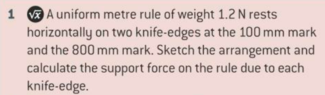
Hi, I have been doing some questions from the textbook and I got the 2 right answers, however for different forces
Relevant Equations
M = FD
Question:
1704455126260.png
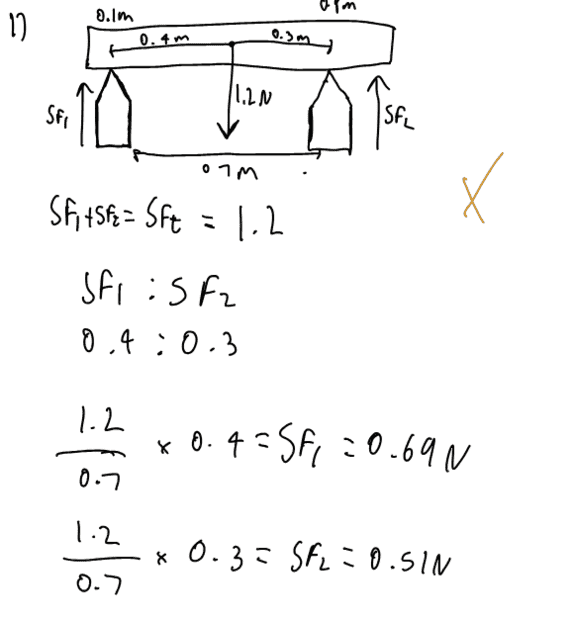
My answer:
1704455314692.png

The books answer:
1704455358742.png
 
Physics news on Phys.org
(1.2)(0.4)=(SF2)(0.7)
 
  • Like
Likes   Reactions: TheePhysicsStudent and MatinSAR
Wow, thanks sir! I realised I was highly overcomplicating things (as per usual)
 
TheePhysicsStudent said:
Wow, thanks sir! I realised I was highly overcomplicating things (as per usual)
No you weren't. You still need another equation to find ##SF_1##. Your solution was actually very close. Your mistake was in the way you wrote your ratios. The ratio of the support distances is not proportional to those two lengths. It's inversely proportional. Think about two kids playing on a seesaw. The heavier kid needs to be closer to the pivot, not further away, to get the seesaw to balance.

Equivalently, you can balance the moments about the center of the metre rule.
 
  • Like
Likes   Reactions: TheePhysicsStudent and MatinSAR
TheePhysicsStudent said:
Wow, thanks sir! I realised I was highly overcomplicating things (as per usual)
Here are some thoughts so that you do not overcomplicate things next time you see something like this.

First, when you have an equilibrium situation, the sum of moments about any point will be zero. That's because the system doesn't know (and doesn't care) what point you choose as reference for the moments. It will not acquire angular acceleration about that point simply because you chose it.

Second, you have two unknowns, namely the two support forces ##SF_1## and ##SF_2.## This means that you need two equations to find them, i.e. you need to solve a system of two equations and two unknowns. The first equation is the sum of forces equal to zero and the second the sum of moments equal to zero. The procedure for tackling this is to solve one equation, say the force equation, for one unknown in terms of the other, e.g. ##SF_2=1.2~(\text{N})-SF_1##, substitute that in the moments equation and solve for ##SF_1##.

However, you can take a shortcut and choose as reference point for the moments the point at which one of the forces is applied. This gives you an equation with only one unknown moment which you can solve for the unknown force. That's exactly what @Chestermiller did in post #2 by choosing as reference the point where ##SF_1## is applied. Of course, the remaining force can be found by substituting in the sum of forces is zero equation.

To summarize, in static equilibrium problems the moment balance is simplified by choosing a reference point for moments where one (or more) forces act.
 
  • Like
Likes   Reactions: berkeman and MatinSAR
Mister T said:
No you weren't. You still need another equation to find ##SF_1##. Your solution was actually very close. Your mistake was in the way you wrote your ratios. The ratio of the support distances is not proportional to those two lengths. It's inversely proportional. Think about two kids playing on a seesaw. The heavier kid needs to be closer to the pivot, not further away, to get the seesaw to balance.

Equivalently, you can balance the moments about the center of the metre rule.
Thanks Mister T, the see saw analogy really helped make it more clear for me where I went wrong, as it does ake more sense now
 
  • Like
Likes   Reactions: Herman Trivilino
kuruman said:
Here are some thoughts so that you do not overcomplicate things next time you see something like this.

First, when you have an equilibrium situation, the sum of moments about any point will be zero. That's because the system doesn't know (and doesn't care) what point you choose as reference for the moments. It will not acquire angular acceleration about that point simply because you chose it.

Second, you have two unknowns, namely the two support forces ##SF_1## and ##SF_2.## This means that you need two equations to find them, i.e. you need to solve a system of two equations and two unknowns. The first equation is the sum of forces equal to zero and the second the sum of moments equal to zero. The procedure for tackling this is to solve one equation, say the force equation, for one unknown in terms of the other, e.g. ##SF_2=1.2~(\text{N})-SF_1##, substitute that in the moments equation and solve for ##SF_1##.

However, you can take a shortcut and choose as reference point for the moments the point at which one of the forces is applied. This gives you an equation with only one unknown moment which you can solve for the unknown force. That's exactly what @Chestermiller did in post #2 by choosing as reference the point where ##SF_1## is applied. Of course, the remaining force can be found by substituting in the sum of forces is zero equation.

To summarize, in static equilibrium problems the moment balance is simplified by choosing a reference point for moments where one (or more) forces act.
Thank Kuruman, for the shortcut method which explained it more than the other user (though i did sort of grasp it), I am gonna practise more questions with all of this in Mind, Thanks once again
 
  • Like
Likes   Reactions: Herman Trivilino and kuruman

Similar threads

  • · Replies 4 ·
Replies
4
Views
1K
  • · Replies 2 ·
Replies
2
Views
712
Replies
4
Views
2K
  • · Replies 6 ·
Replies
6
Views
1K
  • · Replies 7 ·
Replies
7
Views
2K
Replies
2
Views
2K
  • · Replies 13 ·
Replies
13
Views
3K
  • · Replies 40 ·
2
Replies
40
Views
6K
  • · Replies 4 ·
Replies
4
Views
1K
  • · Replies 12 ·
Replies
12
Views
1K
