How Does a TV Use Electric Fields to Control Electron Beams?

Click For Summary
SUMMARY

The discussion focuses on the mechanics of electron deflection in a television set using electric fields. A potential difference of 200 V is applied across two horizontal plates, which are 0.04 m long and 0.012 m apart, to control the trajectory of electrons traveling at a velocity of 6.0 x 10⁷ m/s. To deflect electrons upward, the upper plate must be at a higher potential. The time for electrons to traverse the plates can be calculated using basic kinematic equations, and the vertical displacement during this time can also be determined through acceleration calculations.

PREREQUISITES
  • Understanding of electric fields and potential difference
  • Basic knowledge of kinematics and motion equations
  • Familiarity with electron behavior in electric fields
  • Concepts of force and acceleration in physics
NEXT STEPS
  • Calculate the force acting on the electron in an electric field
  • Learn how to derive acceleration from force and mass using F=ma
  • Study kinematic equations to determine time and displacement
  • Explore the principles of cathode ray tubes and their applications
USEFUL FOR

Physics students, educators, and anyone interested in understanding the principles of electron behavior in electric fields, particularly in the context of television technology.

krosenberg
Messages
6
Reaction score
0
A pair of horizontal plates is used to deflect electrons up or down in a television set by placing a potential difference across them. The plates have length 0.04 m. and separation 0.012 m, and the right edge of the plates is 0.50 m from the screen. A potential difference of 200 V is applied across the plates, and the electrons are deflected toward the top of the screen. Assume that the electrons enter horizontally midway between the plates with a separation of 6.0*10^7 m/s and that fringing effects at the edge of the plates and gravity are negligible.

Determine:
1) which of the two plates must be at the higher potential for the electrons to be deflected upward
2) the time required for the electron to move through the plates
3) the vertical displacement of the electron while it is between the plates
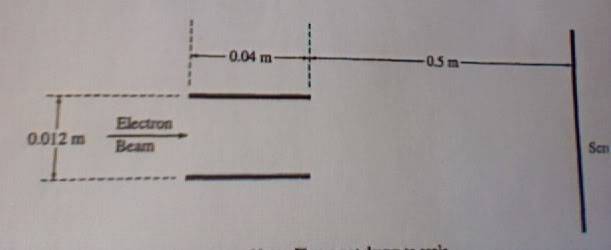
Photo373.jpg


I'm totally lost in this problem, but have a feeling we need to find the acceleration of the electron.
 
Physics news on Phys.org
Well 1) is simple enough, and you should know offhand that higher potential means more/less charge(you pick the right one!) and opposite for lower potential. In that case, will the electron be attracted towards the side with more or less charge?

2)Don't think "omg a cathode ray tube question wtf"

You've got something traveling right with a known velocity which experiences a force. You can calculate this force because you know all the charges and potentials involved and yes, (edit)you can also calculate the acceleration. At that point it's a basic physics 1 problem, use your basic equations and all that

3)If you can do 2 you can do 3
 
Last edited:

Similar threads

  • · Replies 3 ·
Replies
3
Views
7K
  • · Replies 25 ·
Replies
25
Views
6K
  • · Replies 1 ·
Replies
1
Views
3K
  • · Replies 44 ·
2
Replies
44
Views
12K
  • · Replies 1 ·
Replies
1
Views
2K
  • · Replies 2 ·
Replies
2
Views
2K
  • · Replies 11 ·
Replies
11
Views
4K
  • · Replies 3 ·
Replies
3
Views
3K
  • · Replies 3 ·
Replies
3
Views
4K
  • · Replies 32 ·
2
Replies
32
Views
7K