How does an angled rod behave upon collision?

  • Context: Undergrad 
  • Thread starter Thread starter Michal Fishkin
  • Start date Start date
  • Tags Tags
    Collision Rod
Click For Summary
SUMMARY

The discussion focuses on the physics of a falling angled rod and its behavior upon collision, specifically addressing the increase in speed of the rod's free end by 50% upon impact, as derived from the momentum conservation principles. The key equations discussed include the initial momentum (p_i = mv) and the final momentum (p_f = mv_b/2), leading to the conclusion that v_b = 3v/2 for small angles. The impact type, whether plastic or elastic, significantly influences the results, with plastic collisions resulting in energy loss while elastic collisions conserve energy. The discussion also touches on the acceleration of the free end of the rod, which can be expressed as a = 3/2 × g × cos²(θ).

PREREQUISITES
  • Understanding of basic physics concepts such as momentum and angular momentum.
  • Familiarity with equations of motion and their applications in collision scenarios.
  • Knowledge of the differences between elastic and plastic collisions.
  • Ability to apply small angle approximations in physics calculations.
NEXT STEPS
  • Study the principles of conservation of momentum and energy in collisions.
  • Learn about the effects of angular momentum in rigid body dynamics.
  • Investigate the mathematical derivations of motion for falling chains and rods.
  • Explore the implications of elastic versus plastic collisions in mechanical systems.
USEFUL FOR

Physics students, mechanical engineers, and anyone interested in the dynamics of falling objects and collision mechanics.

Michal Fishkin
Messages
8
Reaction score
1
Hi! I am new to the forums and this is my first question.
I am investigating the properties of this type of chain.

our_chain_specs.jpg

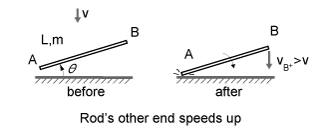
In order to understand it better, I need to know the physics behind a falling angled rod.
tilted_rod_falling.jpg

I understand that the other end speeds up to conserve momentum, but I do not understand how to calculate it. The paper I read on it stated that
If one let's a tilted rod fall onto a table, its other end speeds up on hitting (by 50% for a uniform rod with small θ having plastic impact: VB+ = 3V/2).
I also understand that for very small angles and lengths I could assume that end B is traveling in a straight line.

What would be the derivation behind the 50% increase in speed?
Are there other important aspects I am missing?
Does the angle affect the velocity?
Thank you in advance!
 
Physics news on Phys.org
Can you give a citation for the paper?
 
Cool, I wasn't aware of such physics, so I learned a bunch working it out.

Before the collision, the momentum is ##p_i=mv##
After the collision, the linear momentum is ##p_f=mv_b/2## and the angular momentum about the center of mass is ##L_a=I \omega##, where
##I = mL^2/12## and ##\omega = v_b/L## (taking small angle approximations). So
##L_a = mv_bL/12##
We need to consider the impulse ##p_c## needed at A to slow down the linear momentum and also produce the angular momentum.
Clearly, ##p_c = p_f-p_i##
Also, the impulse creates a change in angular momentum of ##-p_c L/2## which we can set equal to the final angular momentum ##L_a##
We've got two equations and two unknowns:
##-p_c L/2 = mv_bL/12##
##p_c = mv_b/2 - mv##
Eliminate ##p_c## by substitution
##-(v_b/2 m - vm) L/2 = mL/12 v_b##
Clean up:
##v_b/2 - v = -v_b/6##
##v_b = 3v/2##
 
If the angle is not small, you can't use the approximation ##\omega = v_b/L##. You can probably work out the effects.
 
Brilliant! Thank you so much for the explanation. :) Very helpful!
I have a followup question:

I came to the derivation for acceleration of the free end of a rod with one end on the table and the other one in the air, angled at x.
a=3/2×g×cos^2(θ)
This means that the maximum acceleration would result from extremely small angles, so if I were trying to design a super-fast chain the small angle assumption would work.
Under this assumption, in the zig-zig ladder, the first free end would fall 50% faster than gravity, and then the second free end would fall 50% than that, and so on, producing a compounding acceleration effect - is this an accurate way to describe the 'sucking' motion of the chain?
 
That's way too oversimplified. When the chain pulls on a higher link, the higher link pulls back. Overall, the increase in falling speed is slight.
 
Khashishi said:
After the collision, the linear momentum is pf=mvb/2pf=mvb/2p_f=mv_b/2 and the angular momentum about the center of mass is La=IωLa=IωL_a=I \omega, where
I=mL2/12I=mL2/12I = mL^2/12 and ω=vb/Lω=vb/L\omega = v_b/L (taking small angle approximations). So
Hi.
The original paper assumes plastic impact.
Any chance an elastic impact would change the result?
 
Of course. The plastic collision is what keeps point A stuck to the ground after the collision. If you calculate the energy, you will notice that some is lost in the collision.

For an elastic collision, your two equations are conservation of energy and the equation that connects impulse and angular momentum change.
 
  • #10
Khashishi said:
That's way too oversimplified. When the chain pulls on a higher link, the higher link pulls back. Overall, the increase in falling speed is slight.
Ah! Thanks so much, I'm not sure why I'm having trouble visualizing this problem in particular.
So in the design of a super fast chain would have as many bars as possible.
Thanks so much again!
 

Similar threads

  • · Replies 13 ·
Replies
13
Views
3K
  • · Replies 1 ·
Replies
1
Views
2K
  • · Replies 9 ·
Replies
9
Views
4K
  • · Replies 9 ·
Replies
9
Views
3K
  • · Replies 5 ·
Replies
5
Views
2K
  • · Replies 2 ·
Replies
2
Views
2K
  • · Replies 7 ·
Replies
7
Views
2K
  • · Replies 10 ·
Replies
10
Views
5K
Replies
2
Views
2K
  • · Replies 10 ·
Replies
10
Views
4K