How Does an Inverter with Electromechanical Switch Work?

  • Thread starter Thread starter blackgate
  • Start date Start date
  • Tags Tags
    Inverter
Click For Summary
SUMMARY

An inverter with an electromechanical switch operates by utilizing a spring-loaded contact that alternates between two positions, converting direct current (DC) to alternating current (AC). When current flows, an electromagnet pulls the contact down, and once the current ceases, the spring returns the contact to its original position, repeating the cycle. The battery in the circuit serves as the power source, providing the necessary current for operation. Practical implementations typically involve transistors for faster switching, as the basic electromechanical design is outdated and less reliable.

PREREQUISITES
  • Understanding of electromechanical switches
  • Basic knowledge of DC and AC current
  • Familiarity with transformer operation
  • Awareness of inverter circuit designs
NEXT STEPS
  • Research practical inverter circuit designs using transistors
  • Explore the principles of transformer operation in depth
  • Learn about the historical context and evolution of inverter technology
  • Investigate modern inverter applications in renewable energy systems
USEFUL FOR

Electrical engineers, hobbyists interested in circuit design, and anyone looking to understand the fundamentals of inverter technology and its applications.

blackgate
Messages
1
Reaction score
0
Hi guys

Could someone explain to me how does an inverter (with electromechanical switch) works?
Based on the following diagram from wikipedia,
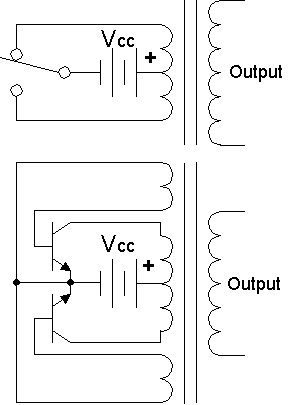
Inverter_ckt_01cjc.png


Source: http://en.wikipedia.org/wiki/Inverter_(electrical)

I understand that (on the above diagram not the bottom) a spring is placed on contact, when a current flows through the circuit, the wire on the opposing side would act as a electromagnet, pulling the contact down. In doing so, the electromagnetic force pulling it would cease. The spring would then move the contact back to the original position and the process repeats, converting DC to AC.

However, could someone please guide me on how the current flows into the circuit and how it exits and why is there a battery in the middle of the circuit?

Thanks
blackgate
 
Engineering news on Phys.org
The diagrams there only show the principle of operation. They are not intended to be complete practical circuits. If you could operate the switches quickly enough, you might get some output, but usually you would have some transistors in there doing the switching for you.

Have a look at this link to see some practical inverter circuits:

http://www.google.com.au/images?hl=...&gbv=2&aq=1&aqi=g10&aql=&oq=inverter&gs_rfai=

When the switch is in the top position, the current flows through the top winding, upwards from the centre tap. When the switch is moved to the bottom position, the current flows from the battery downwards through the lower winding.
So, the magnetic field in the transformer is reversed and you get an alternating voltage from the secondary of the transformer.
 
Last edited:
Vibrator-type power supplies were once used to obtain High Tension supplies for electron-tube (valve) equipment from lower voltage supplies, e.g. for vehicle radio.

This sort of system was never very reliable and has been obsolete for decades
 

Similar threads

Replies
21
Views
2K
  • · Replies 8 ·
Replies
8
Views
2K
  • · Replies 26 ·
Replies
26
Views
4K
Replies
9
Views
2K
Replies
6
Views
4K
  • · Replies 49 ·
2
Replies
49
Views
4K
  • · Replies 15 ·
Replies
15
Views
8K
  • · Replies 9 ·
Replies
9
Views
4K
  • · Replies 22 ·
Replies
22
Views
2K
Replies
3
Views
2K