WMDhamnekar
MHB
- 382
- 31
Homework Statement:: Find the instantaneous acceleration of a projectile fired along a line of longitude (with angular velocity of ##\gamma##constant relative to the sphere) if the sphere
is rotating with angular velocity ##\omega##.
Relevant Equations:: None
Find the instantaneous acceleration of a projectile fired along a line of longitude (with angular velocity of ##\gamma## constant relative to the sphere) if the sphere is rotating with angular velocity ##\omega##. Using the following author's answer, I computed instantaneous acceleration of a projectile fired ##\ddot{r}= -\gamma^2 r + 2\omega \gamma r \cos{\gamma t } \hat{\ell} -\omega^2 r \sin{\gamma t}\hat{n}##
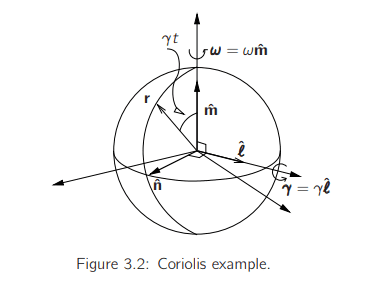
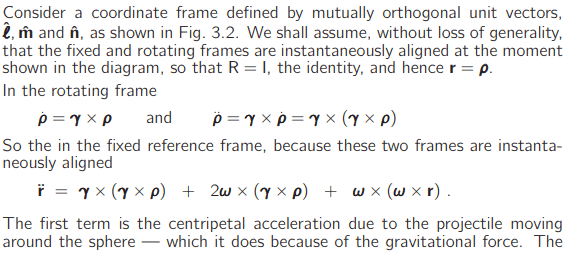
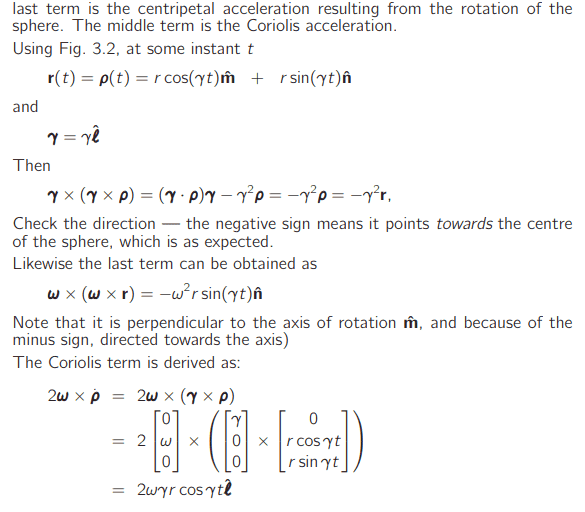
Now, what is the instantaneous acceleration in case of Rocket instead of Projectile?
I don't understand the author's explanation which is as follows:
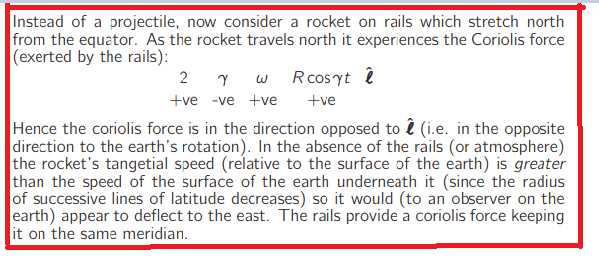
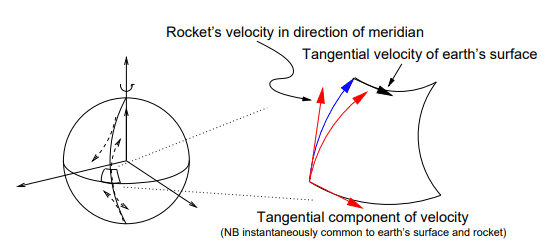
Would anyone here explain me the exact meaning of author's explanation and above picture?[Moderator's note: moved from a homework forum.]
is rotating with angular velocity ##\omega##.
Relevant Equations:: None
Find the instantaneous acceleration of a projectile fired along a line of longitude (with angular velocity of ##\gamma## constant relative to the sphere) if the sphere is rotating with angular velocity ##\omega##. Using the following author's answer, I computed instantaneous acceleration of a projectile fired ##\ddot{r}= -\gamma^2 r + 2\omega \gamma r \cos{\gamma t } \hat{\ell} -\omega^2 r \sin{\gamma t}\hat{n}##
Now, what is the instantaneous acceleration in case of Rocket instead of Projectile?
I don't understand the author's explanation which is as follows:
Would anyone here explain me the exact meaning of author's explanation and above picture?[Moderator's note: moved from a homework forum.]
Last edited by a moderator: