How Does Atmospheric Pressure Affect Measurements in a Torricelli Barometer?

  • Context: Undergrad 
  • Thread starter Thread starter Peter Dimitrov
  • Start date Start date
  • Tags Tags
    Law Pascal's law
Click For Summary
SUMMARY

The discussion centers on the principles of Pascal's law as it relates to the functioning of a Torricelli barometer. It clarifies that while pressure at a specific point in a fluid is determined by the formula (p*g*h), atmospheric pressure must also be considered, especially in closed systems. The barometer measures atmospheric pressure by creating a vacuum above the mercury, which is essential for accurate readings. Misinterpretations of Pascal's law are addressed, emphasizing that pressure is not uniform throughout a fluid in a gravitational field.

PREREQUISITES
  • Understanding of Pascal's law and its implications in fluid mechanics
  • Basic knowledge of barometric principles and the function of a Torricelli barometer
  • Familiarity with the concept of hydrostatic pressure and its calculation
  • Awareness of the effects of atmospheric pressure on fluid systems
NEXT STEPS
  • Study the derivation and applications of hydrostatic pressure equations
  • Explore the concept of static equilibrium in fluids and its implications
  • Investigate the properties of gases and vapors, particularly in relation to barometric measurements
  • Learn about the historical context and experiments related to Torricelli's barometer
USEFUL FOR

Students of physics, educators teaching fluid mechanics, and anyone interested in the principles of pressure measurement and barometric devices.

Peter Dimitrov
Messages
2
Reaction score
0
I have a question about Pascal law. Recenly I was studying and I found this image in my physics book - a copy of the barometer which Torricelli used in his experiment (this is a redraw):
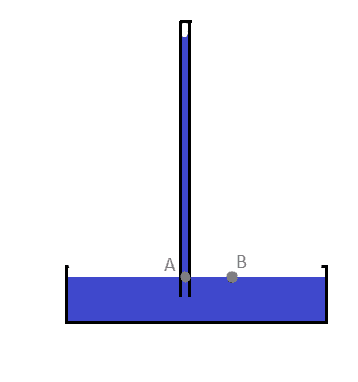
Barometer.png


Where the blue thing is the fluid (mercury), while the black thing is the container.

According to my textbook, the pressure at point A is simply (p*g*h), the preasure caused by the fluid above it. However, why don't we also count the atmospheric pressure? Isn't it supossed to act in the entire fluid according to Pascal's law?

Thanks in advance!
 
Science news on Phys.org
There are no atmospheric pressure in the tube - it is closed tube and that white area at the top is vacuum. Therefore if you press liquid at the point B (atmospheric pressure), liquid will climb the tube at point A due to Pascal's law, until it counter weights the pressure;( here p*g*h is a weight of liquid in the tube).
 
A common misconception is that Pascal's law states that in a fluid at rest, pressure is transmitted throughout the fluid uniformly. This is not correct. Pascal's law actually states that at a particular position within a fluid at rest, the pressure acts the same in all directions (i.e., it is isotropic). This says nothing about how it varies from position to position.
 
Chestemiller, your comment surprises me! It appears my textbook has made a mistake with it's definition of Pascal's law! So, when is pressure transmitted though a fluid uniformly? And does this really have nothing to do with Pascal's law (what I mean is, do the special cases where pressure transmission is uniform follow from Pascal's law)?

(Sorry if some of these questions are unclear. English is a second language for me!)

Thanks for answers!
 
Peter Dimitrov said:
Chestemiller, your comment surprises me! It appears my textbook has made a mistake with it's definition of Pascal's law! So, when is pressure transmitted though a fluid uniformly? And does this really have nothing to do with Pascal's law (what I mean is, do the special cases where pressure transmission is uniform follow from Pascal's law)?

(Sorry if some of these questions are unclear. English is a second language for me!)

Thanks for answers!
In a gravitational field (i.e., with gravity), pressure varies with depth. So it is not uniform throughout the fluid. Pressure is transmitted uniformly throughout a fluid only if the fluid is in static equilibrium and there is no gravity. As I learned it, Pascal's law says only that, at a given spatial location in a fluid, pressure acts identically in all directions. That means that, if I place a tiny surface at an arbitrary location in a fluid that is in static equilibrium, the force per unit area is independent of the orientation of the surface, and acts perpendicular to the surface.
 
Peter Dimitrov said:
I have a question about Pascal law. Recenly I was studying and I found this image in my physics book - a copy of the barometer which Torricelli used in his experiment (this is a redraw):

View attachment 94518

Where the blue thing is the fluid (mercury), while the black thing is the container.

According to my textbook, the pressure at point A is simply (p*g*h), the preasure caused by the fluid above it. However, why don't we also count the atmospheric pressure? Isn't it supossed to act in the entire fluid according to Pascal's law?

Thanks in advance!

there is mercury vapour above the liquid in the tube, the pressure at A is hρg + saturated pressure of mercury at the prevailing temperature.
The space above the mercury is called a 'torrecelli vacuum'
 

Similar threads

  • · Replies 1 ·
Replies
1
Views
2K
  • · Replies 18 ·
Replies
18
Views
3K
  • · Replies 15 ·
Replies
15
Views
2K
  • · Replies 14 ·
Replies
14
Views
4K
  • · Replies 4 ·
Replies
4
Views
7K
  • · Replies 9 ·
Replies
9
Views
3K
  • · Replies 1 ·
Replies
1
Views
2K
  • · Replies 14 ·
Replies
14
Views
8K
Replies
7
Views
8K
  • · Replies 1 ·
Replies
1
Views
3K