How Does Elastic Collision Angle Relate to Mass Ratios?

Join the discussion
Ask a follow-up here, or get your own question answered by working scientists, mathematicians and engineers — people, not an autocomplete.
Real named experts · corrections over time · the nuance an AI answer skips
9 replies · 4K views
TL;DR
Possible condition for maximum deflection during collision
Large mass (M) - moving - collides elastically with stationary small mass (m) as per crude diagram below. Angle θ is formed between the initial path of the large mass and the line of centres during collision. I would like to say that maximum deflection of the large mass occurs when cos(θ)=m/M so that the small mass 'stops' the incoming component of momentum along line of centres leaving the large mass with only the component perpendicular to line of centres. Is this correct thinking ?
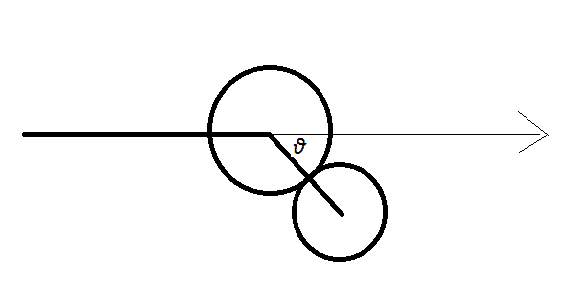
Collision.png
 
Last edited:
Physics news on Phys.org
neilparker62 said:
so that the small mass 'stops' the incoming component of momentum along line of centres leaving the large mass with only the component perpendicular to line of centres
Why would that be the maximal deflection? How do you define deflection?
 
A.T. said:
Why would that be the maximal deflection? How do you define deflection?
Diagram below shows post collision trajectories in red. β is the angle of deflection of the larger mass from its original trajectory. Since the angles θ and β are complementary we have sin(β)=m/M and this is a proven result for angle of maximum deflection. See:

https://www.feynmanlectures.caltech.edu/info/exercises/maximum_angle_deflection.html

I am just not sure if the way we are getting there per diagram is valid or just somehow producing the right result with wrong reasoning.

Post collision.png
 
The way I think about it is as follows. If we do the problem in the ZMF and then transform back into the lab frame, the velocity of the larger mass will be the sum of a vector of magnitude ##\frac{Mv}{M+m}## to the right (the ZMF velocity) and another of magnitude ##v(1-\frac{M}{M+m})## in a direction to be determined (the final velocity in the ZMF).

For maximal deflection, the resultant velocity must be perpendicular to the second vector; this can be seen by drawing a circle of radius ##v(1 - \frac{M}{M+m})## centred on the tip of the first vector, and noting that the resultant velocity is a tangent to this circle. Then we get ##\sin{\beta} = \frac{v(1 - \frac{M}{M+m})}{\frac{Mv}{M+m}} = \frac{m}{M}##.
 
  • Like
Likes   Reactions: TSny
etotheipi said:
Then we get ##\sin{\beta} = \frac{v(1 - \frac{M}{M+m})}{\frac{Mv}{M+m}} = \frac{m}{M}##.
So the defection angle β doesn't depend on the collision angle θ? Is the premise that the stationary ball has less mass than the oncoming ball (m < M)?
 
A.T. said:
So the defection angle β doesn't depend on the collision angle θ? Is the premise that the stationary ball has less mass than the oncoming ball (m < M)?

Yes we must have m<M otherwise deflection angle can be just about anything. Deflection angle does depend on collision angle. For example if it's 0 there will be no deflection at all. My analysis is saying that the collision angle and deflection angle are complementary when you get maximum deflection. But I can't get the Math of energy/momentum conservation to work under that scenario. Which is why I questioned my own premise.
 
neilparker62 said:
Which is why I questioned my own premise.
This part seems doubtful to me: "the small mass 'stops' the incoming component of momentum along line of centres leaving the large mass with only the component perpendicular to line of centres". I think the total transfer of momentum along the line of force happens only for M=m.
 
A.T. said:
This part seems doubtful to me: "the small mass 'stops' the incoming component of momentum along line of centres leaving the large mass with only the component perpendicular to line of centres". I think the total transfer of momentum along the line of force happens only for M=m.
Many thanks - I think you have put your finger on the problem which was to view the momentum component along line of centres as ## (Mcosθ)v = mv ## if cosθ = m/M rather than correctly ## M(vcosθ) ##. Velocity is a vector which can have components but mass is a scalar and cannot. It makes no difference to the momentum but of course it does when considering Kinetic energy.

So now that perhaps begs the question - what collision angle does in fact give rise to maximum deflection ?
 
Let's redraw this setup:

Collision.png

From the above we have established that sin(β)=cos(2α)=m/M. Hence β=90-2α. From these relationships we can establish a refraction type formula:

$$\frac{sin(θ_i)}{sin(θ_r)}=cot(α)=\sqrt{\frac{M+m}{M-m}}$$

Fraction of energy transmitted to stationary mass m: $$\frac{2m}{M+m}$$

Fraction of energy retained by large mass: $$\frac{M-m}{M+m}$$

Interesting similarity of these formulas to those in the transmission/reflection of wave energy from one medium to another!