How Does Frequency Affect a Circuit with Capacitors and Inductors?

  • Thread starter Thread starter Electro_vass
  • Start date Start date
  • Tags Tags
    Frequency
Click For Summary

Discussion Overview

The discussion revolves around the effects of frequency on circuits containing capacitors and inductors, particularly in the context of AC analysis. Participants explore theoretical concepts, simulation results, and the implications of frequency on circuit behavior.

Discussion Character

  • Exploratory
  • Technical explanation
  • Conceptual clarification
  • Debate/contested
  • Mathematical reasoning

Main Points Raised

  • One participant notes that at low frequency, capacitors exhibit high resistance while inductors show low resistance, leading to uniform voltage across the circuit.
  • Another participant emphasizes the importance of distinguishing between time and frequency domain analyses, stating that AC analysis does not reflect time dependence.
  • Concerns are raised about the theoretical understanding of phasors in steady-state AC circuit analysis, suggesting that simulations may not be helpful without this background.
  • Discussion includes the behavior of output voltage across a series LC resonant block, which has a minimum impedance at the resonant frequency, affecting voltage output.
  • Participants discuss the use of logarithmic units (dB) for displaying results, citing advantages such as covering a wide range of values and simplifying the representation of large numbers.
  • One participant mentions that time analysis at various frequencies would reveal delays in output settling to steady-state values, indicating frequency dependence.

Areas of Agreement / Disagreement

Participants express differing views on the relationship between frequency and circuit behavior, particularly regarding time dependence and the interpretation of simulation results. No consensus is reached on these points.

Contextual Notes

Limitations include potential misunderstandings of the underlying theory, the dependence on specific definitions of frequency and time analysis, and unresolved mathematical steps in the discussion.

Who May Find This Useful

Readers interested in AC circuit analysis, the behavior of capacitors and inductors in varying frequency conditions, and the application of logarithmic scales in electrical engineering may find this discussion relevant.

Electro_vass
Messages
5
Reaction score
0
Hi,

Im quite new to frequency and how it effects a circuit with both capacitors and inductor. I have created a simple circuit in Multisim and run an AC-analysis.
Pictures of both circuit and analysis is attachments.

What is happening here.

And arent the circuit also depending on the time (When the capacitors is getting fully charged)?

What I think is happening;

1. With lov frequency both the capacitor will have very high resistance, and the inductor will have very lov. Because of JWL, and 1/Jwl W= rad/s
And all the voltage will be the same, because now current will run tru the circuit.

2. Then with higher frequency the capacitors will start charging, and therefore it will take som voltage.

But is it not time depending, only frequency depending?
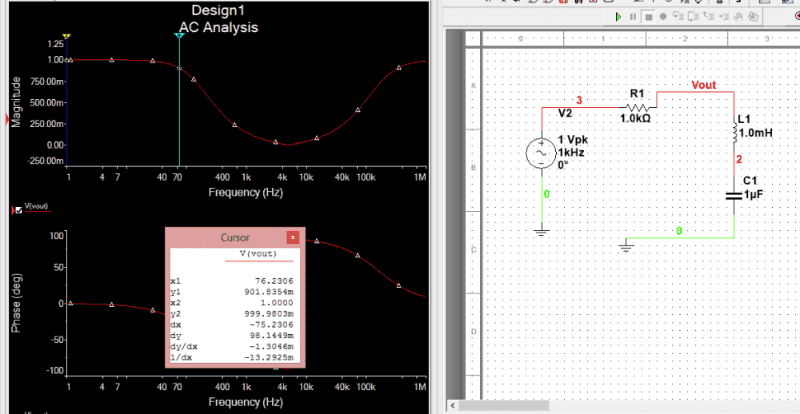
bilde77.png
 
Engineering news on Phys.org
I am not quite sure what your problem is - however, you must strictly discriminate between analyses in the TIME and FREQUENCY domain.
You have performed an AC analysis (frequency domain) and, therefore, you cannot expect to see any time dependence in the simulation result.
Your output voltage is measured across a series LC resonant block which has an impedance minimum (zero) at the resonant frequency.
As a consequence, the output voltage goes down to zero at this frequency.
Very far below and above this frequency either the capacitor or the inductor, respectively, provide a very large impedance - hence, the complex impedance divider between R and the LC block exhibits (nearly) no damping and the output approaches "1".
Please note that it is common practice to display such results using logarithmic units (dB).
In case you want to study the time behaviour of the circuit you have two choices (TRAN analysis):
* Response to a voltage step at the input,
* Response to a sinusoidal signal (fixed frequency) .
 
Electro_vass said:
Im quite new to frequency and how it effects a circuit with both capacitors and inductor. I have created a simple circuit in Multisim and run an AC-analysis.

Simulations won't help you if you don't understand anything about theory behind them.
Theory in this case is the application of the phasors in a steady state AC circuits analysis.
How quickly will you learn this depends on the math background you have.
http://www.ece.msstate.edu/~donohoe/ece3183ac_analysis.pdf
 
Last edited by a moderator:
  • Like
Likes   Reactions: jim hardy
LvW said:
I am not quite sure what your problem is - however, you must strictly discriminate between analyses in the TIME and FREQUENCY domain.
You have performed an AC analysis (frequency domain) and, therefore, you cannot expect to see any time dependence in the simulation result.
Your output voltage is measured across a series LC resonant block which has an impedance minimum (zero) at the resonant frequency.
As a consequence, the output voltage goes down to zero at this frequency.
Very far below and above this frequency either the capacitor or the inductor, respectively, provide a very large impedance - hence, the complex impedance divider between R and the LC block exhibits (nearly) no damping and the output approaches "1".
Please note that it is common practice to display such results using logarithmic units (dB).
In case you want to study the time behaviour of the circuit you have two choices (TRAN analysis):
* Response to a voltage step at the input,
* Response to a sinusoidal signal (fixed frequency) .
Thanks a lot for the response. I now understand much better. Do you know why its common pratice to display results using logarithmic units (db9?
 
zoki85 said:
Simulations won't help you if you don't understand anything about theory behind them.
Theory in this case is the application of the phasors in a steady state AC circuits analysis.
How quickly will you learn this depends on the math background you have.
http://www.ece.msstate.edu/~donohoe/ece3183ac_analysis.pdf
Thanks. I will read the PDF. I have learn some stedy state before, but its getting more complex now, with different frequency. I am sure its a good ide to read it over again then.
 
Last edited by a moderator:
Electro_vass said:
Do you know why its common pratice to display results using logarithmic units (db9?

Your question concerns the so called BODE diagram. Here, the magnitude is displayed in dB and the phase in deg - both over a log. spaced frequency axis.
This has many advantages. One adavantage is that it is very easy to verify the relation between amplitude (magnitude) and phase. I recommend to read some book chapters or other contributions using the keyword "Bode diagram".
 
Electro_vass said:
Do you know why its common pratice to display results using logarithmic units (db9?
The main reason for using a dB scale is that you can cover a huge range of values. This is along the same lines as the use of 'Standard Form' - e.g. 2.34 X10¹², which avoids writing masses and masses of zeros (2340000000000). The dB scale is similarly based on the base ten logarithm of a number. Confusing until you get so used to it that you can't do without it.
 
  • Like
Likes   Reactions: Electro_vass
Electro_vass said:
Thanks. I will read the PDF. I have learn some stedy state before, but its getting more complex now, with different frequency. I am sure its a good ide to read it over again then.
the graph you have of Vout is the steady state magnitude and phase of the signal Vout in your circuit vs frequency. if you did a time analysis at various frequencies, you would find that there would be some delay before the outut mag and phase settled at their steady state value

that means that with a 1k frequency input, your output will be one value after some time. If you were to use a signal of a different frequency this value will be different.

Lets look at the circuit. at DC, current will not move through a capacitor, so it makes sense that Vout will equal the voltage input (zero current through the resistor, so zero voltage drop)
at daylight ("inf" frequency) current will not move through an inductor, so it makes sense that Vout will equal the voltage input (zero current through the resistor, so zero voltage drop)
 
sophiecentaur said:
The main reason for using a dB scale is that you can cover a huge range of values. This is along the same lines as the use of 'Standard Form' - e.g. 2.34 X10¹², which avoids writing masses and masses of zeros (2340000000000). The dB scale is similarly based on the base ten logarithm of a number. Confusing until you get so used to it that you can't do without it.
Thanks for a very good explanation. That makes so much sense now
sophiecentaur said:
The main reason for using a dB scale is that you can cover a huge range of values. This is along the same lines as the use of 'Standard Form' - e.g. 2.34 X10¹², which avoids writing masses and masses of zeros (2340000000000). The dB scale is similarly based on the base ten logarithm of a number. Confusing until you get so used to it that you can't do without it.
Thanks for a good, simple explanation. That makes so more sense now.
 

Similar threads

  • · Replies 3 ·
Replies
3
Views
5K
  • · Replies 4 ·
Replies
4
Views
3K
  • · Replies 3 ·
Replies
3
Views
2K
  • · Replies 4 ·
Replies
4
Views
4K
  • · Replies 12 ·
Replies
12
Views
2K
  • · Replies 5 ·
Replies
5
Views
2K
  • · Replies 2 ·
Replies
2
Views
2K
  • · Replies 32 ·
2
Replies
32
Views
6K
  • · Replies 13 ·
Replies
13
Views
4K
  • · Replies 81 ·
3
Replies
81
Views
8K