How Does Pivot Point Location Affect the Time Period of a Physical Pendulum?

Click For Summary

Homework Help Overview

The discussion revolves around the effects of pivot point location on the time period of a physical pendulum, specifically in the context of a spring-mass system. The original poster expresses confusion regarding the relationship between the center of mass, pivot point, and the time period of the pendulum.

Discussion Character

  • Exploratory, Conceptual clarification, Mathematical reasoning

Approaches and Questions Raised

  • Participants explore the nature of the problem, questioning whether it is more aligned with spring-mass oscillation rather than a traditional pendulum. There are discussions about free body diagrams, moments, and the role of the moment of inertia.

Discussion Status

Participants are actively engaging with the problem, providing feedback on diagrams and suggesting the need for specific analysis. Some have offered guidance on writing equations of motion based on the moments involved, while others are clarifying concepts related to forces and moments.

Contextual Notes

There is an emphasis on the importance of accurately identifying the forces and moments acting on the system, as well as the need to consider the mass distribution of the rod in relation to the pivot point. The original poster is reminded to provide visual aids directly on the forum to enhance clarity.

Yossi33
Messages
22
Reaction score
3
Homework Statement
Physical pendulum time period
Relevant Equations
T=2pi*(I/mgh)
hello, i have some diffuculties with this problem, there's the point where the spring is attached to the rod and according to the equation of time period of physical pendulum , h represent the distance from the COM and the pivot point. here the pivot point is at the COM. and i know that it can't be (then the T would be infinity). i don't know if i need to calculate the T of the spring and it would be the same but than what part of the mass is attached to it.
thanks for the help.
https://ibb.co/nsGTrQw

[Mentor Note -- Newbie OP reminded to upload images to PF to avoid confusion when externally linked images disappear (and the associated suspicions of student cheating). All associated images have been uploaded by the Mentors]
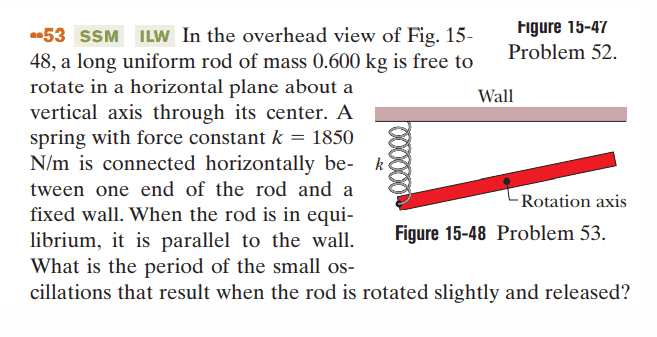
1647018355455.png
 
Last edited by a moderator:
  • Like
Likes   Reactions: Tea_Aficionado
Physics news on Phys.org
It looks more like a spring-mass oscillation problem than a pendulum problem to me. Can you show us your FBD for the horizontal lever during small oscillations?
 
  • Like
Likes   Reactions: Yossi33
I think you need some specific analysis and an equation of motion for this problem.
 
  • Like
Likes   Reactions: Yossi33
berkeman said:
It looks more like a spring-mass oscillation problem than a pendulum problem to me. Can you show us your FBD for the horizontal lever during small oscillations?
https://ibb.co/LPhzYhf
you mean like this? it's an overhead view so the weight and normal cancel each other so there is only the kx of the spring.

1647018429135.png
 
Yossi33 said:
https://ibb.co/LPhzYhf
you mean like this? it's an overhead view so the weight and normal cancel each other so there is only the kx of the spring.
That's a good start.
 
  • Like
Likes   Reactions: Yossi33
PeroK said:
That's a good start.
but how can i express the partial mass of the rod that is attached to the rod?
 
What have you learned about moments?
 
  • Like
Likes   Reactions: Yossi33
pbuk said:
What have you learned about moments?
the force by the spring exert a moment on the rod equal to F*(half length of rod) ( the perpendicular distance for the line of action of the force and the rotation axis)
if i denote the rod L and F is kx then
the moment about the rotation axis , exerted by the spring is kx*0.5*L
 
  • Like
Likes   Reactions: pbuk
And what resists the moment exerted by the spring?
 
  • Like
Likes   Reactions: Yossi33
  • #10
do you mean the screw at the center of the rod?
 
  • #11
Yossi33 said:
do you mean the screw at the center of the rod?
I think he meant the moment of inertia!
 
  • Like
Likes   Reactions: Yossi33 and pbuk
  • #12
PeroK said:
I think he meant the moment of inertia!
Yes. So can you write an equation of motion using the moment exerted by the spring and the moment of intertia of the rod?
 
  • Like
Likes   Reactions: Yossi33
  • #13
pbuk said:
Yes. So can you write an equation of motion using the moment exerted by the spring and the moment of intertia of the rod?
https://ibb.co/kgYgSL9 is it correct?

1647049718000.png
 
Last edited by a moderator:
  • #15
thank you all for the help
 
  • Like
Likes   Reactions: berkeman

Similar threads

Replies
3
Views
2K
  • · Replies 3 ·
Replies
3
Views
4K
  • · Replies 4 ·
Replies
4
Views
7K
Replies
1
Views
2K
  • · Replies 11 ·
Replies
11
Views
7K
  • · Replies 11 ·
Replies
11
Views
5K
  • · Replies 3 ·
Replies
3
Views
3K
Replies
3
Views
6K
Replies
12
Views
11K
Replies
4
Views
2K