Kashmir
- 466
- 74
A disc initially has angular velocities as shown
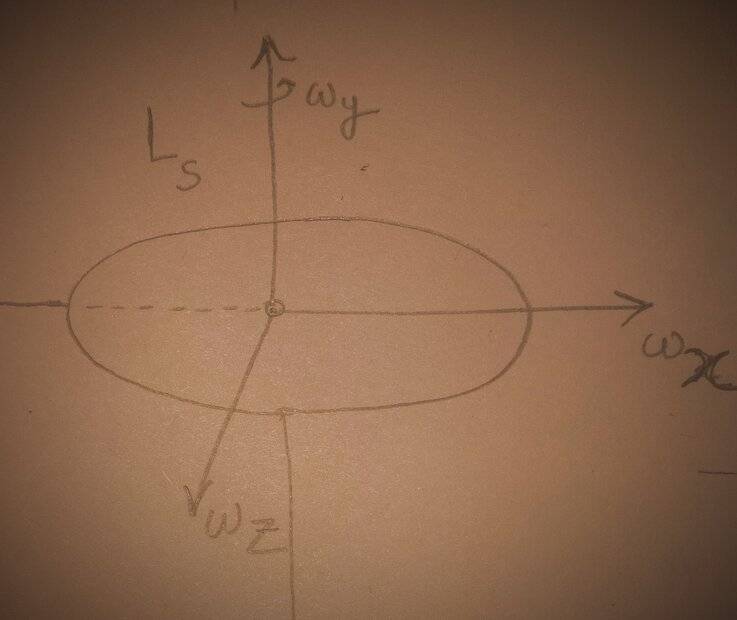
It's angular momentum along the y-axis initially is ##L_s##
I tried to find its angular momentum and ended up with this:##L=I_{x} \omega_{x}+I_{y} w_{y}+I_{z} z_{z}##The z component of angular momentum is thus ##L_{z}=I_{z} \omega_{z}##
However I found a similar situation in a book
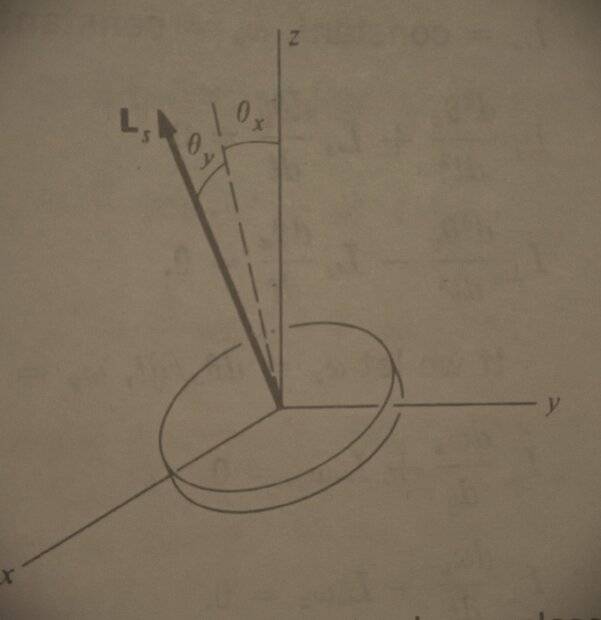
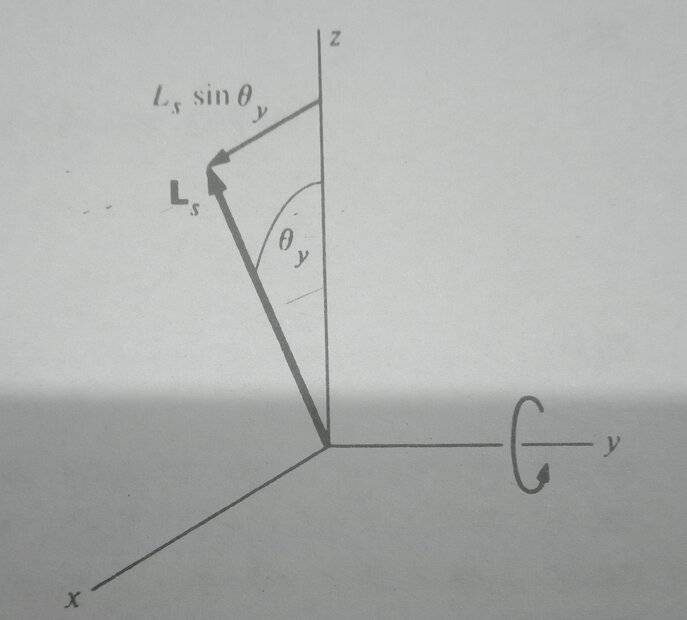
that writes the components of angular momentum along x as ##L_{x}=I_{x x} \frac{d \theta_{x}}{d t}+L_{s} \sin \theta_{y}##
The book has an additional term ##L_{s} \sin \theta_{y}## for the angular momentum which I don't.
Why am I wrong ?
It's angular momentum along the y-axis initially is ##L_s##
I tried to find its angular momentum and ended up with this:##L=I_{x} \omega_{x}+I_{y} w_{y}+I_{z} z_{z}##The z component of angular momentum is thus ##L_{z}=I_{z} \omega_{z}##
However I found a similar situation in a book
that writes the components of angular momentum along x as ##L_{x}=I_{x x} \frac{d \theta_{x}}{d t}+L_{s} \sin \theta_{y}##
The book has an additional term ##L_{s} \sin \theta_{y}## for the angular momentum which I don't.
Why am I wrong ?
Last edited: