How does the inclusion of a massive rod affect the dynamics of a pendulum?

  • Context: Graduate 
  • Thread starter Thread starter ellipsis
  • Start date Start date
  • Tags Tags
    Pendulum Rod
Click For Summary

Discussion Overview

The discussion centers on the dynamics of a pendulum that includes a massive rod in addition to a bob. Participants explore how the mass distribution affects the pendulum's motion, torque, and center of mass, with a focus on modeling approaches and the implications of mass on the pendulum's behavior.

Discussion Character

  • Exploratory
  • Technical explanation
  • Mathematical reasoning
  • Debate/contested

Main Points Raised

  • One participant suggests treating the bob and rod as separate point masses for torque calculations, noting that the center of mass shifts closer to the pivot, which affects the frequency of motion.
  • Another participant proposes finding the center of mass of the system and treating the pendulum as a massless rod with a combined point mass at the center of mass, asserting that the period is related only to the length to the center of mass, not the mass itself.
  • Some participants express uncertainty about the use of Lagrangian mechanics, preferring to model the pendulum using second-order differential equations derived from basic trigonometry.
  • There is a discussion about the difference between torque and moment of inertia, with one participant clarifying that torque is analogous to force while moment of inertia is analogous to mass.
  • Several participants mention the complexity of integrating the mass distribution of the rod and bob when considering the pendulum as a rigid body.

Areas of Agreement / Disagreement

Participants generally agree on the importance of the center of mass in determining the dynamics of the pendulum. However, there are competing views on the best modeling approach, with some favoring Lagrangian methods and others preferring direct differential equations. The discussion remains unresolved regarding the optimal modeling technique.

Contextual Notes

Participants express limitations in their understanding of Lagrangian mechanics and its application in numerical simulations. There is also mention of the need to consider the moment of inertia when calculating torque, indicating potential gaps in the discussion regarding the treatment of the pendulum as an extended body.

ellipsis
Messages
158
Reaction score
24
Consider a realistic pendulum with a bob of mass ##M## and a rod of mass ##m##. For the purposes of torque, is it correct to treat the bob and rod as two separate point masses, one at length ##L##, and the other at length ##\frac{L}{2}##?

When I implemented this idea, I found that centripetal acceleration increased by a factor of ##\frac{3}{2}##

The only change I detected was that the center of mass of the bob/rod combo shifted closer to the pivot, which increased the frequency of motion. In this case, the total mass had no effect.

This is the force analysis I used for a massless pendulum. For the massive pendulum, I treated the rod as a second point mass at length ##\frac{L}{2}, with its own set of forces. I then added the forces together. The acceleration due to gravity did not change (the bottom blue line), but the centripetal acceleration increased (the top blue line).
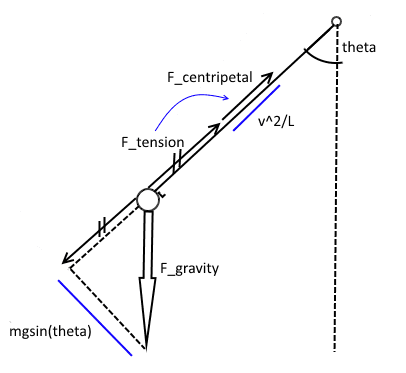
massless_pendulum.png


I did not specify any density information, and the pendulum swings faster, but independently of the added mass, which leads me to conclude that this is a spurious result.

If so, how should you model a pendulum with a massive rod? I'd prefer a purely force-based model (rather than Lagrangians, which I've never been introduced to)
 
Physics news on Phys.org
Find the centre of mass of the system of rod and bob. Then treat your pendulum as a massless rod with a point mass of M+m at the centre of mass. For small perturbations of a pendulum the period is related only to the length between the pivot and the centre of mass, not the mass. The pendulum clock in Westminster (colloquially known as Big Ben), was once (is still ?) regulated by adding or subtracting pennies from the top of the pendulum bob. It was not the extra mass that made a difference but the raising or lowering of the centre of mass.
 
ianchristie said:
Find the centre of mass of the system of rod and bob. Then treat your pendulum as a massless rod with a point mass of M+m at the centre of mass. For small perturbations of a pendulum the period is related only to the length between the pivot and the centre of mass, not the mass. The pendulum clock in Westminster (colloquially known as Big Ben), was once (is still ?) regulated by adding or subtracting pennies from the top of the pendulum bob. It was not the extra mass that made a difference but the raising or lowering of the centre of mass.

Thanks, that was very informative - and elegantly simple in retrospect. It turns out the behavior of a pendulum with a rod with mass is simply isomorphic to a pendulum of slightly shorter length, and the only added complexity is finding the center of mass.
 
If you regard the whole thing as a rigid body, you can simply treat each piece as an infitesimal mass and integrate for the lagrangian.
 
HomogenousCow said:
If you regard the whole thing as a rigid body, you can simply treat each piece as an infitesimal mass and integrate for the lagrangian.

Like I said above, I don't really understand what a Lagrangian is, and, more importantly, how it can be practically used in i.e. a numerical simulation. Could you demonstrate?

As it is, I'm modeling the pendulum as two second-order differential equations of motion in Cartesian coordinates - which was derived using basic trigonometry. The origin is at the pivot point, in this model.

$$
\frac{d^2x}{dt^2} = \frac{gxy - xv^2}{L^2}
$$
$$
\frac{d^2y}{dt^2} = \frac{-gx^2 - yv^2}{L^2}
$$
 
Last edited:
ellipsis said:
Like I said above, I don't really understand what a Lagrangian is, and, more importantly, how it can be practically used in i.e. a numerical simulation. Could you demonstrate?

As it is, I'm modeling the pendulum as two second-order differential equations of motion in Cartesian coordinates - which was derived using basic trigonometry.

Thing is the y and x coordinates are coupled, thus you only need one second order differential equation.
Basically, treat the infitesimal pieces of the rod as individual particles (all posessing the shared degree of freedom, the angle), and then integrate through the lengths of the rod. It's rather straightforward to do this with the lagrangian, but it's also do-able directly with the equations of motion.
 
HomogenousCow said:
Thing is the y and x coordinates are coupled, thus you only need one second order differential equation.
Basically, treat the infitesimal pieces of the rod as individual particles (all posessing the shared degree of freedom, the angle), and then integrate through the lengths of the rod. It's rather straightforward to do this with the lagrangian, but it's also do-able directly with the equations of motion.
Frankly, I still don't get it. I'm interested in modeling the system with just one second-order differential equation, though. I realize I could alternatively model everything in polar coordinates, but that isn't the Lagrangian (which, I understand, is supposed to be in generalized coordinates).
 
ellipsis said:
Consider a realistic pendulum with a bob of mass ##M## and a rod of mass ##m##. For the purposes of torque, is it correct to treat the bob and rod as two separate point masses, one at length ##L##, and the other at length ##\frac{L}{2}##?
To calculate the torque, yes. But you need to treat it as an extended body to calculate the moment of inertia.
 
Doc Al said:
To calculate the torque, yes. But you need to treat it as an extended body to calculate the moment of inertia.

Thanks for the response. What's the difference between torque and the moment of inertia?
 
  • #10
ellipsis said:
What's the difference between torque and the moment of inertia?
It's the rotational equivalent to the difference between force and mass: Torque is to force as moment of inertia is to mass.
 
  • #11
Doc Al said:
It's the rotational equivalent to the difference between force and mass: Torque is to force as moment of inertia is to mass.

Ah, that clears it up a great deal. Nice analogy. I see now: I calculated the torque correctly using that method, but I neglected to take into account the moment of inertia - which itself is proportional to the distance of the center of mass from the pivot point.

Thanks - you have a way of simplifying topics, Doc Al.
 

Similar threads

  • · Replies 11 ·
Replies
11
Views
2K
  • · Replies 10 ·
Replies
10
Views
2K
  • · Replies 1 ·
Replies
1
Views
2K
  • · Replies 4 ·
Replies
4
Views
2K
  • · Replies 2 ·
Replies
2
Views
2K
  • · Replies 8 ·
Replies
8
Views
2K
  • · Replies 76 ·
3
Replies
76
Views
7K
  • · Replies 3 ·
Replies
3
Views
1K
  • · Replies 15 ·
Replies
15
Views
3K
  • · Replies 2 ·
Replies
2
Views
1K