How Does the Kinetic Theory of Gases Describe Particle Collisions?

Click For Summary

Discussion Overview

The discussion centers on the Kinetic Theory of gases, specifically focusing on the concept of particle collisions and the associated probability functions. Participants explore the meaning of the velocity distribution function and its implications for understanding collisions between gas molecules.

Discussion Character

  • Exploratory
  • Technical explanation
  • Conceptual clarification
  • Debate/contested

Main Points Raised

  • Some participants question whether ##f(v,v')## represents the velocity distribution function and if it indicates the fraction of molecules with specific velocities.
  • Others clarify that ##f(v,v')## is the probability of two molecules with velocities ##\vec v## and ##\vec v'## colliding, noting potential confusion due to its expression over a small range of velocities.
  • There is a query about the derivation of the exponential expression for ##f(v^2)## and ##f(v'^2)##, and how the product of these functions relates to the probability of collision.
  • One participant suggests replacing "f" with "p" for clarity and provides a mathematical expression related to the distribution of kinetic energies.
  • Concerns are raised about the interpretation of the product of ##f(v)## and ##f(v')## as implying a molecule can possess two velocities simultaneously, which seems nonsensical to some participants.
  • Questions arise regarding the relationship between collision time, probability of collision, mean free path, and the distribution of velocities.

Areas of Agreement / Disagreement

Participants express differing views on the interpretation of the probability functions and their implications for collisions. There is no consensus on the relationship between the probability of collision and the distribution of velocities, leaving the discussion unresolved.

Contextual Notes

Some participants note that the discussion lacks clarity on the relationship between collision time, relative velocities, and the probability functions, indicating potential limitations in the current understanding.

unscientific
Messages
1,728
Reaction score
13
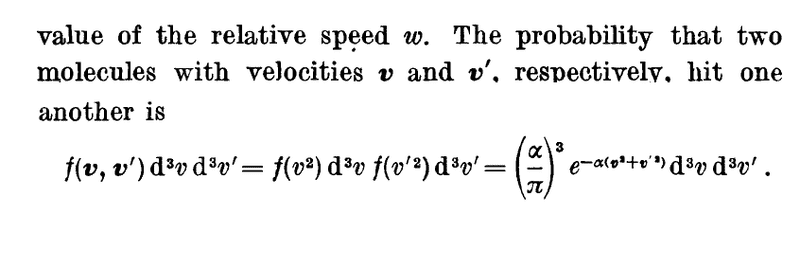
Hi guys, I'm studying the Kinetic Theory of gases from Pauli's book Vol. 3. Here he describes a section on the Mean free path, where the probability of two particles with speed v and v' colliding is described as:
2cmtys.png
What is f(v,v') here? Is it the velocity distribution function? If so, isn't it simply the fraction of molecules with velocities v and v' ?
 
Physics news on Phys.org
##f(\vec v, \vec v')## appears to be the probability that two molecules with velocities ##\vec v## and ##\vec v'## hit one another - as stated in the accompanying text.

It may be a bit confusing because it is expressed as a small range of velocities.
 
Simon Bridge said:
##f(\vec v, \vec v')## appears to be the probability that two molecules with velocities ##\vec v## and ##\vec v'## hit one another - as stated in the accompanying text.

It may be a bit confusing because it is expressed as a small range of velocities.

How did they get the exponential expression for f(v2) and f(v'2)?

And it is implied that the probability of both of them colliding is the product: f(v2) f(v'2) dv dv'

Then on its own, what does f(v2)dv and f(v'2)dv' mean?
 
replace the "f"'s with "p"'s ... you may be able to read it better.

$$p(\vec v^2) = \sqrt{\frac{\alpha^3}{\pi}}e^{-\alpha \vec v^2}$$ ... comes from the distribution of kinetic energies perhaps (as ##K\propto v^2##) ...

You may find the following approach easier:
http://physics.bu.edu/~redner/542/refs/reif-chap12.pdf
 
Simon Bridge said:
replace the "f"'s with "p"'s ... you may be able to read it better.

$$p(\vec v^2) = \sqrt{\frac{\alpha^3}{\pi}}e^{-\alpha \vec v^2}$$ ... comes from the distribution of kinetic energies perhaps (as ##K\propto v^2##) ...

You may find the following approach easier:
http://physics.bu.edu/~redner/542/refs/reif-chap12.pdf

I have verified that the book meant f(v2) represents the fraction of molecules traveling with velocity v:

98axx0.png


Why is the product of f(v) and f(v') the probability that both particles with velocities v and v' collide? Technically the product means fraction of molecules with velocities v and v', implying a molecule having two velocities at the same time --- which doesn't make sense?
 
Did you read the link I gave you?
 
Simon Bridge said:
Did you read the link I gave you?

Yeah, nothing is said about the relation between probability of collision and distribution of velocities.

Collision time, probability of collision and mean free path was explained, but it didn't relate them to the distribution of velocities?
 
Is the collision time not related to the relative velocities (w)?
Is the distribution of relative velocities not related to the P(v,v') ?
 

Similar threads

  • · Replies 27 ·
Replies
27
Views
15K
  • · Replies 1 ·
Replies
1
Views
2K
  • · Replies 7 ·
Replies
7
Views
2K
  • · Replies 2 ·
Replies
2
Views
3K
  • · Replies 1 ·
Replies
1
Views
2K
  • · Replies 3 ·
Replies
3
Views
4K
  • · Replies 6 ·
Replies
6
Views
2K
  • · Replies 4 ·
Replies
4
Views
8K
  • · Replies 4 ·
Replies
4
Views
3K
  • · Replies 5 ·
Replies
5
Views
2K