How Does the Photoelectric Effect Relate to Electron Kinetic Energy?

Click For Summary

Discussion Overview

The discussion revolves around the relationship between the photoelectric effect and the kinetic energy of electrons, particularly focusing on how potential energy converts to kinetic energy as electrons move through an electric field. Participants seek clarification on the concepts involved and the specific mechanics of energy transformation in this context.

Discussion Character

  • Conceptual clarification
  • Debate/contested
  • Mathematical reasoning

Main Points Raised

  • One participant expresses confusion about how the final kinetic energy of an electron can equal its initial potential energy, referencing a previous explanation that compares the situation to a ball falling from a height.
  • Another participant attempts to clarify by suggesting that the comparison should be made at the moment just before the electron impacts the anode, where potential energy has been fully converted to kinetic energy.
  • A participant questions the complexity of the initial explanation and seeks to understand the role of a 50V potential difference in the context of kinetic energy.
  • There is an acknowledgment from one participant that they begin to understand the relationship after considering the potential difference, indicating a shift in their comprehension.

Areas of Agreement / Disagreement

Participants generally agree on the conceptual framework of energy conversion but express differing levels of understanding and clarity regarding the explanations provided. Some confusion remains about the details of the energy transformation process and the implications of the potential difference.

Contextual Notes

Participants reference specific scenarios and analogies (e.g., the waterfall analogy) to illustrate their points, indicating that the discussion may involve varying interpretations of energy concepts. The mention of the 50V potential difference suggests a need for further exploration of its implications in the context of the photoelectric effect.

Who May Find This Useful

This discussion may be useful for students or individuals seeking to understand the principles of the photoelectric effect, energy conversion in electric fields, and the underlying physics concepts related to potential and kinetic energy.

kabtq9s
Messages
3
Reaction score
0
Hello,

This question is based on the passage to the left.
Please I need some one to explain it to me in "baby steps" if possible. I already read another explanation of it .. (posted below the picture) but i still can't understand how the final kinetic energy will be the same as the initial potential energy

especially since the explanation of a smiliar problem on this exams states that "The charged electron particles accelerate in an electric field. The electron starts with a velocity that increases as it approaches the anode through the vacuum. "
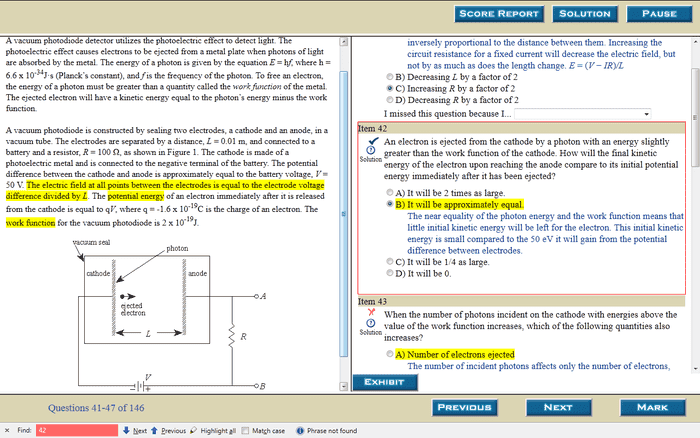

42.png


The other explanation: An electron is negatively charged, so it will accelerate from the negatively charged cathode to the positively charged anode. From energy standpoint, this is equivalent to the electron's potential energy being converted to the kinetic energy. If the energy of the photon that is used to eject the electron is only slightly larger than the electron's work function, then the electron has very little kinetic energy. In other words, its initial kinetic energy is approximately 0. When the electron reaches the anode, approximately all of its final kinetic energy is from the initial potential energy. Hence they are equal.
 
Physics news on Phys.org
but i still can't understand how the final kinetic energy will be the same as the initial potential energy

What don't you understand about it? The explanation pretty much says it all. Do you understand potential energy?
 
Drakkith said:
What don't you understand about it? The explanation pretty much says it all. Do you understand potential energy?

The question asks to compare the final kinetic energy to the initial potential energy. I imagine the electron as a ball on top of a waterfall. At the top of the waterfall it's potential energy will be at max, and when it finally falls and reaches the bottom of the waterfall its kinetic energy will be at 0 . So how can the potential energy equal the kinetic energy in this case.

Thanks in advance
 
kabtq9s said:
The question asks to compare the final kinetic energy to the initial potential energy. I imagine the electron as a ball on top of a waterfall. At the top of the waterfall it's potential energy will be at max, and when it finally falls and reaches the bottom of the waterfall its kinetic energy will be at 0 . So how can the potential energy equal the kinetic energy in this case.

Thanks in advance

You are supposed to consider the instant right before it hits, while it is still in free-fall, but has traveled the full height of the waterfall. At that instant, all of the gravitational potential energy the ball had when it was at the top of the waterfall has been converted into kinetic energy, so the two quantities are equal.
 
SpectraCat said:
You are supposed to consider the instant right before it hits, while it is still in free-fall, but has traveled the full height of the waterfall. At that instant, all of the gravitational potential energy the ball had when it was at the top of the waterfall has been converted into kinetic energy, so the two quantities are equal.

Ok that makes sense, thank you. But does the explanation in blue say the same thing? it looks more complicated, also where does the 50V fit in our explanation ?

Thanks in advance

Edit: Never mind, I think I understand now. The 50v is the potential difference between the electrons that will drive the kinetic energy
 

Similar threads

  • · Replies 8 ·
Replies
8
Views
2K
  • · Replies 4 ·
Replies
4
Views
2K
  • · Replies 5 ·
Replies
5
Views
3K
  • · Replies 16 ·
Replies
16
Views
3K
  • · Replies 3 ·
Replies
3
Views
2K
Replies
3
Views
1K
  • · Replies 1 ·
Replies
1
Views
4K
  • · Replies 4 ·
Replies
4
Views
2K
  • · Replies 35 ·
2
Replies
35
Views
4K
  • · Replies 12 ·
Replies
12
Views
2K