How Does the Reciprocal Lattice Relate to Real Space Lattice Vectors?

Click For Summary
SUMMARY

The discussion focuses on the relationship between reciprocal lattice vectors (b1, b2, b3) and real space lattice vectors (R) in solid-state physics. The key equation discussed is K·R = 2πl, where K represents the reciprocal lattice vector and R is expressed as R = ∑i ni ai. The participants emphasize the importance of the Kronecker delta in establishing the orthogonality condition a_i·b_j = 2πδij, which is crucial for deriving the reciprocal lattice vectors. The discussion concludes that finding the correct normalization for the vectors is essential for proving the relationships between these lattice vectors.

PREREQUISITES
  • Understanding of reciprocal lattice vectors and real space lattice vectors
  • Familiarity with the Kronecker delta notation
  • Basic knowledge of solid-state physics principles
  • Proficiency in vector calculus and cross products
NEXT STEPS
  • Study the derivation of reciprocal lattice vectors in solid-state physics
  • Learn about the properties of the Kronecker delta in mathematical physics
  • Explore normalization techniques for vector spaces
  • Investigate the role of Brillouin zones in reciprocal lattice theory
USEFUL FOR

Students and professionals in solid-state physics, physicists working with crystallography, and anyone interested in the mathematical foundations of lattice structures.

nixego
Messages
1
Reaction score
0
Hey folks,

Here's my problem:

Knowing that for reciprocal lattice vectors K and real space lattice vectors R:

eqn001.gif


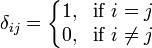
and using the Kronecker delta:

6cd0853395bed28ab128bc5691bc2cc5.png


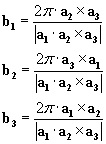
I need to prove b1, b1, b3 as shown http://www.doitpoms.ac.uk/tlplib/brillouin_zones/reciprocal.php" :
eqn004.gif


I understand that for the first equation above, the exponential needs to equal zero for the expression to equal 1. So I have K.R=0 as one piece of information, but I don't see how this leads me to the expressions for b1, b1, b3 which I'm trying to find.

I'm assuming this is part of the proof:

eqn005.gif


But how do I use this and where does the 2*pi come from?


Thanks all!
 
Last edited by a moderator:
Physics news on Phys.org
This type of calculation can be found in any book on solid-state physics.

Anyway:
So we know that \mb{R}=\sum_i n_i\mb{a}_i, \ n_i\in \mathbb{Z}, and we want to find a basis \mb{b}_i of our reciprocal lattice such that for \mb{K}=\sum_i m_i\mb{b}_i, \ m_i\in \mathbb{Z} we have \mb{K}\cdot\mb{R}=2\pi l, \ l\in \mathbb{Z}, which means e^{iK\cdot R}=1. It is quite easy to see that this is satisfied if a_i\cdot b_j=2\pi \delta_{ij}. Problem is just to find b_i which satisfy this condition. A vector a_1\times a_2 will be orthogonal to both a_1 and a_2 so it makes sense to define b_3 \propto a_1\times a_2 since it will naturally give you a_i\cdot b_3\propto \delta_{i3} and so on. The rest is just a matter of finding the correct normalization, which I leave to you.
 
Last edited:

Similar threads

  • · Replies 4 ·
Replies
4
Views
3K
  • · Replies 2 ·
Replies
2
Views
2K
  • · Replies 1 ·
Replies
1
Views
2K
  • · Replies 3 ·
Replies
3
Views
2K
  • · Replies 11 ·
Replies
11
Views
3K
  • · Replies 2 ·
Replies
2
Views
2K
Replies
1
Views
2K
  • · Replies 6 ·
Replies
6
Views
5K
  • · Replies 5 ·
Replies
5
Views
2K
  • · Replies 3 ·
Replies
3
Views
5K