How Does the Smaller Block's Slide Affect the Larger Block's Acceleration?

  • Thread starter Thread starter cupid.callin
  • Start date Start date
  • Tags Tags
    Acceleration Block
Click For Summary

Homework Help Overview

The discussion revolves around the dynamics of two blocks, one smaller and one larger, where the smaller block slides down an inclined surface of the larger block, which is also accelerating. Participants are exploring the relationship between the forces acting on the blocks and the resulting accelerations.

Discussion Character

  • Exploratory, Assumption checking, Problem interpretation

Approaches and Questions Raised

  • Participants are attempting to apply Newton's second law (F = ma) to determine the acceleration of the larger block. Questions arise about the forces acting on the blocks, particularly the normal force and its relation to the acceleration of the wedge.

Discussion Status

There is an ongoing exploration of the forces involved, with some participants questioning the assumptions made about the normal force and the acceleration of the wedge. Multiple interpretations of the problem are being discussed, and guidance has been offered regarding the complexities of the system.

Contextual Notes

Participants note that the problem is complicated by the fact that the wedge is accelerating, which affects the normal force and the motion of the smaller block. There is also mention of the need to reconsider free body diagrams in light of the accelerations involved.

cupid.callin
Messages
1,130
Reaction score
1
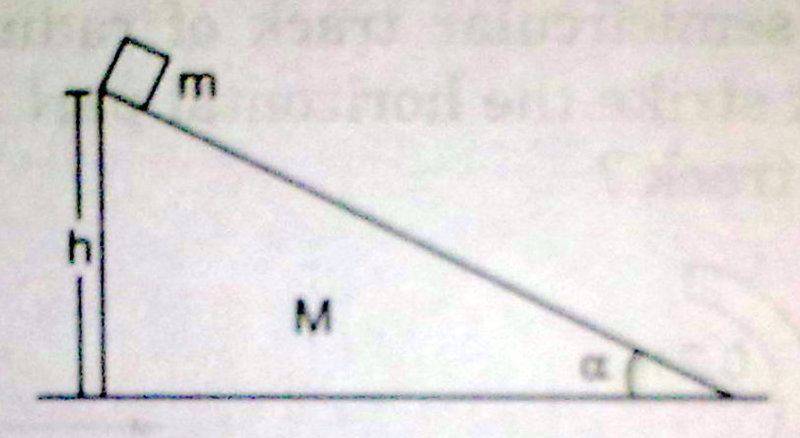
Look at the pic
attachment.php?attachmentid=32937&stc=1&d=1299803110.jpg


Obviously the smaller block will slide down and the bigger block will accelerate to right ... i want to know that what will be the acceleration of the bigger block ... i have found the answer using that Center of mass has no acceleration. but i want to find out using tradition way ... like F = Ma

What will be the force pushing bigger block towards right?
 

Attachments

  • 01182.jpg
    01182.jpg
    31.8 KB · Views: 545
Physics news on Phys.org
cupid.callin said:
What will be the force pushing bigger block towards right?
The block and wedge exert a normal force on each other. That's the force that pushes the wedge. (Looking at your diagram, I'd say that the wedge will move to the left, not the right.)
 
the block exert force of mg(cosα) at the bigger block

so the force in the right direction is mg(cosα)(sinα)

so acceleration is a = mg(cosα)(sinα) / M

but that is wrong
 
cupid.callin said:
the block exert force of mg(cosα) at the bigger block
That would be the normal force if the wedge were stationary, but it's not. It accelerates.
 
cupid.callin said:
the block exert force of mg(cosα) at the bigger block

so the force in the right direction is mg(cosα)(sinα)

so acceleration is a = mg(cosα)(sinα) / M

but that is wrong

That would be true if the block is not accelerating in direction perpendicular to surface of wedge but that is not so because the wedge itself accelerates.
 
I am not getting you guys ...

Am i missing something conceptual?
 
On what basis did you conclude that the normal force equals mg(cosα)?
 
The acceleration of block is along the incline as well as perpendicular to it. Consider this and work on the fbd again
 
Here is my FBD:

attachment.php?attachmentid=32964&stc=1&d=1299854271.jpg


and as the cos component of weight gives N so its mgcosα
Is it wrong?
 

Attachments

  • 01183.jpg
    01183.jpg
    29.1 KB · Views: 476
  • #10
cupid.callin said:
Here is my FBD:

and as the cos component of weight gives N so its mgcosα
Is it wrong?
Your diagram for the wedge is OK (except that you left out the normal force of the floor on the wedge), but your conclusion that "the cos component of weight gives N" is not correct. N = mgcosα is true for a non-accelerating wedge, since the block would have no acceleration perpendicular to the plane thus the net force in that direction must be zero.

Just call the normal force N. Don't make any assumptions about what it equals.

Your diagram for the block shows the acceleration of the block as being parallel to the plane of the wedge. That's not exactly true, since the wedge accelerates.

Hint: The block is constrained to slide along the wedge. So, in the frame of the wedge, the block accelerates parallel to the surface of the wedge.

(This is a bit tricky, so take it slow.)
 
  • #11
Last edited by a moderator:

Similar threads

  • · Replies 4 ·
Replies
4
Views
3K
Replies
13
Views
3K
  • · Replies 6 ·
Replies
6
Views
2K
Replies
15
Views
2K
Replies
3
Views
1K
  • · Replies 33 ·
2
Replies
33
Views
2K
  • · Replies 12 ·
Replies
12
Views
3K
Replies
61
Views
4K
  • · Replies 7 ·
Replies
7
Views
2K
  • · Replies 11 ·
Replies
11
Views
3K