How Does V-Belt Tension Arise in a Free Body Diagram?

  • Thread starter Thread starter etotheipi
  • Start date Start date
  • Tags Tags
    Belt Fbd
Click For Summary

Discussion Overview

The discussion revolves around the interpretation of a diagram related to V-belt tension in the context of free body diagrams (FBDs). Participants explore how belt tension arises, the representation of forces in the diagram, and the clarity of the visual depiction.

Discussion Character

  • Technical explanation
  • Debate/contested

Main Points Raised

  • One participant questions how belt tension arises, suggesting it may be due to unbalanced tension forces from the belt elements around the pulley.
  • Another participant indicates that the two forces of ##\frac{1}{2}\mathbf{F}_1## represent the belt's exertion on the pulley, clarifying that the diagram is an incomplete FBD of the pulley rather than the belt.
  • A participant proposes that the diagram would be clearer if the two ##\frac{1}{2}\mathbf{F}_1## forces were represented with dotted lines to avoid confusion regarding the vertical component of the reaction force.
  • There is a suggestion that the diagram should include context to clarify that it shows how belt tension is propagated to the pulley, rather than being an FBD of the belt itself.
  • Another participant expresses the opinion that the ##\frac{1}{2}\mathbf{F}_1## arrows should be removed entirely to prevent misunderstanding.
  • A different approach is proposed, suggesting a diagram where inner forces act on the V-belt and outer forces act on the groove/pulley, emphasizing the need for clear distinction of components.
  • Links to external resources are shared for further reference, indicating that some participants found alternative diagrams more aligned with their understanding.

Areas of Agreement / Disagreement

Participants express differing views on the clarity and accuracy of the diagram, with no consensus reached on the best representation of forces or the appropriateness of the current diagram's elements.

Contextual Notes

Participants note that the diagram lacks context and may misrepresent the forces involved, leading to potential confusion about the nature of the forces acting on the belt and pulley.

etotheipi
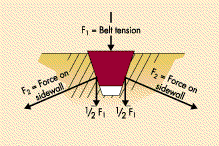
I found this diagram,
1590221457366.png


How does the belt tension arise? I would assume it be exerted by belt elements on either side (i.e. unbalanced tension forces due to curvature around the pulley), but that's not clear from this diagram.

Also, just to make sure I'm not going crazy, why have they drawn two forces of ##\frac{1}{2}\mathbf{F}_1## on here? I'm pretty sure they're intended to be vector components of the force ##\mathbf{F}_2## on the walls due to the belt, but if so then it's not really that clear :confused:. Thank you!
 
Last edited by a moderator:
Engineering news on Phys.org
Hi,
A sideways view would reveal tension along the heart line of the belt, as you expect. Most of it is pulling the belt into the groove.
You're not going crazy (at least not in this matter :smile: ). The two ##{1\over 2}{\bf F}_1## is what the belt exerts on the pulley.
In that respect this is an (incomplete) FBD of the pulley, not of the belt.
 
  • Like
Likes   Reactions: etotheipi
BvU said:
The two ##{1\over 2}{\bf F}_1## is what the belt exerts on the pulley.
In that respect this is an (incomplete) FBD of the pulley, not of the belt.

Ah okay awesome. `I just wondered since I think it would be clearer to draw the two ##\frac{1}{2}\mathbf{F}_1##'s with dotted lines instead of solid lines, since that diagram is double counting the vertical component of the reaction force.

Thank you!
 
There will be a context for this diagram. That may say "this diagram shows how the belt tension is propagated to the pulley", as opposed to the incorrect "this is an FBD of the belt" -- because then reversing the two ##{1\over2}1{\bf F}_1## and ##{\bf F}_2## would be better, but then the diagram becomes cluttered and unclear.
 
  • Like
Likes   Reactions: etotheipi
BvU said:
There will be a context for this diagram. It's not 100% corerct for sure. Reversing the two ##\frac{1}{2}\mathbf{F}_1## and ##\mathbf{F}_2## would be better, but then the diagram becomes cluttered and unclear.

I would get rid of the ##\frac{1}{2}\mathbf{F}_1## arrows entirely.
 
  • Skeptical
Likes   Reactions: BvU
@BvU I would draw a diagram like this, where the 3 inner forces act on the V belt and the two outer ones act on the groove/pulley:

1590231670715.png

Whilst we could also add components in, I would make sure to distinguish them clearly:

1590231814746.png


My opposition to the presence of the two ##\frac{1}{2}\mathbf{F}_1## arrows is because one might then be inclined to believe erroneously that it is a separate force acting on the V belt, as opposed to a vertical component of an existing force on the diagram.
 
  • Like
Likes   Reactions: Lnewqban

Similar threads

  • · Replies 2 ·
Replies
2
Views
3K
Replies
4
Views
1K
  • · Replies 31 ·
2
Replies
31
Views
5K
  • · Replies 3 ·
Replies
3
Views
2K
  • · Replies 6 ·
Replies
6
Views
4K
  • · Replies 25 ·
Replies
25
Views
2K
Replies
6
Views
2K
  • · Replies 7 ·
Replies
7
Views
3K
  • · Replies 6 ·
Replies
6
Views
3K
  • · Replies 22 ·
Replies
22
Views
5K