How Is Kinetic Friction Affecting the Pulley System with Different Masses?

  • Thread starter Thread starter braindead101
  • Start date Start date
  • Tags Tags
    Friction Pulleys
Click For Summary

Homework Help Overview

The discussion revolves around a pulley system involving two blocks with different masses, specifically focusing on the effects of kinetic friction on their motion. The original poster attempts to analyze the forces acting on each mass and how they relate to the system's acceleration.

Discussion Character

  • Mixed

Approaches and Questions Raised

  • Participants discuss free body diagrams for each mass, attempting to establish relationships between tension, gravitational force, and friction. Questions arise regarding the correct application of acceleration and the use of tension in the equations.

Discussion Status

Some participants have provided guidance on eliminating variables and substituting values to progress in the problem. There are ongoing questions about the correct interpretation of forces and accelerations, indicating that multiple interpretations are being explored.

Contextual Notes

There is mention of a side note from a teacher regarding string constraints and acceleration relationships, which some participants express uncertainty about incorporating into their calculations. Additionally, there are discussions about the correct values for acceleration and the implications of the given velocity.

braindead101
Messages
158
Reaction score
0
The block with mass m2=0.50kg is found to have a speed of 0.30m/s after it has dropped 0.80m. how large a (kinetic) friction force retards the motion of the block with mass m1=2.0kg?

(side note from teacher)
To solve this problem, you can use a string constraint. the total length of the string (L) is constant. However, as block m1 moves to the right, the portion of the string that is horizontal shortens by delta y and this length is distributed over the portion of the string taht is vertical according to the relationship; |delta x|=1/2|delta y|. By taking a derivative with respect to time twice, we have a1=2a2.
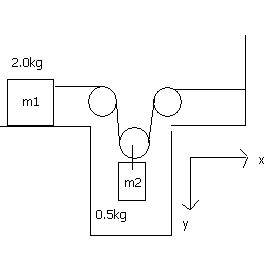
image_2Oj40.jpg


i think i did this completely wrong

i drew a free body diagram for each,for 1st free body diagram (mass1) and found m1 had Fn of 19.6

on the 2nd free body diagram (mass 2), i had Fg-Ft = ma
then, 4.9 N - 2Ft =0 , Ft = 2.45, then i said the Ft in the first free body diagram was also equal to 2.45, and therefore the kinetic friction force equals 2.45

its probably wrong, since i didnt use any info my teacher gave in the side note
 
Physics news on Phys.org
braindead101 said:
...
i drew a free body diagram for each,for 1st free body diagram (mass1) and found m1 had Fn of 19.6
on the 2nd free body diagram (mass 2), i had Fg-Ft = ma
then, 4.9 N - 2Ft =0 ,...
You put the accln of m2 as zero - it should be a2.
 
ohh.
okay, i did it like u said, but now I am stuck

for the mass 1 fbd, i got
Ft - Ff = a1

for the mass 2 fbd, i got
Fg - 2Ft = ma2 (is it 2Ft?)
then isolate for a2
4.9 - 2Ft = 0.5a2
9.8 - 4Ft = a2

and the equaion from fbd #1:
Ft - Ff = ma1
since a1 = 2a2
Ft - Ff = 4a2 (1)
then i substituted a2 into equation (1)
Ft - Ff = 4(9.8 - 4Ft)
Ft - Ff = 39.2 - 16Ft
17Ft = 39.2 + Ff

okay I am stuck, how do i find Ft?
 
braindead101 said:
ohh.
okay, i did it like u said, but now I am stuck
for the mass 1 fbd, i got
Ft - Ff = a1
for the mass 2 fbd, i got
Fg - 2Ft = ma2 (is it 2Ft?)
then isolate for a2
4.9 - 2Ft = 0.5a2
9.8 - 4Ft = a2
and the equaion from fbd #1:
Ft - Ff = ma1
since a1 = 2a2
Ft - Ff = 4a2 (1)
then i substituted a2 into equation (1)
Ft - Ff = 4(9.8 - 4Ft)
Ft - Ff = 39.2 - 16Ft
17Ft = 39.2 + Ff
okay I am stuck, how do i find Ft?
You have,

9.8 - 4Ft = a2 (from fbd #2)
Ft - Ff = 4a2 (from fbd #1)

eliminate Ft from these two eqns, giving you,

9.8 - 4Ff = 17a2

Now use the info about the movement of m2 given in the question to work out a2.
Substitute for a2 and solve for Ff.
 
so, a2 = 0.30m/s / 0.80m = 0.375 m/s^2
and then sub it into get Ff = 0.856 N
oops, that's not the acceleraton
hmm, u need kinematics??
is the veloctiy given v1 or v2
a = 9.8 m/s^2
d= 0.80
if velocity given is v2, so v1 = 0?
 
Last edited:
actually i have a question, i used 2Ft in one of the equations, and I am wondering if this is right.

for this step i used 2Ft :
for the mass 2 fbd, i got
Fg - 2Ft = ma2 (is it 2Ft?)
 
braindead101 said:
actually i have a question, i used 2Ft in one of the equations, and I am wondering if this is right.
...
Yes, that's right.


braindead101 said:
so, a2 = 0.30m/s / 0.80m = 0.375 m/s^2 ...
Nope, that's wrong :smile:
use the kinematic eqn,
v² = u² + 2as
 

Similar threads

  • · Replies 5 ·
Replies
5
Views
1K
  • · Replies 4 ·
Replies
4
Views
3K
  • · Replies 1 ·
Replies
1
Views
8K
  • · Replies 40 ·
2
Replies
40
Views
6K
  • · Replies 24 ·
Replies
24
Views
10K
  • · Replies 4 ·
Replies
4
Views
4K
  • · Replies 66 ·
3
Replies
66
Views
8K
  • · Replies 10 ·
Replies
10
Views
4K
  • · Replies 1 ·
Replies
1
Views
3K
  • · Replies 3 ·
Replies
3
Views
2K