How is the Angular Velocity of a Planetary Gear Determined?

Click For Summary
SUMMARY

The angular velocity of gear D in a planetary gear system can be determined using the relationship between the angular velocities of connected gears and their radii. Given gear C with a radius of 0.12 m rotating at 1.9 k rad/s and gear D with a radius of 0.05 m, the angular velocity of gear D can be calculated using the formula ωD = ωC × (rC / rD). The calculated angular velocity of gear D is -2.125 rad/s, indicating a reverse rotation relative to gear C.

PREREQUISITES
  • Understanding of angular velocity and its units (rad/s)
  • Familiarity with gear ratios and their calculations
  • Knowledge of planetary gear systems and their mechanics
  • Basic vector analysis in the context of rotational motion
NEXT STEPS
  • Study the principles of gear ratios in planetary gear systems
  • Learn about the kinematics of rotating bodies in mechanical systems
  • Explore the concept of velocity vectors in rotational motion
  • Investigate the dynamics of angular momentum in gear systems
USEFUL FOR

Mechanical engineers, students studying dynamics, and anyone involved in the design or analysis of gear systems will benefit from this discussion.

rara
Messages
3
Reaction score
0
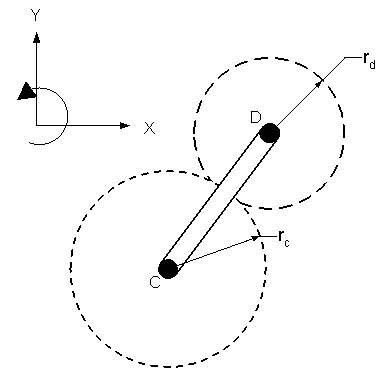
Gear C has radius 0.12 m and rotates with angular velocity 1.9 k rad/s. The connecting link rotates at angular velocity 1.5 k rad/s. Gear D has radius 0.05 m. Find the angular velocity of gear D (in rad/s). Note that gear C is pinned to ground and gear D is a planetary gear.
2vxegq8.jpg


Since gear c is pinned, the gear ratio ωc/ωd=rd/rc does not directly apply here right? I wonder if the correct solution would be ωd=ωc x rcd / rd. I got -2.125 rad/s. Thanks.
 
Physics news on Phys.org
Hello.

At the point of contact of the gears, suppose you pick a point ##c## on the rim of gear C and a point ##d## on the rim of gear D as shown.

Let ##\vec{V_c}## and ##\vec{V_d}## be the velocities of those points, respectively, as measured relative to the fixed point at the center of gear C.

How are ##\vec{V_c}## and ##\vec{V_d}## related?
 

Attachments

  • Gears.jpg
    Gears.jpg
    7.7 KB · Views: 552
Last edited:
Vc and Vd are the same
 
OK. So, ##\vec{V_c}## = ##\vec{V_d}##. If you can express each of these velocities in terms of the angular velocities of the gears (##\omega_C## and ##\omega_D##) and the angular velocity of the link (##\omega_L##), then you would have an equation that you could solve for ##\omega_D##.

Start with the velocity vector ##\vec{V_c}##. Suppose you introduce a unit vector ##\hat{t}## that is tangent to the gears at the point of contact, as shown. How can you express ##\vec{V_c}## in terms of ##\omega_C##, ##r_C##, and ##\hat{t}##?
 

Attachments

  • Gears 2.jpg
    Gears 2.jpg
    8.3 KB · Views: 578
Last edited:

Similar threads

  • · Replies 5 ·
Replies
5
Views
2K
  • · Replies 4 ·
Replies
4
Views
2K
  • · Replies 1 ·
Replies
1
Views
5K
Replies
3
Views
2K
  • · Replies 5 ·
Replies
5
Views
4K
  • · Replies 5 ·
Replies
5
Views
6K
  • · Replies 1 ·
Replies
1
Views
3K
Replies
7
Views
6K
Replies
23
Views
1K
  • · Replies 1 ·
Replies
1
Views
1K