How is the Angular Velocity of a Planetary Gear Determined?

Click For Summary

Discussion Overview

The discussion centers on determining the angular velocity of gear D in a planetary gear system, given the angular velocities and radii of connected gears. It involves mathematical reasoning and technical explanations related to gear mechanics.

Discussion Character

  • Technical explanation
  • Mathematical reasoning

Main Points Raised

  • One participant presents a calculation for the angular velocity of gear D based on the known values of gear C and the connecting link, questioning the applicability of the gear ratio due to gear C being pinned.
  • Another participant introduces the concept of velocities at the points of contact on the gears, suggesting that the velocities of points on gear C and gear D are equal.
  • A subsequent reply confirms the equality of the velocities at the contact points and proposes expressing these velocities in terms of the angular velocities of the gears and the connecting link to derive an equation for ωD.

Areas of Agreement / Disagreement

Participants appear to agree on the equality of the velocities at the points of contact on the gears, but there is no consensus on the method to calculate the angular velocity of gear D, as different approaches and interpretations are being discussed.

Contextual Notes

The discussion includes assumptions about the relationship between angular velocities and linear velocities at the contact points, which may depend on the specific configuration of the gears and the connecting link. The applicability of the gear ratio is also questioned, indicating potential limitations in the initial approach.

Who May Find This Useful

This discussion may be useful for individuals interested in mechanical engineering, gear systems, and the mathematical relationships governing angular motion in planetary gear arrangements.

rara
Messages
3
Reaction score
0
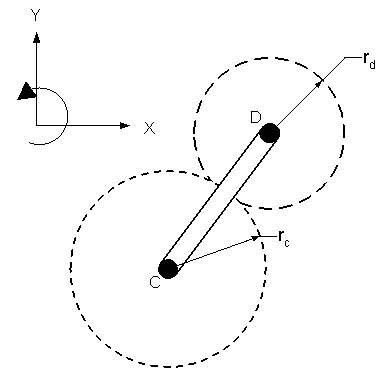
Gear C has radius 0.12 m and rotates with angular velocity 1.9 k rad/s. The connecting link rotates at angular velocity 1.5 k rad/s. Gear D has radius 0.05 m. Find the angular velocity of gear D (in rad/s). Note that gear C is pinned to ground and gear D is a planetary gear.
2vxegq8.jpg


Since gear c is pinned, the gear ratio ωc/ωd=rd/rc does not directly apply here right? I wonder if the correct solution would be ωd=ωc x rcd / rd. I got -2.125 rad/s. Thanks.
 
Physics news on Phys.org
Hello.

At the point of contact of the gears, suppose you pick a point ##c## on the rim of gear C and a point ##d## on the rim of gear D as shown.

Let ##\vec{V_c}## and ##\vec{V_d}## be the velocities of those points, respectively, as measured relative to the fixed point at the center of gear C.

How are ##\vec{V_c}## and ##\vec{V_d}## related?
 

Attachments

  • Gears.jpg
    Gears.jpg
    7.7 KB · Views: 567
Last edited:
Vc and Vd are the same
 
OK. So, ##\vec{V_c}## = ##\vec{V_d}##. If you can express each of these velocities in terms of the angular velocities of the gears (##\omega_C## and ##\omega_D##) and the angular velocity of the link (##\omega_L##), then you would have an equation that you could solve for ##\omega_D##.

Start with the velocity vector ##\vec{V_c}##. Suppose you introduce a unit vector ##\hat{t}## that is tangent to the gears at the point of contact, as shown. How can you express ##\vec{V_c}## in terms of ##\omega_C##, ##r_C##, and ##\hat{t}##?
 

Attachments

  • Gears 2.jpg
    Gears 2.jpg
    8.3 KB · Views: 594
Last edited:

Similar threads

  • · Replies 5 ·
Replies
5
Views
2K
  • · Replies 4 ·
Replies
4
Views
2K
  • · Replies 1 ·
Replies
1
Views
5K
Replies
3
Views
2K
  • · Replies 5 ·
Replies
5
Views
4K
  • · Replies 5 ·
Replies
5
Views
6K
  • · Replies 1 ·
Replies
1
Views
3K
Replies
7
Views
6K
Replies
23
Views
2K
  • · Replies 1 ·
Replies
1
Views
1K